Marching On Spot Shoulders Rotation
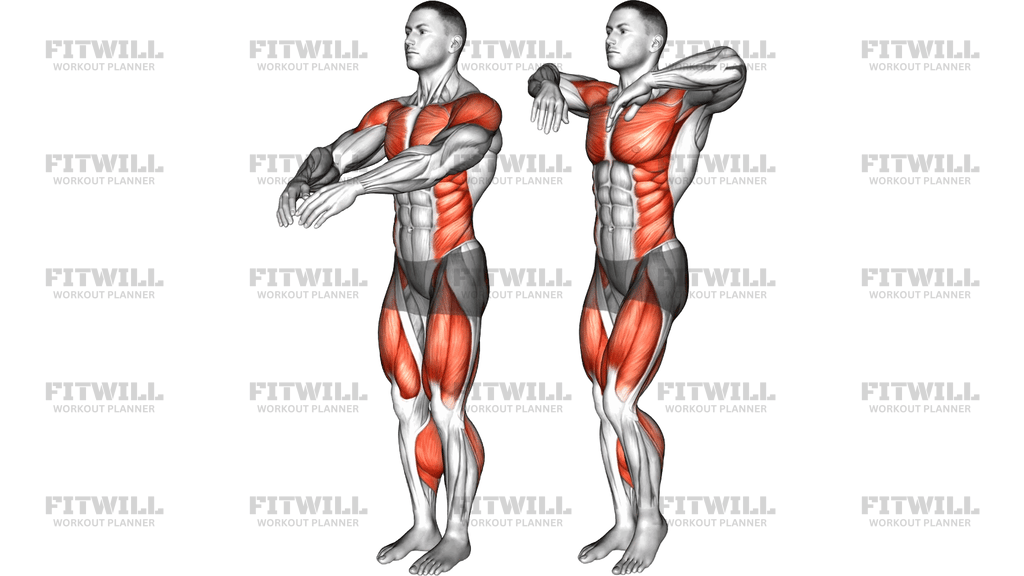
Marching On Spot Shoulders Rotation is a standing, body-weight movement that combines two things at once: lifting your knees in a steady marching rhythm while your arms sweep through large horizontal rotations around the shoulder joints. One repetition of the arm pattern takes the hands from a crossed position in front of the chest, out wide to the sides, and around behind you before they cross again in front. Because the legs keep stepping the whole time, the trunk has to stay organized while the arms move, which makes this a classic warm-up and coordination drill rather than a pure strength lift.
This movement is useful for almost anyone before an upper-body or full-body session. The wide arm rotations take the shoulder joints through a broad range of motion and wake up the deltoids, rotator cuff, and muscles around the upper back, while the marching raises your heart rate and primes the hip flexors, glutes, and calves. It is a common choice in group warm-ups, martial arts and boxing preparation, and general morning mobility routines, because it needs no equipment and very little space.
Setup matters more than it looks. Stand tall with your feet roughly hip-width apart, ribs stacked over your pelvis, and your gaze forward. If you sway backward or let your lower back arch as the arms travel, the rotation loses its quality and the shoulders end up working from a poor position. Think of the torso as the anchor: the arms rotate around a stable, upright trunk, not the other way around.
To execute it well, bring both arms up to chest height and cross your forearms in front of your body. From there, sweep the hands out to the sides and back in a wide, rounded path until they meet or cross behind you, then continue the circle so they return to the front. Keep the elbows soft rather than locked, and let each arm rotation take about one to two seconds. Match the arm tempo to your marching: one full rotation every two to four knee lifts works well for most people.
The most common execution errors are shrugging the shoulders toward the ears, rushing the circles so the arms just flap, and marching with a slouched chest. Slow the rotation down, keep the shoulder blades drawing down and back as the arms travel, and lift each knee to roughly hip height with a tall spine. Breathe steadily throughout — inhale as the arms open wide, exhale as they cross — and avoid holding your breath as the pace builds.
As a low-impact, joint-friendly drill, this exercise suits beginners, older adults, and experienced lifters equally, though for different reasons. Beginners use it to build coordination between upper and lower body, while trained people use it to raise core temperature and lubricate the shoulder joints before pressing, pulling, or throwing. If a full backward rotation feels pinched at the front of the shoulder, shrink the circle and gradually widen it over sessions rather than forcing the range.
[ Workout Log & Planner ]
Put your next workout in Fitwill
Keep your plan and training log ready when you are.


Instructions
- Stand with your feet hip-width apart, weight spread evenly across both feet, and your posture tall with the crown of your head lifted.
- Raise both arms forward to chest height and cross your forearms in front of your torso, elbows slightly bent and shoulders relaxed away from the ears.
- Brace your trunk lightly as if bracing for a light push, and keep your ribs stacked over your hips before you start moving.
- Begin marching on the spot, lifting each knee to about hip height with a controlled rhythm, landing softly on the ball of each foot.
- While the legs keep marching, sweep both arms out to the sides and around behind you in a wide, circular path until the hands approach each other behind your back.
- Continue the rotation so the arms travel back around to the crossed position in front of your chest, completing one full circle.
- Keep the elbows soft and the movement smooth; aim for one full shoulder rotation every two to four marching steps.
- Inhale as the arms open wide to the sides, exhale as they cross in front, and keep the breathing even with the marching rhythm.
- Continue for your target time or rep count, then slow the marching gradually, let the arms drop to your sides, and stand still for a few breaths to reset.
Tips & Tricks
- If you feel a pinch at the front of the shoulder during the backward sweep, make the circle smaller and bring the hands slightly lower — the range can widen as the joint warms up.
- Watch for the elbows drifting behind the ribcage and the shoulders rolling forward when the hands cross in front; keep the chest open so the rotation happens at the shoulder joints, not the spine.
- Shrugging toward the ears is the most common fault here; think about pushing the shoulder blades gently down and back as the arms travel behind you.
- Do not let the marching turn into heel-slapping stomps; land softly on the balls of the feet to keep the knees and ankles comfortable.
- Keep the trunk facing forward the whole time. If your torso twists to help the arms reach behind you, shorten the circle instead of rotating the spine.
- Start with 20–30 seconds at a slow tempo before speeding up; rushing the circles usually collapses both the arm path and the marching height.
- Alternate the circle direction between sets — backward rotations open the chest and shoulders, while occasional forward rotations balance the pattern.
- If coordinating arms and legs is difficult at first, slow the marching to half tempo or march without knee lifts until the arm pattern feels automatic.
Frequently Asked Questions
Which muscles does Marching On Spot Shoulders Rotation work?
The primary work comes from the deltoids and the rotator cuff as the arms sweep through the wide circle, with the upper back assisting. The marching adds steady engagement from the hip flexors, glutes, calves, and core to keep you upright on each step.
Is Marching On Spot Shoulders Rotation a strength exercise or a warm-up?
It is primarily a warm-up and mobility drill with a light aerobic element. It raises your heart rate and prepares the shoulder joints for pressing, pulling, or overhead work, but it does not load the muscles heavily enough to build strength on its own.
How high should I lift my knees while marching?
Aim for roughly hip height with a tall torso, but a lower lift is fine if balance or hip mobility limits you. The key is a consistent, controlled rhythm rather than maximum knee height.
Should the arms rotate forward or backward?
The standard version rotates the arms backward, sweeping from a crossed position in front of the chest, out wide, and around behind before returning. Backward rotations open the chest and front shoulders, which is why they are the usual choice before upper-body training.
My shoulders click or feel tight when my hands go behind my back — is that a problem?
A mild, pain-free click is common and usually harmless. If you feel pinching or discomfort, reduce the circle size, lower the arm path slightly, and build the range gradually; persistent pain should be checked by a professional.
How long should I perform Marching On Spot Shoulders Rotation?
Twenty to sixty seconds is typical as part of a warm-up, or around 30–60 rotations split across sets with different directions. Treat it as a quality-of-movement drill rather than something to push to fatigue.
Can beginners do this exercise?
Yes — it is low-impact and needs no equipment. Beginners often start by slowing the marching or marching without knee lifts until the arm circle feels natural, then combine the two patterns fully.
What can I use instead if standing balance is difficult?
Stand next to a wall or sturdy chair and rest one hand lightly on it while rotating the arms, or perform the shoulder rotations seated and add the marching separately once stable. Seated arm circles with high-knee marches done as two separate drills are a fair substitution.
Why do my shoulders rise toward my ears during the rotation?
The upper traps tend to take over when the arms travel behind the body or when fatigue sets in. Slow the tempo, deliberately relax the neck, and think of the shoulder blades drawing down as the hands sweep back — the circle will feel smoother immediately.