Barbell Standing Military Press (Close Stance)
The Barbell Standing Military Press (Close Stance) is the strictest version of the overhead press: you stand with your feet roughly hip-width apart or closer, hold a barbell at collarbone height with a grip just outside your shoulders, and press the bar straight overhead without any leg drive. Every rep starts and ends at the front of your shoulders, and the only thing moving the weight is your upper body. Because the legs stay quiet and the stance is narrow, there is nowhere to hide a weak link, which is exactly why lifters and strength coaches have treated this lift as the standard measure of pressing strength for decades.
This exercise builds the front and side delts as the primary movers, with the triceps locking the bar out overhead and the upper traps assisting near the top. What many people overlook is everything underneath: your glutes, abs, and lower back have to brace hard to keep the torso upright, and the upper back and rotator cuff stabilize the shoulder blades as the bar passes your forehead. A close stance adds a balance and midline-stability demand that a wider base removes, so the whole trunk works overtime on every rep.
Setup matters more here than in most pressing variations. A grip too wide shifts stress away from the delts and shortens the triceps' work, while a grip too narrow makes the bar drift forward and irritates the wrists. The bar should rest on the front of your shoulders with your elbows slightly ahead of it, so your chest and delts support the weight before you ever press. From there, the bar travels straight up and slightly back so it finishes over the middle of your head, not out in front of your face.
To execute it well, squeeze the bar, brace your abs as if bracing for contact, and press until your elbows are locked and the bar sits over your mid-foot. Keep your ribs down and your lower back from arching into a lean; if you have to lean back to finish a rep, the weight is too heavy for a strict press. Lower the bar under control back to the shoulders, reset your brace, and go again.
This lift fits well as a main strength movement early in a shoulder or upper-body session, typically for sets of 4 to 8 reps. It suits intermediate lifters who already own solid shoulder mobility and have practiced pressing with lighter loads, and it pairs naturally with pulls and rows to keep pressing volume balanced. Newer lifters can benefit too, but should start with an empty bar or a lighter fixed bar and only add weight once the bar path stays vertical and the torso stays tall.
[ Workout Log & Planner ]
Put your next workout in Fitwill
Keep your plan and training log ready when you are.


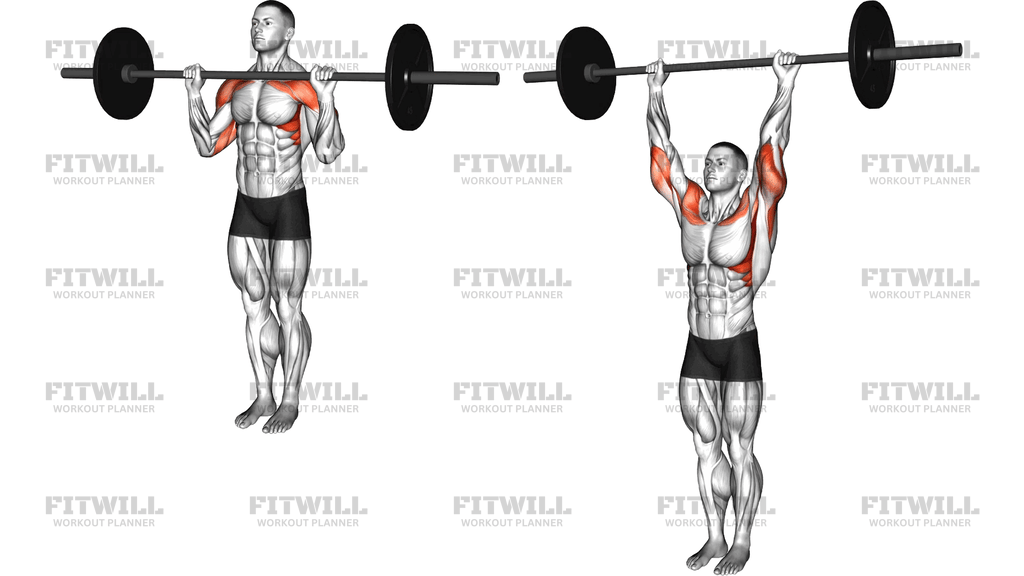
Instructions
- Set a barbell in a rack at roughly upper-chest height and load it evenly. Stand with your feet about hip-width apart or slightly narrower, toes pointing forward, and step under the bar.
- Grip the bar with your hands just outside shoulder width, palms facing forward, and position the bar across the front of your shoulders and upper chest. Keep your elbows slightly in front of the bar, then unrack and step back into a tall, upright stance.
- Set your gaze straight ahead, squeeze the bar hard, and brace your core by taking a moderate breath into your belly and tightening your abs and glutes.
- Press the bar straight up from your shoulders, letting your head move back just enough for the bar to pass your face.
- As the bar clears your forehead, drive it slightly back so it finishes directly over the middle of your head, with your elbows fully extended and your upper arms close to your ears.
- Hold the lockout for a beat with your abs and glutes tight, making sure your lower back has not arched and your ribs have not flared up.
- Inhale at the top, then lower the bar under control back to the front of your shoulders by pulling your elbows slightly forward as the bar descends past your face.
- Exhale at the top of each press or at the end of the descent, whichever keeps your brace most solid, and take a fresh breath before the next rep.
- Complete your set with the bar racked back at shoulder height or re-rack it in the stands. Never drop the bar forward or backward from the overhead position.
- Between sets, reset your stance and brace from scratch rather than pressing the first rep on autopilot.
Tips & Tricks
- If the bar drifts forward as it climbs, the problem is usually the finish position: think about pushing the bar toward a spot slightly behind the top of your head rather than straight above your eyes.
- A lower back arch that grows as the set continues means your brace is failing. Lighten the load and squeeze your glutes deliberately; that alone often flattens the arch.
- Keep your wrists stacked over your forearms. If your wrists are bent back and the bar rolls toward your fingers, narrow or adjust your grip until the bar sits on the heel of your palm.
- Do not press around your chin by pushing the bar away from your body. Move your head back a couple of inches, let the bar pass close, and return your head to neutral early so the bar can travel in a straight line.
- With a close stance, small weight jumps feel bigger than they would in a wide-stance or push press variation. Progress in small increments and keep the rep quality consistent.
- If your shoulders feel pinched at the bottom, check your grip width and your elbow position. Elbows tucked too far toward your ribs or flared too wide both change the path of the bar at your collarbone.
- Fight the urge to look up at the ceiling. Eyes forward and a neutral neck keep the bar path vertical and protect your cervical spine under load.
- Tight hamstrings or hips can pull your torso forward or backward with a narrow base. Spend a few minutes on hip hinges and thoracic mobility before heavy pressing sessions.
- Record a side-view video of your heaviest set. From the front or a 45-degree angle you cannot see the forward bar drift or lumbar arch that matter most in this lift.
Frequently Asked Questions
What muscles does the Barbell Standing Military Press (Close Stance) work?
The front delts do most of the pressing, supported by the side delts and triceps. Your upper traps, upper chest, and the entire trunk, including the abs and lower back, work to keep you upright and the bar path straight.
Why use a close stance instead of a wider one for the Military Press?
A narrow base gives you less lateral support, so your core and stabilizers have to work harder to keep the torso upright. It also makes it easier to spot side-to-side sway and torso lean, which helps you press with cleaner mechanics.
How wide should my grip be on the Barbell Standing Military Press?
Place your hands just outside shoulder width so your forearms are roughly vertical when the bar is on your shoulders. Going much wider shifts work off the delts, and going narrower forces the wrists backward and pushes the bar off its ideal path.
Is the Barbell Standing Military Press suitable for beginners?
Yes, but start with an empty bar or a light fixed barbell and focus on a vertical bar path and a stable torso before adding plates. Beginners who lack shoulder mobility may be better served by a landmine press or a seated dumbbell press for a few weeks first.
Why do I lean back when the weight gets heavy?
Leaning back turns the strict press into a standing incline press, letting your stronger upper chest take over. It usually means the load exceeds your current strict strength; reduce the weight, squeeze your glutes, and keep your ribs pulled down.
Can I use a push press or leg drive with this exercise?
No, leg drive changes the exercise into a push press. In the Military Press the legs stay still and act only as support, so any knee dip or hip thrust takes away the shoulder-dominant stimulus the lift is designed for.
What can I substitute if I do not have a barbell or rack?
Standing dumbbell overhead presses train the same pattern with a more joint-friendly path, and a landmine press works well if overhead mobility is limited. Seated machine or Smith machine presses remove the balance demand but keep the vertical pressing motion.
Should the bar pass in front of or behind my head?
In front. Tilt your head back slightly as the bar leaves your shoulders, then press the bar up and finish it just behind your forehead line so it stacks over your mid-foot at lockout. Pressing behind the neck from the front rack is unnecessary and hard on the shoulders.
How do I breathe during the Barbell Standing Military Press?
Take a breath into your belly and brace before each press, exhale near the top of the rep, then re-brace before lowering. Some lifters prefer a breath at the bottom of each rep; either way, never press with your ribs flared and core relaxed.
Is this press safe for the lower back and shoulders?
With an honest weight, a braced trunk, and a straight bar path, it is a well-tolerated lift. The risk comes from heavy loads pressed with an arched back, bent wrists, or a bar drifting in front of the body, so prioritize bar path and brace quality over adding weight.