Barbell Walking Lunge
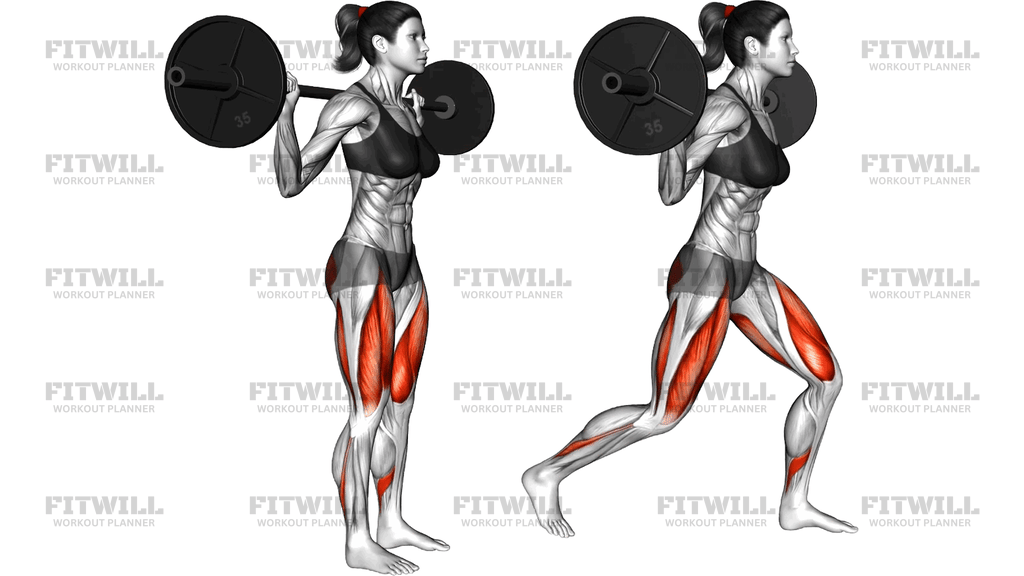
The Barbell Walking Lunge is a traveling unilateral leg exercise performed with a barbell resting across the upper back and traps, the same bar position you would use for a back squat. Instead of lunging in place, you step forward with one leg, drop into a split stance, then push through the front foot and bring the rear leg through to take the next step. Each stride is essentially a single-leg squat under load, which makes it one of the more demanding ways to train the legs with nothing more than a bar and open floor space.
The main work comes from the quads of the front leg as it bends and straightens, with strong contributions from the glutes and hamstrings as they control the descent and drive you back up. Because you are moving forward and balancing on one leg at a time, the adductors, calves, and deep trunk muscles work continuously to keep your torso upright and your hips level. That stabilizing demand is something stationary lunges and squats simply do not reproduce to the same degree.
This movement suits lifters who already have solid squat and lunge mechanics and want to build leg strength, muscle, and single-leg control at the same time. It is a staple in strength and conditioning programs for athletes because walking lunges expose and correct left-right imbalances while training deceleration, which carries over to sprinting and changing direction. Recreational lifters benefit too, especially if back squats have stalled and the legs need a different stimulus.
Setup matters more than most people expect. The bar should sit on the traps, not the neck, with the shoulder blades pulled together to create a shelf. A stance that starts too narrow makes the first step wobbly, and steps that are too short drive the knee far past the toes and shift stress away from the glutes. Give yourself a clear, unobstructed walking path of at least ten to fifteen feet before you unrack the bar.
To execute well, keep your torso tall and braced as you step out, lower straight down until both knees reach roughly ninety degrees, then drive through the front heel to rise and bring the back leg forward. The most common faults are leaning the torso forward, letting the front knee cave inward, and rushing the steps so balance falls apart. Slow the tempo down before adding weight; the barbell version punishes sloppy mechanics quickly.
A practical safety note: always perform this exercise in a clear lane with collars on the bar, and start lighter than you think you need. Because fatigue hits the stabilizers before the big prime movers, form tends to degrade on the last few steps of a set, which is exactly when you should rack the bar rather than grind out another stride.
[ Workout Log & Planner ]
Put your next workout in Fitwill
Keep your plan and training log ready when you are.


Instructions
- Set a barbell in a squat rack at about shoulder height and load it evenly, securing plates with collars.
- Position the bar across your upper traps just below the neck, grip it slightly wider than shoulder width, and pull your shoulder blades together to create a stable shelf.
- Unrack the bar, step back, and set your feet hip-width apart with your toes pointing straight ahead, leaving a clear walking path in front of you.
- Brace your core as if preparing for a light squat, lift your chest, and look straight ahead at a fixed point.
- Step forward with your right leg into a long stride, keeping the bar level and your torso vertical as your foot lands flat.
- Lower your body straight down by bending both knees until your right thigh is roughly parallel to the floor and your left knee hovers just above the ground.
- Check that your right knee stays stacked over your ankle and points in the same direction as your toes, not caving inward.
- Drive through the heel and midfoot of the front leg to stand up, and as you rise, bring your left leg forward so your feet come together or flow directly into the next stride.
- Continue alternating legs down your path, exhaling as you push up out of each lunge and inhaling at the top between steps.
- When the set is finished, stop with feet side by side and carefully re-rack the bar or lower it to the floor only if it is safely unloaded.
Tips & Tricks
- Take longer steps than feel natural at first. Short strides shift the load to the front knee and quads exclusively and make the back knee slam toward the floor.
- Keep the bar path level. If one side of the bar dips as you step, you are leaning sideways over the working leg, usually a sign the load is too heavy.
- Squeeze the glute of the trailing leg as you descend. This keeps your hips square and stops the rear foot from rotating outward.
- Do not let your torso fold forward as you fatigue. A collapsing chest usually means your core brace has faded; reset your breathing at the top of the next stride.
- Pause for a beat in the bottom of each lunge if you are new to the barbell version. The pause exposes balance issues that momentum would otherwise hide.
- Breathe at the top, not at the bottom. Holding your breath through a whole walking set of six to ten steps per leg is a fast route to dizziness under the bar.
- Walk the full length of your path, turn around carefully with small controlled steps, then perform the return set so each leg gets equal work leading and trailing.
- If your front heel lifts off the floor, widen your stance slightly or reduce the load; ankle mobility is often the limiting factor, not strength.
- Choose a lighter weight than your back squat suggests. Six controlled steps per leg with a barbell is significantly harder than the same weight for eight squats.
Frequently Asked Questions
Which muscles does the Barbell Walking Lunge target most?
The quads of the front leg do the primary work, with the glutes and hamstrings driving you up out of each stride. The adductors, calves, and core work to stabilize your torso and hips throughout the set.
How is the Barbell Walking Lunge different from a stationary Barbell Lunge?
In the stationary version you lunge in place and step back to the start, while the walking version requires you to pull your body forward over the front foot each rep. This adds a balance and forward-drive demand and keeps each leg under continuous tension.
Should beginners use a barbell for walking lunges right away?
It is better to master bodyweight and dumbbell walking lunges first, since the barbell raises your center of gravity and makes balance errors more costly. Move to the barbell once you can complete controlled, wobble-free bodyweight sets.
How long should each step be?
Aim for a stride long enough that your front shin stays close to vertical at the bottom, with both knees around ninety degrees. Too short a step pushes the front knee past the toes and reduces glute involvement.
Why does my front knee cave inward during the Barbell Walking Lunge?
This usually comes from weak glute stabilizers or insufficient hip control under load. Cue your front knee to track over your second toe, reduce the weight, and add glute work such as lateral band walks on accessory days.
Can I do the Barbell Walking Lunge if I do not have a long walking path?
Yes, you can walk a short lane and turn around, or switch to stationary alternating lunges with the bar in the same position. Just make sure the turning space is clear and take small, controlled steps when changing direction with the bar on your back.
How many steps per leg should I do?
Most lifters do six to twelve steps per leg per set. Because form breaks down as stabilizers fatigue, it is smarter to do more sets of fewer clean steps than one long set that ends in a stumble.
What can I use instead of a barbell for walking lunges?
Dumbbells held at your sides, a kettlebell in the goblet position, or a weighted vest all work well. These options lower the center of gravity and make balance easier while keeping the same movement pattern.
Is it safe to do the Barbell Walking Lunge without a rack?
Yes, you can clean and press the bar onto your back from the floor if the weight is light enough, but most lifters should unrack from a rack at shoulder height. Always use collars and never walk lunges with a bar you cannot safely lower under control.