Wall Star Plank
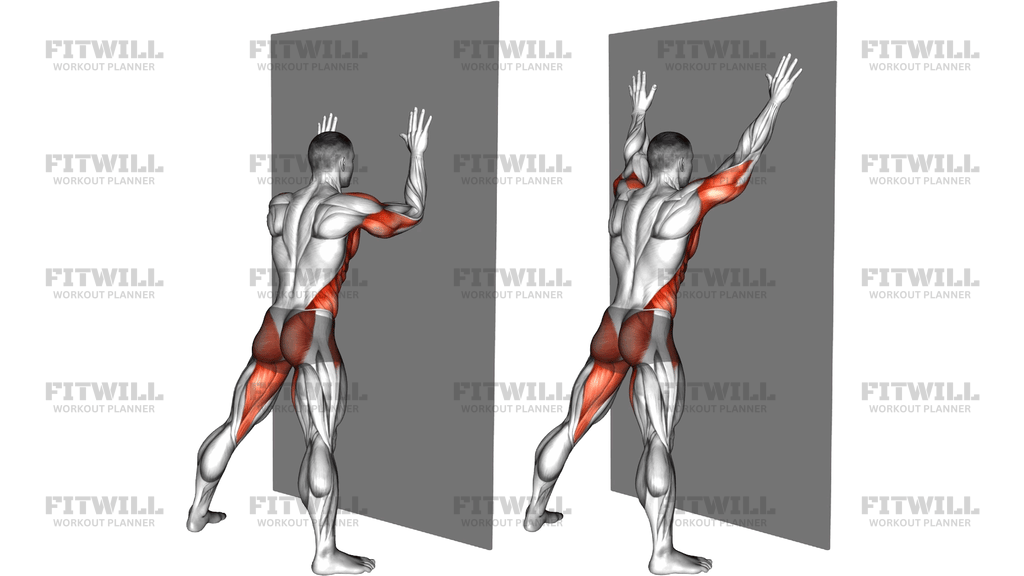
The Wall Star Plank is a bodyweight core exercise performed in a standing lean against a wall. You place your hands on the wall at roughly head height, walk your feet back into a wide, staggered stance, and hold your body in a straight diagonal line from head to heels. From there, you extend one arm up the wall and overhead into a stretched star shape, hold briefly, and return it before switching sides. The wall provides just enough support to let you focus on keeping your trunk rigid while the wide stance and overhead reach challenge your obliques, hips, and shoulders together.
This movement works well for people who find floor planks uncomfortable on the wrists or shoulders, or who spend long hours seated and need a standing way to load the lateral core. Because one support point leaves at a time, your midsection has to resist rotation and side-bending, which is exactly the anti-rotation and anti-lateral-flexion role the obliques play in everyday movement and sport. The wide leg position also places a gentle stretch and stability demand on the inner thighs, glutes, and hamstrings, so the exercise trains the whole chain that connects your shoulder to your opposite hip.
Setup matters more here than it might seem. The distance of your feet from the wall controls the angle of your lean, which controls the difficulty. Stand too close and the hold becomes easy and the reach loses tension; stand too far back and your heels may lift, your hips sag, or your lower back takes over. Aim for a lean firm enough that pressing your hands into the wall feels purposeful, with your body forming one straight line and your weight spread across both feet.
To execute it well, brace your abdominals lightly as if bracing for a light push, squeeze your glutes, and keep your ribs stacked over your pelvis. When you lift one hand off the wall, reach it up and slightly out so your body forms the star shape, but do not let your torso twist or your hips swing toward the wall. The moving arm should travel smoothly, and the supporting shoulder should stay pressed into the wall rather than shrugging toward your ear.
The Wall Star Plank fits nicely into warm-ups, core circuits, and rehab-style or beginner programming because the wall makes it self-limiting and low-impact. More advanced trainees can use it as a high-tension hold between heavier lifts, or move the feet farther back to increase the lean. Start with two or three sets of five to eight reaches per side, holding each star position for three to five seconds, and progress by lengthening the holds or stepping back before adding reps.
A few practical safety points: choose a clean, dry wall so your hands do not slip, keep your fingers spread for a wider base, and stop the set as soon as your hips drop or your lower back starts to arch. If your shoulders complain in the overhead reach, lower the angle by stepping closer to the wall and reduce the reach height until your mobility allows a fuller star position.
Fitwill
Log Workouts, Track Progress & Build Strength.
Achieve more with Fitwill: explore over 9600 exercises with images and videos, access built-in and custom workouts, perfect for both gym and home sessions, and see real results.
Start your journey. Download today!




Instructions
- Stand facing a clear, smooth wall and place both palms flat against it at about head height, fingers spread and pointing up.
- Walk both feet back and out into a wide, staggered stance so your body forms a straight diagonal line from head to heels, with your weight on the balls of both feet.
- Lightly squeeze your glutes and brace your abdominals so your ribs stay stacked over your pelvis and your lower back does not arch.
- Press both hands firmly into the wall and pull your shoulder blades down away from your ears.
- Keeping your hips square to the wall, lift your right hand and reach it up and slightly out toward the ceiling, forming a star shape with your right arm and your wide legs.
- Hold the star position for three to five seconds while resisting any twist in your torso or drop in your hips.
- Control the arm back down to the wall and re-establish firm contact with both palms before moving.
- Repeat the reach with your left hand, alternating sides for the target number of reps per set.
- Breathe steadily throughout, exhaling as you reach up and inhaling as the hand returns to the wall.
- When the set ends, walk your feet toward the wall one step at a time to come out of the lean, and reset your stance before the next set.
Tips & Tricks
- If your heels lift or your feet slide, you are leaning too far back for your strength; step closer to the wall until your body line stays intact.
- The most common mistake is rotating the chest toward the wall as the hand lifts. Watch that both hip bones stay facing the wall for the entire hold.
- Keep a small bend in the knees if your hamstrings or inner thighs feel overstretched in the wide stance; stiffness there tends to pull the hips out of line.
- Do not shrug the supporting shoulder toward your ear. Press that hand into the wall and think of pushing the floor away to keep the shoulder stable.
- The overhead reach should feel like a lengthening of your whole side, not a collapse. If your ribs flare and your lower back arches, shorten the reach height.
- Spread your fingers and use the whole palm for contact rather than resting on the heel of the hand; this gives you a wider, more secure base.
- Rest periods matter less than line quality. End the set when your hips sag or your torso twists, even if reps remain.
- To progress, first lengthen the hold at the top, then step your feet back to increase the lean angle. Add reps last.
- Wear shoes or use a dry, textured wall surface if your palms sweat; a slipping hand undermines the entire anti-rotation demand.
Frequently Asked Questions
What muscles does the Wall Star Plank work?
The primary work is done by the obliques and deep core as they resist rotation and side-bending while one hand leaves the wall. The shoulders, glutes, inner thighs, and hamstrings assist by stabilizing the lean and the wide stance.
Is the Wall Star Plank suitable for beginners?
Yes, it is one of the more approachable core exercises because the wall reduces the load compared to a floor plank. Beginners should stand closer to the wall so the lean is mild, and focus on keeping the hips square during each reach.
How far should my feet be from the wall during the Wall Star Plank?
Start with your feet about one to two feet back so the lean feels noticeable but your heels stay grounded and your body holds a straight line. Step back only when you can complete all reps without your hips sagging or twisting.
Why does the exercise use such a wide, staggered stance?
The wide stance creates the star shape and challenges the adductors, glutes, and hamstrings to stabilize the legs, while the stagger helps you keep the pelvis square to the wall. A narrower stance makes balance the limiting factor instead of your core.
Should I raise the same arm repeatedly or alternate sides in the Wall Star Plank?
Alternating sides is the standard approach because it keeps the load even on both obliques and highlights any difference in control between sides. If one side feels noticeably weaker, you can add a few extra reaches to that side at the end of the set.
What is the most common mistake in this exercise?
Letting the torso rotate toward the wall when the hand lifts, which turns an anti-rotation drill into an easy lean. Fix it by pressing the supporting hand firmly into the wall and keeping both hip bones facing forward throughout the reach.
Can I do the Wall Star Plank if floor planks hurt my wrists?
That is one of its best use cases, since the wrists stay in a neutral position with the palms flat against a vertical wall. If flat palms still bother you, try resting on your forearms against the wall and performing the reach with the free arm.
What can I substitute if I do not have a suitable wall?
A sturdy door, a stable rack upright, or any fixed vertical surface at about head height works the same way. Without any vertical surface, a standing side plank hold or a slow alternating bird dog offers a similar anti-rotation challenge.
How long should I hold each star position?
Three to five seconds per reach is enough to build control, and you can progress toward eight to ten seconds as your line stays clean. Holding longer only helps if your hips stay square and your lower back does not arch.
Is the Wall Star Plank safe for people with shoulder issues?
The wall reduces loading on the shoulder compared to floor planks, but the overhead reach still demands shoulder mobility. If reaching up causes discomfort, limit the reach to a comfortable height or step closer to the wall to lower the angle, and consult a professional if pain persists.