Dumbbell Side Plank Clamshell
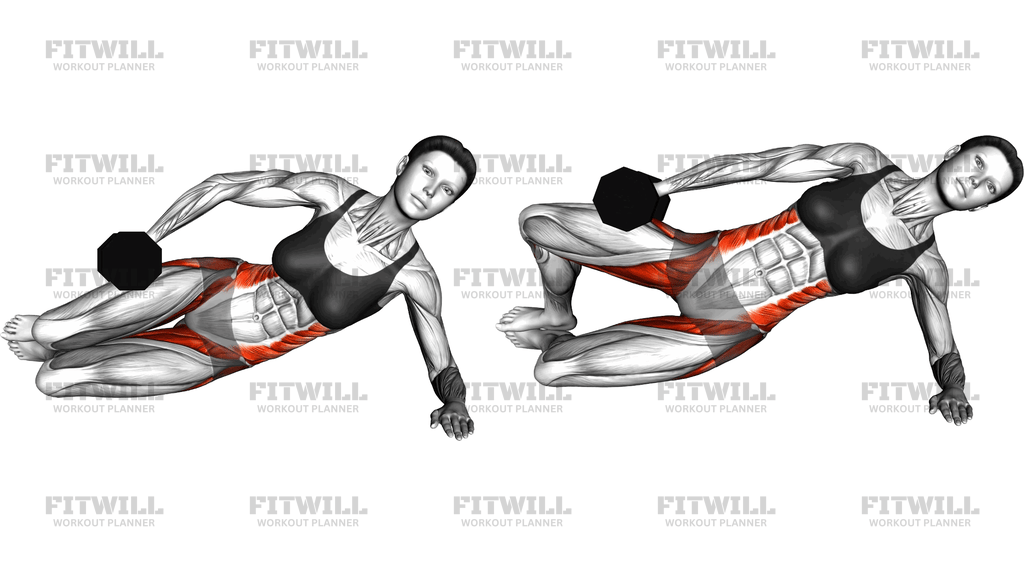
The Dumbbell Side Plank Clamshell combines two of the most effective lateral-chain exercises into one movement: a side plank hold and a clamshell. You lie on your side with your knees bent, place a light dumbbell on your top hip to add resistance, then lift your hips off the floor into a side plank while opening your top knee outward against the weight. This trains the side glutes and outer hip musculature together with the obliques and deep core, which is a combination few exercises hit this efficiently.
This movement is especially useful for anyone dealing with weak or underactive hip abductors, a common issue for people who sit for long hours or run frequently. Strong side glutes support better knee tracking during squats, lunges, and running, and they play a large role in pelvic stability during single-leg activities. Because the side plank component simultaneously demands anti-lateral-flexion strength from the trunk, you get hip stability and torso stability in a single drill rather than needing two separate exercises.
The setup matters more here than in most floor exercises. Your bottom elbow or hand should be stacked directly under your shoulder, your hips and knees stacked, and your feet together before each rep. The dumbbell rests on the upper side of your top hip, held in place by your top hand so it does not slide as your knee opens. If your shoulder is not stacked or your hips drift backward, the plank portion loses its challenge and the dumbbell becomes harder to control.
To execute well, think of lifting the hips and opening the knee as one coordinated action. Press the floor away with your bottom arm, drive the bottom knee and the side of the bottom foot into the mat, and raise your hips until your body forms a straight line from head to knees. From there, rotate the top knee upward while keeping your feet in contact, pause briefly at the top, then lower the knee and hips back down under control. The temptation is to rush the knee opening and let the hips sag, so move deliberately and treat the pause as part of the rep.
Start with a very light dumbbell, anywhere from 2 to 5 pounds, because the lever arm from the hip makes even small loads feel significant. Complete all repetitions on one side before switching, and expect your bottom shoulder and the side of your bottom hip to work harder than you anticipate. If the full version is too demanding, drop the dumbbell first, then perform the movement from a forearm rather than a straight arm, and finally reduce to a side-lying clamshell without the plank until your strength builds.
[ Workout Log & Planner ]
Put your next workout in Fitwill
Keep your plan and training log ready when you are.


Instructions
- Lie on your right side on an exercise mat with your knees bent to roughly 45 degrees, hips and knees stacked, and feet together.
- Prop yourself up on your right forearm or right hand, making sure the elbow or palm sits directly under your shoulder, and place your left hand on the top of your left hip.
- Rest a light dumbbell flat on the upper side of your left hip and hold it steady with your left hand so it cannot slide during the rep.
- Brace your abdominal wall and squeeze your glutes before you move, pulling your ribs down so your lower back does not arch.
- Press your forearm into the floor and drive the side of your bottom knee and foot into the mat as you lift your hips until your body forms a straight line from head to knees.
- Keeping your feet touching, rotate your left knee upward toward the ceiling as high as the dumbbell allows, keeping your pelvis square and your hips lifted the entire time.
- Pause for one to two seconds with the knee open and hips high, feeling the work in the side of your bottom hip glutes.
- Lower the top knee back down with control, then lower your hips to the mat to complete one repetition.
- Breathe steadily throughout: exhale as you lift the hips and open the knee, inhale as you return.
- Finish all reps on the right side, then reset the dumbbell on your right hip and repeat the set lying on your left side.
Tips & Tricks
- If the dumbbell keeps sliding off your hip as the knee opens, switch to a lighter hex dumbbell or wedge it slightly against the top of your hip crease rather than the thigh.
- A common mistake is letting the hips drop toward the mat the moment the knee opens. If this happens, hold the plank portion isometrically for a few sessions before adding the knee movement back in.
- Do not roll your pelvis backward to get a bigger knee opening. A smaller, square-hip rep trains the side glutes better than a large rep where your trunk rotates.
- Check your bottom shoulder: if you feel pinching or collapsing into the joint, push the floor away more actively and keep a slight space between your ear and shoulder.
- Keep your feet glued together throughout. Separating the feet turns this into a hip abduction exercise and reduces the clamshell rotation the movement is built around.
- Wear leggings or place a towel under the dumbbell if the plate digs into your hip on a hard floor.
- If your obliques cramp on the working side, that usually means the load is too heavy for the plank portion, not just the clamshell. Reduce the weight and rebuild the hold.
- Film yourself from the front or use a mirror, because lateral drift at the hips is nearly impossible to feel from inside the position.
- Move the knee open on a two-count and close on a three-count. Speed is the main reason people lose tension in this exercise.
Frequently Asked Questions
Which muscles does the Dumbbell Side Plank Clamshell work?
The main muscles are the side glutes, particularly the gluteus medius on the working top hip, along with the gluteus maximus. The obliques and deep core stabilizers work hard isometrically to keep your hips lifted and your body in a straight line.
Why put the dumbbell on the hip instead of holding it?
Placing the dumbbell on the top hip loads the clamshell rotation directly, so the side glutes work against resistance through their main action. Holding a weight in your hand would not add meaningful resistance to the hip movement and would make the plank harder to stabilize.
Is the Dumbbell Side Plank Clamshell suitable for beginners?
Yes, but start with no weight and a bent-knee side plank version. If you can hold a solid side plank from the knees for 20 to 30 seconds while opening the top knee, you are ready to add a very light dumbbell of 2 to 5 pounds.
My hips sag as soon as I open my knee. What should I change?
This usually means the combination is too demanding right now. Practice the side plank hold and the clamshell as separate exercises for a week or two, then blend them with a lighter dumbbell and a shorter pause at the top.
Should I support myself on my forearm or my straight arm?
Both work. The straight-arm version matches the setup shown and places more demand on the shoulder, while the forearm version is easier on the wrist and shoulder and is the better starting point for most people.
How heavy should the dumbbell be?
Stay light. Because the weight sits at the end of a long lever at your hip, a 5-pound dumbbell can feel like far more once the knee starts moving. Begin at 2 to 5 pounds and only increase once you can complete all reps without your hips dropping.
Can I do the Dumbbell Side Plank Clamshell every day?
Light versions can be done frequently because the loads are small, but treat weighted sets like any strength work and allow at least a day of recovery between challenging sessions. If the side of your hip stays sore, back off the volume.
What can I use instead of a dumbbell if I do not have one?
A small weight plate, a light kettlebell, or a mini band placed just above the knees all work well. The band changes the resistance direction slightly but still challenges the side glutes during the knee opening.
Why does my bottom shoulder burn more than my hips?
The bottom shoulder is stabilizing your entire upper body against gravity throughout the plank. Push the floor away actively, keep the shoulder stacked over the elbow or wrist, and if it remains the limiting factor, switch to the forearm-supported version.
Is it a problem if my top knee does not open very far?
A modest range is fine as long as your pelvis stays square and your feet stay together. Forcing a large knee opening by rotating the trunk backward takes work away from the side glutes and turns the rep into a spinal rotation.