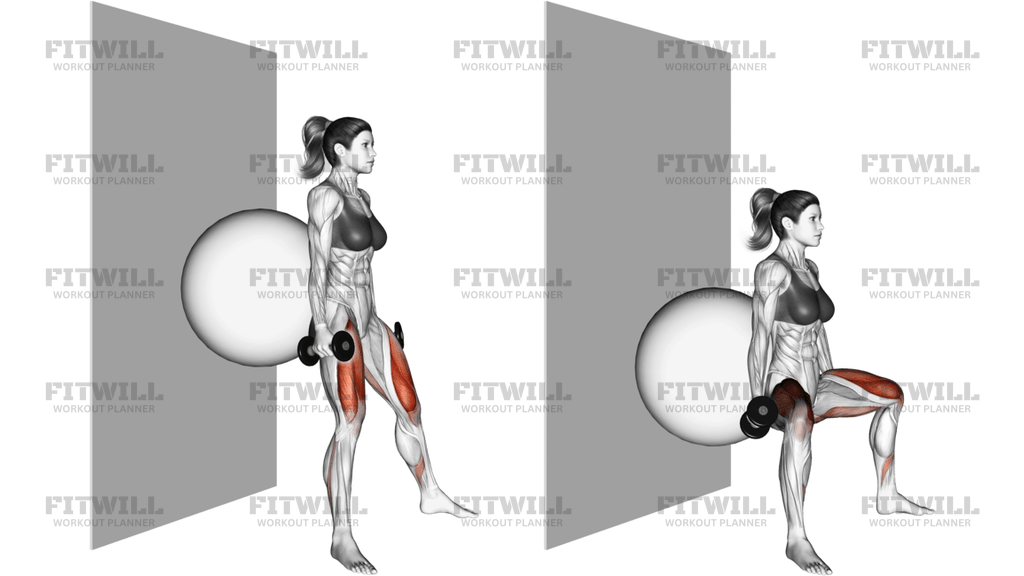
Exercise Ball Single Leg Split Squat
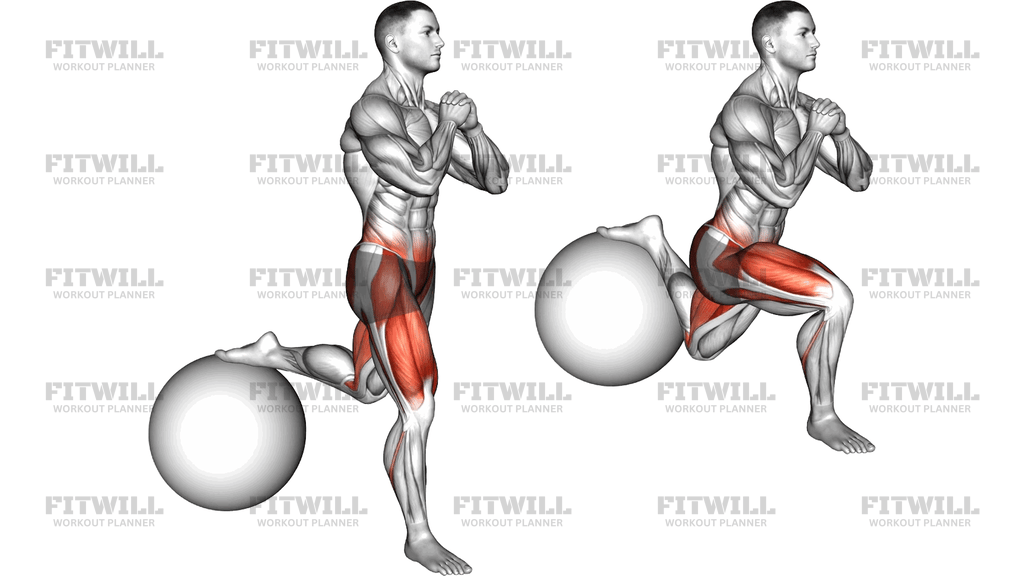
The Exercise Ball Single Leg Split Squat is a single-leg strength exercise where your rear foot rests on top of a stability ball instead of a bench. As you lower into the squat, the ball rolls backward and slightly away from you, forcing the rear leg to travel with it. This makes the movement less rigid than a traditional Bulgarian split squat, but it demands more balance and control from your front leg, hips, and trunk.
This is a useful progression for anyone who has mastered bodyweight split squats and static rear-foot-elevated variations. Because the ball moves, your stabilizing muscles have to make constant small corrections throughout the descent and ascent. That makes it a solid choice for building unilateral leg strength, improving hip stability, and addressing left-to-right imbalances without adding load.
The front leg does the bulk of the work. The quadriceps of the front leg drive the squat, the glutes extend the hip as you stand back up, and the hamstrings and calves assist with control. The rear leg on the ball works mainly as a stabilizer, while your core stays engaged the entire time to keep your torso upright as the base of support shifts beneath you.
Setup matters more here than in a standard split squat. The distance between your front foot and the ball determines both your depth and your stability. Place your front foot far enough forward that your knee tracks over your mid-foot at the bottom, and close enough that you can comfortably reach the ball with your rear foot. An oversized or overinflated ball is harder to control, so a firmly inflated but slightly giving ball works best.
To execute it well, keep most of your weight on the front leg, drop straight down rather than forward, and let the ball roll away naturally as your rear knee bends. Avoid pushing off the ball with the rear foot; it should ride along, not contribute force. Pause briefly at the bottom, then drive through the front foot to stand.
Common use cases include home training with minimal equipment, rehab-friendly unilateral work once cleared for single-leg loading, and as an accessory movement for squats and lunges. Because the ball adds an element of instability, start with shallow range and no added weight until you can control the full descent without wobbling or losing your rear foot contact.
[ Workout Log & Planner ]
Put your next workout in Fitwill
Keep your plan and training log ready when you are.


Instructions
- Place a stability ball behind you and stand facing away from it, then position your front foot about two to three feet in front of the ball.
- Lift your rear foot and place the top of your ankle or instep on the crown of the ball, toes pointing down, with your weight fully on the front leg.
- Clasp your hands together in front of your chest and brace your trunk, keeping your torso upright and your gaze forward.
- Inhale, then bend your front knee and hip to lower your body straight down, letting the ball roll backward as your rear knee folds beneath you.
- Descend until your front thigh is roughly parallel to the floor and your rear knee hangs low, keeping your front knee stacked over your mid-foot.
- Pause for a beat at the bottom without letting your front knee collapse inward or your rear foot slip off the ball.
- Exhale and press through your entire front foot to stand back up, pulling the ball back under your rear leg as you rise.
- Complete all repetitions on one leg, then step off the ball carefully and switch sides.
- Reset your stance width each set so the ball and front foot relationship stays consistent.
Tips & Tricks
- If the ball shoots out behind you at the bottom, your front foot is too far from the ball; shorten your stance until the rear leg can fold comfortably.
- Do not push off with the rear foot. If you feel your toes gripping the ball to drive upward, shift your weight fully into the front heel and mid-foot.
- A ball that is too firm or too large raises your rear hip and arches your lower back; deflate it slightly or use a smaller ball to level your hips.
- Watch for the front knee diving inward as you fatigue. Cue your knee to track over your second toe on every rep.
- Keep your hands at your chest rather than reaching forward. Reaching shifts weight toward the ball and makes the rear foot bear load it should not.
- Start with a partial range and lower gradually over sessions. Depth you cannot control on a moving surface is depth that will pull you off balance.
- If your front ankle lifts or your heel rises at the bottom, widen your stance slightly instead of forcing depth.
- Slow the descent to a two- or three-second count. The rolling ball rewards controlled tempos and punishes rushing.
- Set up near a wall or rack until you are steady, and use one fingertip for balance only if you truly need it.
Frequently Asked Questions
Which muscles does the Exercise Ball Single Leg Split Squat work hardest?
The quadriceps and glutes of the front leg do most of the work, with the hamstrings assisting. The rear leg on the ball, along with your calves and core, works mainly to stabilize.
How is this different from a Bulgarian split squat with a bench?
A bench keeps your rear foot fixed, while the ball rolls backward and away as you descend. That adds instability, increases balance demands, and makes the rear leg follow a moving path instead of a static one.
Is the Exercise Ball Single Leg Split Squat suitable for beginners?
It is a progression, not a starting point. Beginners should first be comfortable with regular split squats and static rear-foot-elevated split squats before introducing the rolling ball.
How far should my front foot be from the ball?
Start with roughly two to three feet between them, then adjust so your front knee stays over your mid-foot at the bottom and your rear knee can fold without the ball rolling too far away.
Should my rear foot push into the ball for help?
No. The rear foot should rest on top of the ball and ride along with the movement. Pushing off turns it into a two-leg effort and removes the single-leg challenge.
What is the most common mistake in this exercise?
Standing too far from the ball, which causes the ball to shoot backward and pulls you into a forward lean. Shorten the stance and control the descent to fix it.
Can I add weight to the Exercise Ball Single Leg Split Squat?
Yes, once you can perform controlled reps with full depth and no wobbling. Hold dumbbells at your sides, but expect the balance demand to increase noticeably.
What can I use if I do not have a stability ball?
A bench, chair, or couch for a standard Bulgarian split squat is the closest substitute. The ball version adds instability, so treat the substitution as a regression in balance demand.
Is it safe for my knees?
When performed with your front knee tracking over your mid-foot and a depth you can control, it is a standard single-leg strength exercise. If you have a current knee issue, get clearance from a qualified professional first and start with a partial range.
How do I stop my rear foot from slipping off the ball?
Place the laces or instep of your shoe on the crown of the ball with toes pointing down, keep light downward contact rather than squeezing, and avoid letting the hip of the rear leg drop during the descent.