Band Bench Press
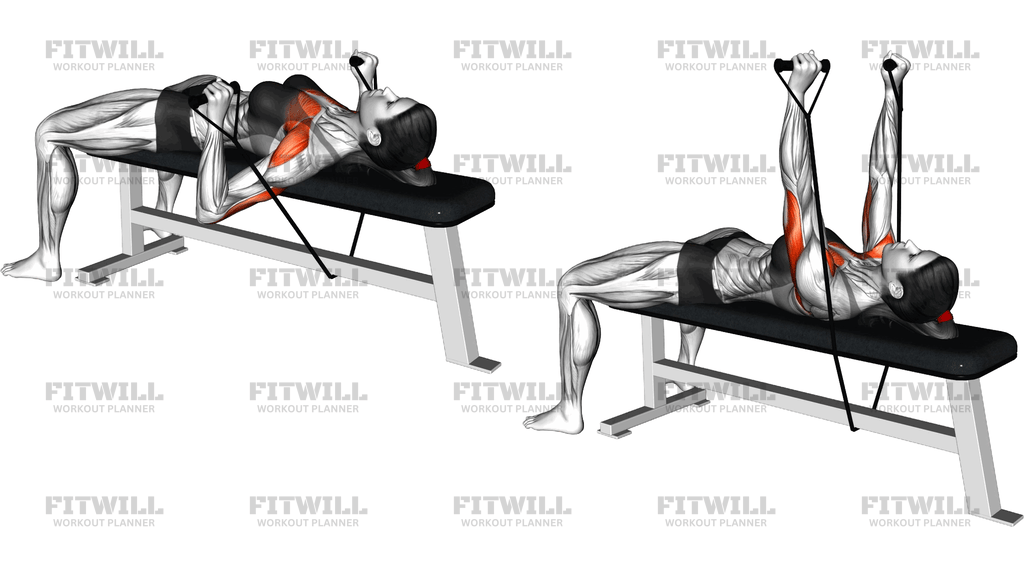
The Band Bench Press is a lying press performed on a flat bench with a resistance band instead of a barbell or dumbbells. The band is anchored underneath the bench, you lie back holding a handle in each hand, and you press your arms straight up toward the ceiling before lowering with control. Because the band stretches as you press, the resistance is lightest at the bottom and heaviest at the top, which is the opposite of how a free-weight press feels.
This movement works the chest as the primary muscle, with the triceps extending the elbows and the front shoulders assisting through the middle of the press. The stabilizing demand is real but different from a barbell press: the band pulls your hands slightly inward and downward, so your shoulders and upper back work to keep the handles tracking over your chest. That makes it a useful teaching press for learning a straight, controlled pressing path.
The Band Bench Press suits home lifters, beginners, and anyone training without heavy equipment. It is also a smart option for deload weeks, warm-up ramping before barbell pressing, or lifters who want joint-friendly pressing volume without a loaded bar over their face. Since tension peaks at lockout, it places less strain on the shoulders at the stretched position than a heavy free-weight press.
Setup matters more than it looks. The band needs to be centered under the bench so both sides pull evenly, and your grip should place your hands roughly over your elbows at the bottom. If the band sits off-center, one arm will fight more tension than the other and the press will twist. Lie far enough down the bench that the band clears the edge and does not drag across your torso or the bench pad.
To execute well, keep your feet planted, ribs down, and press the handles up and slightly together until your arms are straight over your mid-chest. Lower until your upper arms reach bench level or your hands are beside your chest, pause briefly, and drive back up. exhale on the press, inhale on the way down.
The most common use cases are home chest training, high-rep finishers after a main press, and progressive pressing for people building toward barbell work. If the band feels too easy at the bottom and unmanageable at the top, use a thicker band, add a second band, or shorten the band by wrapping it once around the bench frame for more starting tension.
[ Workout Log & Planner ]
Put your next workout in Fitwill
Keep your plan and training log ready when you are.


Instructions
- Lay a resistance band lengthwise under a flat bench so an equal length of band hangs on each side, or anchor it securely to the bench frame at the center.
- Sit on the bench, take a handle in each hand, and walk your upper back down onto the bench so the band runs under your torso toward the floor behind you.
- Position your hands slightly wider than shoulder width, roughly above your elbows when they touch your sides, with the band outside your arms rather than pressing across your chest.
- Plant your feet flat on the floor, brace your core lightly, and let your shoulder blades rest back and down on the bench.
- Start with your arms extended over your mid-chest, then inhale and lower the handles in a smooth arc until your upper arms reach bench level and your elbows sit at about 45 degrees to your torso.
- Pause for a beat when your hands are beside your chest, keeping the band taut rather than letting it go slack.
- Exhale and press the handles up and slightly together, finishing with your arms straight over your chest, not drifting back over your face.
- Keep your wrists stacked over your elbows throughout so the band tension stays in a straight line from handle to anchor.
- Complete your reps, then sit up carefully by rolling to one side and letting the band slack before standing.
- Check that the band is centered and undamaged before each set, since an off-center or worn band changes the pull on each arm.
Tips & Tricks
- If the handles drift toward your head as you press, your hands are set too close together; widen your grip slightly so the band pulls straight down instead of behind you.
- Do not let the band go fully slack at the bottom. Losing tension makes the first inch of the press a free ride and makes the transition jerky when the band snaps taut again.
- A band that is too thick will collapse your elbows inward as you struggle at lockout. Drop to a lighter band and slow the tempo before forcing a heavy one.
- Keep your elbows around 45 degrees from your ribs rather than flared straight out, which is easier on the shoulders and keeps the chest doing the work.
- Because tension is heaviest at the top, control the lowering phase for two to three seconds. Rushing the descent wastes the part of the rep where the chest is loaded most.
- Wrap the band around the bench frame one extra time if the starting tension feels too light with a single pass underneath.
- Press slightly toward each other at the top rather than letting the band pull your hands outward; the squeeze at lockout is where this exercise earns its chest stimulus.
- If your hips lift off the bench as you press, the band is too strong or your feet are too far forward. Reset your stance and reduce tension so your body stays planted.
- Use handles or choke the band shorter on one side only if you notice one arm locking out before the other, then re-center it before your next set.
Frequently Asked Questions
Which muscles does the Band Bench Press work?
The chest is the main mover, with the triceps straightening the elbows and the front shoulders assisting through the middle of the press. Your upper back and shoulder stabilizers also work to keep the handles tracking straight as the band pulls inward.
How do I anchor the band for the Band Bench Press?
Run the band underneath the bench from head end to foot end, or hook it around the center of the bench frame, so both sides pull evenly. Verify that the handles rise with equal tension before you start your set.
Is the Band Bench Press good for beginners?
Yes. The light tension at the bottom makes the stretched position approachable, and there is no heavy bar to control over your face. Start with a light band, focus on a smooth pressing path, and add band thickness as your pressing strength grows.
Why does the Band Bench Press feel easy at the bottom and hard at the top?
A band's resistance increases as it stretches, so tension is lowest when your elbows are down and highest at lockout. This is the reverse of a barbell press, which is heaviest near the bottom of the movement.
What is the most common mistake with the Band Bench Press?
Pressing with the band off-center, which loads one arm more than the other and twists the torso. Center the band under the bench every time, and stop the set if you feel one side pulling noticeably harder.
How heavy should the band be for the Band Bench Press?
Choose a band you can press for your target rep range while keeping your elbows at about 45 degrees and your wrists stacked. If your elbows cave inward or your hips lift at lockout, the band is too heavy.
Can the Band Bench Press replace a barbell bench press?
It can be your main pressing exercise when you have no barbell, and it builds the same basic pushing pattern. However, the resistance curve differs, so most lifters use it alongside or as a supplement to free-weight pressing rather than a total replacement.
How do I make the Band Bench Press harder without buying a thicker band?
Wrap the band an extra time around the bench frame to shorten it, combine two lighter bands, or slow the lowering phase to three or four seconds per rep. All three increase tension without new equipment.
Is it safe to let the band snap back down during the Band Bench Press?
No. Always lower the handles under control so the band stays taut. Letting it recoil suddenly jerks your shoulders and makes the bottom of the rep hard to control.
Where should my hands finish at the top of the Band Bench Press?
Finish with your arms straight over your mid-chest, pressing the handles slightly toward each other. If the handles end up over your face or neck, the band angle or your hand position needs adjusting before your next rep.