Weighted Sandbag Walking Lunge
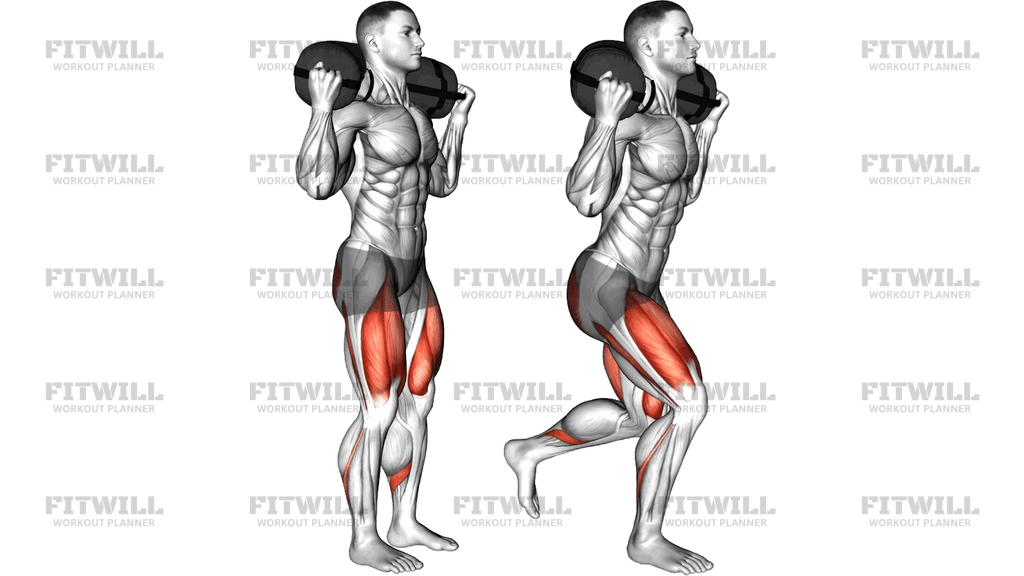
The Weighted Sandbag Walking Lunge is a traveling lunge variation where you rest a sandbag across the back of your shoulders, behind your neck, and step forward into alternating lunges that carry you across the floor. Unlike a stationary lunge, each rep begins from a fresh standing position, which forces you to decelerate, stabilize, and drive up one leg at a time while the shifting load sits on your upper back.
The sandbag is what separates this from a dumbbell or barbell walking lunge. Because the filler inside the bag shifts as you move, your trunk has to work continuously to keep your chest tall and your path steady. The bag also sits more comfortably across the shoulders than a barbell for most people, making it a practical way to load the pattern hard without needing a rack or spotters.
The main work comes from the quads and glutes of the front leg, with the hamstrings and calves assisting through the drive back to standing. Holding the bag behind the neck keeps your torso upright, which increases the demand on the core and the muscles along the spine that hold your posture with every step. Grip and upper back endurance also get trained simply from carrying and controlling the bag.
This movement suits lifters who already own a solid bodyweight lunge and want to add load, as well as strongman-style and general conditioning training where sandbag carries and lunges are common. It works well as a primary lower body strength exercise in moderate rep ranges or as a finisher performed down the length of a room or turf strip.
Setup matters more than most people expect. The bag should rest on the meat of your upper traps, not on your neck, with your hands gripping the bag or its handles to keep it from rolling. Your stance starts at hip width, and every step should land far enough forward that your front shin stays close to vertical and your knee tracks over your foot rather than collapsing inward.
Keep the working rep controlled: lower until your back knee hovers just above the floor, push through the whole front foot to rise, and bring the trailing leg through to a full standing position before the next step. Because you are walking under a shifting load, fatigue usually shows up as a shortened stride or a leaning torso long before your legs give out, so end the set when either of those starts to happen.
[ Workout Log & Planner ]
Put your next workout in Fitwill
Keep your plan and training log ready when you are.


Instructions
- Clean or lift the sandbag behind your neck so it rests across your upper traps and the top of your back, and grip the bag or its handles firmly with both hands.
- Stand tall with your feet hip-width apart, elbows pointed down, and your chest lifted.
- Brace your core as if preparing for a light punch, and take a breath before your first step.
- Step forward with one leg into a long stride, planting your whole front foot flat on the floor.
- Lower straight down until your front thigh is roughly parallel to the floor and your back knee hovers just above the ground, keeping your torso upright.
- Check that your front knee is stacked over or slightly behind your toes, not caving inward.
- Drive through your front heel and mid-foot to stand, pulling your back leg through until your feet are together and you are fully upright.
- Exhale as you rise, then inhale again before stepping with the opposite leg.
- Continue alternating legs down the floor, resetting your grip on the sandbag whenever it starts to slide.
- When finished, stop with feet together, then lift or roll the sandbag off your shoulders to the floor in front of you.
Tips & Tricks
- If the bag rolls or slides during the set, it is usually sitting too high on your neck. Pull it down so it rests on the shelf of your upper traps and re-grip before continuing.
- Short steps are the most common fault in this exercise. If your front knee shoots well past your toes and your heel lifts, your stride is too short for the sandbag position.
- Keep your eyes on a fixed point a few meters ahead. Watching your feet under a load behind your neck tends to pull your chest forward and round your upper back.
- Because the sand shifts inside the bag, expect one side to feel heavier at times. Counter it by keeping your hands working evenly rather than letting the bag drift to one shoulder.
- Choose a bag weight you could comfortably front-carry for a minute. If your grip or traps fail before your legs, the load is too heavy to learn from.
- Pause for a beat with both feet together between steps at first. Rushing the walk-through turns this into a sloppy shuffling motion instead of a lunge.
- Train on a flat, clear surface with room for at least 10-15 steps. Turning around mid-set under the bag is awkward and easy to get wrong.
- If your lower back fatigues before your legs, spend some volume on lighter bags or bodyweight walking lunges to build trunk endurance before adding load.
- Barefoot or flat-soled shoes work well here, since a soft cushioned heel can destabilize your balance as you plant each step.
Frequently Asked Questions
Which muscles does the Weighted Sandbag Walking Lunge work the most?
The quads and glutes of the front leg do most of the work, with the hamstrings and calves assisting on the drive up. Holding the sandbag behind your neck also loads your core and upper back throughout the set.
Why hold the sandbag behind the neck instead of in front of the chest?
The behind-the-neck position keeps your torso upright and places the load directly over your spine, which emphasizes the legs and challenges your postural muscles. A front-held bag shifts more demand to the core and changes the feel of the movement considerably.
Is the Weighted Sandbag Walking Lunge suitable for beginners?
Beginners should first master bodyweight walking lunges with a full-depth, balanced rep. Once the pattern is stable, a light sandbag is actually a friendly first load because it sits comfortably on the shoulders and is easy to drop safely if you lose balance.
How heavy should the sandbag be?
Pick a weight that lets you complete 8-12 lunges per leg with an upright torso and a full stride. If you have to shorten your steps or lean forward to finish the set, the bag is too heavy.
My sandbag keeps sliding off one shoulder during the lunge. What should I do?
Reposition the bag so it is centered across your upper traps, and grip the bag or its handles with both hands for the whole set. Also check that your hands are pulling down evenly rather than favoring one side.
How long should each stride be in the Weighted Sandbag Walking Lunge?
Long enough that your front shin stays close to vertical at the bottom and your back knee can lower toward the floor without your torso pitching forward. If your knee travels far past your toes, lengthen the stride.
Can I substitute another lunge variation if I do not have a sandbag?
Yes. Dumbbell walking lunges with weights held at your sides, barbell walking lunges with a bar on your back, or bodyweight walking lunges all train the same pattern. The sandbag version simply adds the shifting-load challenge and a carry component.
Is it a problem if my back knee touches the floor?
A light, controlled touch on a padded surface is fine, but slamming the knee down means you are descending too fast or too deep for your control. Slow the lowering phase and stop just above the floor if the touch is heavy.
How many steps should I perform per set?
For strength, work in the range of 8-12 lunges per leg. For conditioning, walk a fixed distance, such as the length of a turf strip, and rest when your stride shortens or your torso starts to lean.
Are there any safety points specific to the Weighted Sandbag Walking Lunge?
Make sure your walking path is clear of obstacles before you start, since you cannot easily see your feet with a bag behind your neck. If you lose balance mid-rep, step the bag off your shoulders to the floor rather than trying to save the rep with a twisted torso.