Suspender Leg Curl
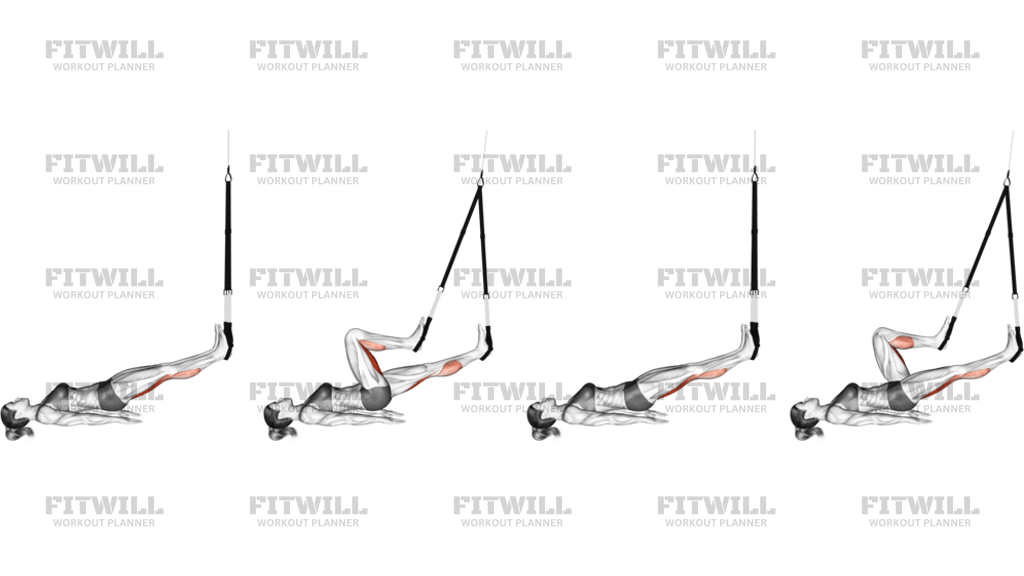
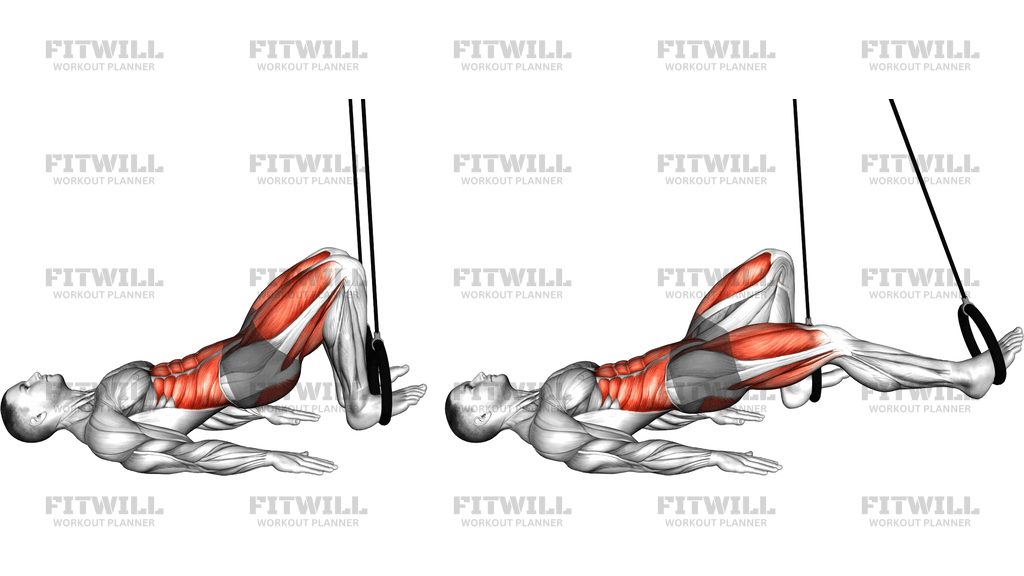
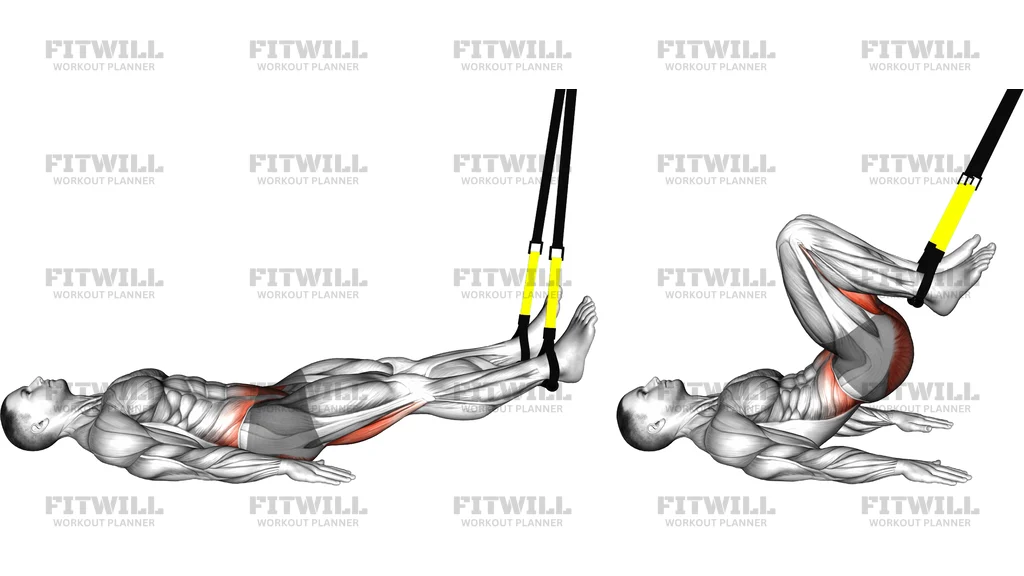
The Suspender Leg Curl is a bodyweight hamstring exercise performed lying on your back with your heels secured in the foot cradles of a suspension trainer. From there, you curl your heels in toward your hips while driving the hips upward, then extend back out to the starting position under control. Because the straps are unstable and the movement is loaded only by your own bodyweight, it challenges the hamstrings through both knee flexion and hip extension at the same time.
This movement is especially useful for people who train at home or travel frequently, since a suspension trainer and a bit of floor space are all that is required. It is also a smart option for lifters who want dedicated hamstring work without a leg curl machine, and for athletes who need knee-flexion strength that carries over to sprinting, jumping, and change of direction. The hamstrings rarely work in isolation in real movement, and this exercise respects that by blending knee flexion with hip extension.
The setup matters more than most people expect. The closer the anchor point is to directly above your heels, the more stable the straps will feel; an anchor set too far toward your head pulls the cradles backward and makes balance the limiting factor. Strap length determines difficulty as well: a longer strap lowers your body closer to the floor and increases the lever load on the hamstrings, while a shorter strap makes the curl easier to control.
To perform it well, keep your ribcage down and brace your trunk before the first rep, then pull your heels toward your glutes while lifting your hips until your knees, hips, and shoulders roughly line up. The knees should travel up toward the ceiling, not flare outward, and the hips should not sag as you extend back out. Slow, controlled extensions are where most of the muscle-building value lives, so resist the temptation to snap back to the start.
Common use cases include posterior-chain accessory work after squats or deadlifts, rehabilitation-friendly hamstring loading when machine leg curls are unavailable, and high-rep finisher sets that leave the hamstrings fatigued without heavy spinal loading. If the floor is hard, a mat under your back and arms improves comfort. Start with 2 to 3 sets of 8 to 12 reps, and progress by slowing the lowering phase, adding a pause at the top, or performing the curl one leg at a time.
[ Workout Log & Planner ]
Put your next workout in Fitwill
Keep your plan and training log ready when you are.


Instructions
- Anchor the suspension trainer securely overhead and adjust the straps so the foot cradles hang roughly 30 to 45 centimeters off the floor.
- Lie on your back on a mat, place both heels into the foot cradles, and extend your legs out in front of you with your arms flat at your sides, palms down.
- Press your heels down into the cradles, squeeze your glutes, and lift your hips until your body forms a straight line from shoulders to knees.
- Brace your trunk and keep your lower ribs pulled down so your lower back does not arch before the rep begins.
- Pull your heels in toward your glutes by bending your knees, letting your hips rise slightly as the knees move toward the ceiling.
- Continue curling until your heels are close to your hips and your knees are fully bent, keeping the knees pointing straight up rather than splaying outward.
- Pause briefly at the top, then slowly straighten your legs back out, lowering your hips with control until your body returns to the straight shoulder-to-knee line.
- Exhale as you curl the heels in and inhale as you extend back out, keeping the breath steady throughout the set.
- Complete all reps without letting the hips drop to the floor between repetitions; if you need to rest, set the hips down fully and reset your brace before continuing.
Tips & Tricks
- If the straps sway or drift side to side, check that the anchor point sits directly above your feet; an offset anchor is the most common cause of an unstable setup.
- Keep some downward pressure on the cradles with your heels at all times; letting the straps go slack mid-rep removes tension and is usually why people feel the exercise in their lower back instead of their hamstrings.
- If your hamstrings cramp, shorten the strap slightly or reduce the range on the first few sets; cramping is common because the hamstrings work over both the knee and hip at once.
- Do not let the hips sag toward the floor as you extend your legs; a sagging hip turns the exercise into an unstable bridge and shifts load away from the hamstrings.
- Press your arms and upper back into the floor for stability, but avoid pushing so hard with the arms that you turn the movement into a hip thrust.
- The lowering phase should take noticeably longer than the curl; if your legs shoot back out, the hamstring eccentric is doing none of the work.
- Point your toes toward your shins (dorsiflexion) to increase hamstring and calf involvement, or keep the feet neutral if the calves fatigue first.
- Progress by moving your body farther away from the anchor so more of your weight hangs in the straps, or by curling one leg at a time once double-leg reps feel easy.
- Wear smooth-soled shoes or place the cradles on your heels rather than the middle of the foot so the straps do not press uncomfortably into the Achilles area.
Frequently Asked Questions
What muscles does the Suspender Leg Curl work?
The hamstrings are the primary movers, working to flex the knees as the heels pull in. The glutes, calves, and trunk stabilizers assist by holding the hips up and keeping the body steady in the straps.
How is the Suspender Leg Curl different from a machine leg curl?
A machine leg curl isolates knee flexion on a fixed path, while the Suspender Leg Curl combines knee flexion with hip extension and requires you to stabilize your own body. It is generally harder to control but demands far less equipment.
Is the Suspender Leg Curl suitable for beginners?
Yes, if the strap length and body angle are adjusted to make it easier. Shorten the straps, keep the hips lifted higher, and start with a partial range before progressing to full curls.
Why do I feel the Suspender Leg Curl in my lower back instead of my hamstrings?
This usually means the hips are sagging or the lower back is arching before the curl begins. Re-brace your trunk, squeeze the glutes to lift the hips, and shorten the range until you can keep a straight shoulder-to-knee line throughout.
How far should my heels travel during the curl?
Curl until your heels are close to your glutes and your knees are fully bent, with the knees stacked over the hips at the top. If you cannot reach full bend without the hips dropping, work within a shorter range and build up gradually.
What can I use if I do not have a suspension trainer?
A stability ball leg curl is the closest substitute, since it also trains knee flexion with hip extension in a supine position. Sliding your heels on a towel along a smooth floor is another option, though it offers less tension.
How many sets and reps should I do?
Two to three sets of 8 to 12 controlled reps is a solid starting point. As you improve, slow the lowering phase to three or four seconds or progress to single-leg variations rather than simply adding large volumes.
Should the Suspender Leg Curl replace heavy hamstring training?
It is an excellent accessory and home-training option, but bodyweight resistance plateaus faster than loaded leg curls or Romanian deadlifts. Use it as a supplement or a travel alternative rather than your only hamstring exercise if maximal strength is the goal.
Are there any safety precautions I should know before starting?
Check that the anchor point and straps are rated for bodyweight and fully secured, and test the setup with a partial rep before committing to a full set. Keep the floor area around you clear, and stop the set if the straps begin to slip on your heels.