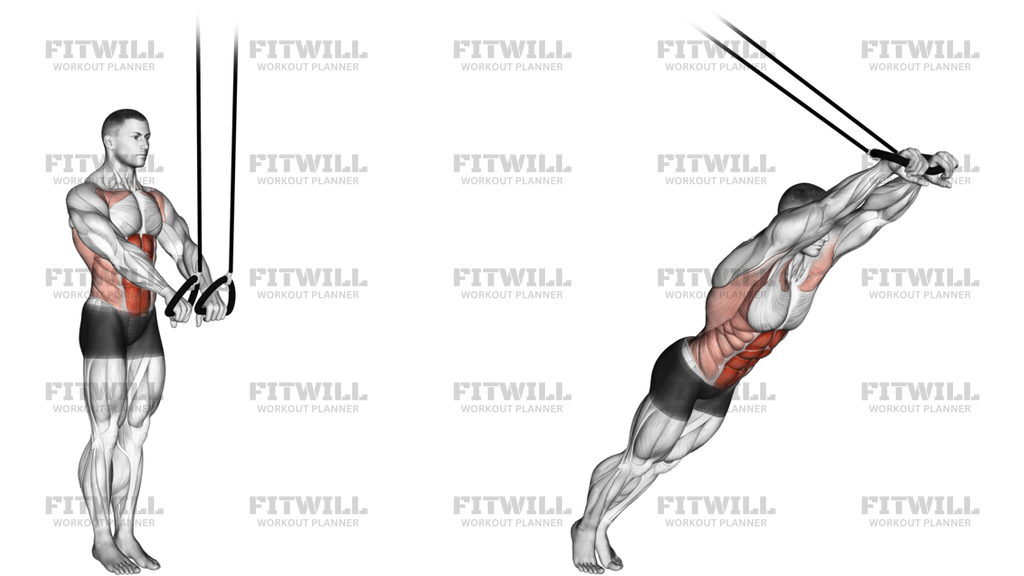
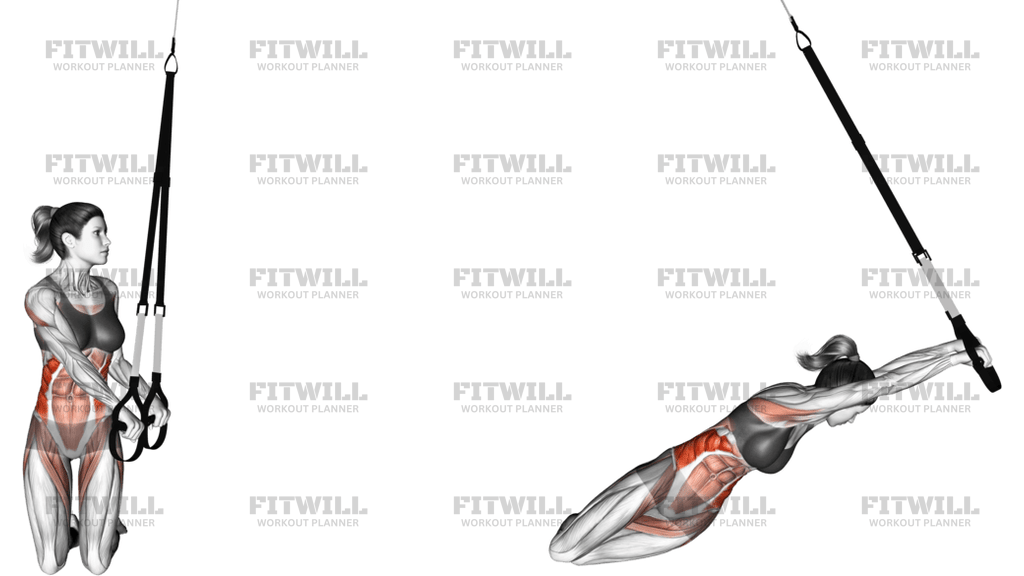
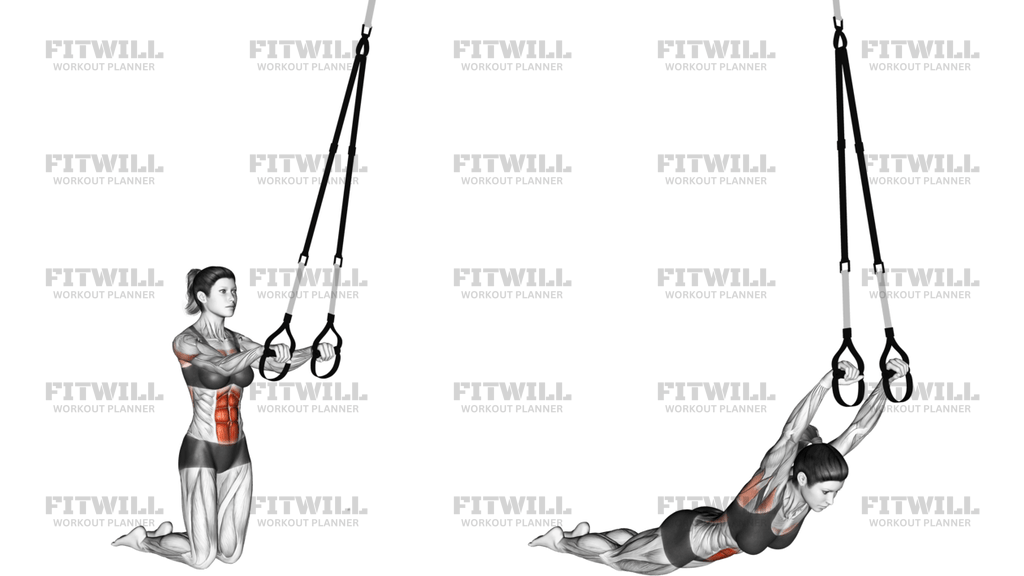
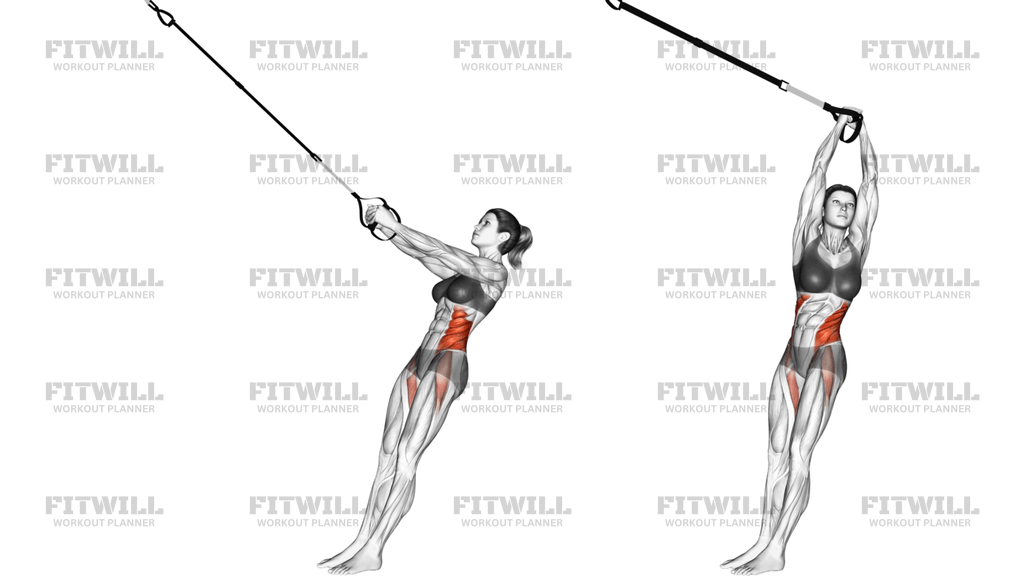
Suspender Rollout
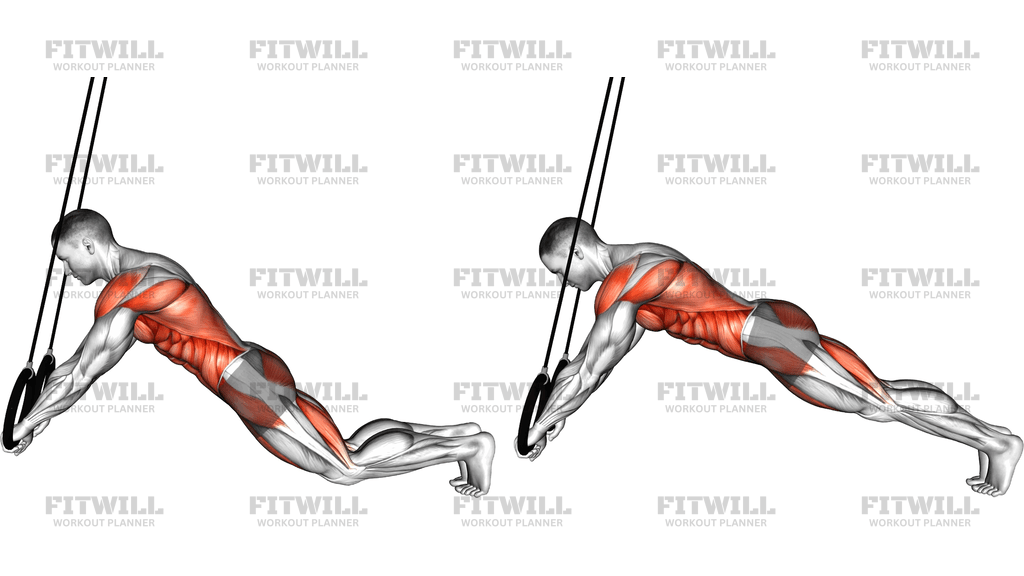
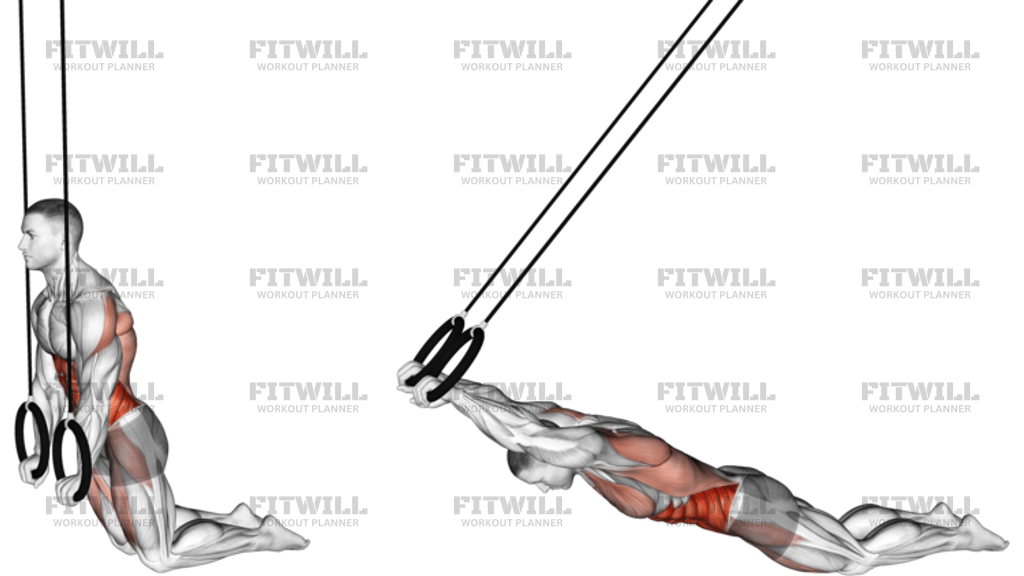
The Suspender Rollout is an anti-extension core exercise performed with a suspension trainer set at roughly knee height. You kneel facing the anchor point, grip the handles, and let your body roll forward as your arms travel overhead until you're stretched into a long, plank-like line. From there, you pull yourself back to the start using your abs rather than your arms. The straps are unstable and free-moving, which adds a balance and control demand you simply don't get from a fixed ab wheel or cable station.
This movement is aimed at lifters who already handle planks and basic rollouts and want a harder anti-extension challenge. Because you kneel throughout, the lower body stays largely out of the equation, letting you focus entirely on keeping the ribs down and the spine neutral as your torso extends away from your knees. The rectus abdominis does the visible work, while the deep core bracing hard against the pull of the straps, and the lats and shoulders stabilize as your arms move overhead.
Setup matters more here than in most core work. The lower the straps hang, the longer the lever and the harder the rollout; raising them toward waist height shortens the movement and gives you a mechanical way to scale it. Your knee position acts the same way — knees directly under the hips is the easiest version, and letting them drift back as you extend turns it into a near-full-body challenge. Grip the handles firmly but don't hang off your shoulder joints, and keep the straps close to your forearms so they don't saw sideways.
To execute well, brace before you move. Squeeze the glutes, tuck the pelvis slightly, and push the handles down into the straps to create tension. Roll out by letting the arms rise overhead in a smooth arc while the hips stay extended and the lower back stays flat — the moment your lumbar spine starts to arch, you've gone past your current range. Pull back by driving the handles down and toward your thighs, thinking about rounding the mid back slightly as your knees come under you again.
The Suspender Rollout fits well at the start of a core block when you're fresh, or as the hardest movement in a short ab finisher. Two to four sets of five to eight controlled reps is a realistic starting dose. If your lower back takes over, shorten the range rather than pushing through the arch — the exercise rewards depth you can reverse cleanly, not distance you fall into and grind out of.
[ Workout Log & Planner ]
Put your next workout in Fitwill
Keep your plan and training log ready when you are.


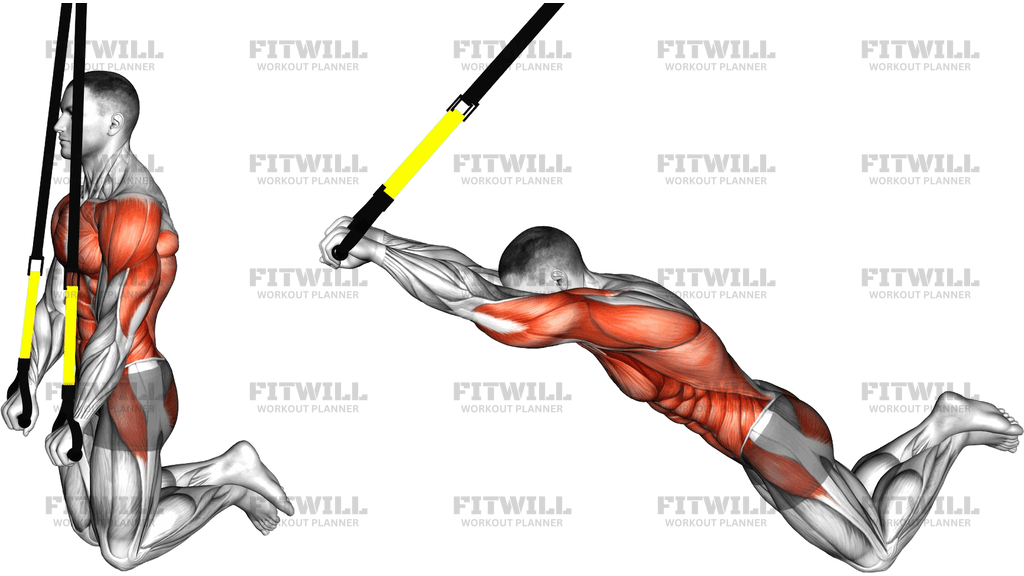
Instructions
- Anchor the suspension trainer at roughly knee-to-waist height and kneel on a mat facing the anchor point, knees about hip-width apart.
- Grip the handles with a neutral grip and position your torso upright, shoulders stacked over the hips, straps hanging vertical under light tension.
- Squeeze the glutes, brace the abs as if preparing for a push to the stomach, and push the handles down slightly to load the straps.
- Slowly extend the arms overhead and let the body roll forward, keeping the hips extended and the lower back flat throughout.
- Continue until the arms are alongside the ears and the body forms one long line from knees to head — stop just before the lower back begins to arch.
- Pause briefly at the fully extended position, keeping tension in the straps rather than resting the shoulder joints.
- Pull the handles down toward the thighs and drive the hips forward to return to the upright kneeling start.
- Exhale as you roll out under control, and exhale again on the pull back in; avoid holding a strained breath at the deepest point.
- Reset the brace between each rep before beginning the next rollout rather than flowing reps together.
- Adjust strap length between sets if the range feels too easy or too difficult — longer straps make it harder, shorter straps make it easier.
Tips & Tricks
- The most common mistake is letting the hips sag and the lower back arch at full extension. If your lumbar spine caves in, stop the rollout several inches earlier and build range gradually over weeks.
- Watch for the straps drifting outside the forearms as you extend. Keep your wrists stacked over the handles so the straps track in line with the arms; a sideways angle makes the shoulders rotate and lose stability.
- Don't let the head lead the movement. Craning the neck up to watch the anchor usually coincides with losing the brace — keep the neck neutral and look at the floor a short distance ahead.
- If your shoulders feel pinched overhead, the issue is usually a loose grip and a shrugged shoulder position. Press the handles actively away and pull the shoulder blades down slightly before rolling out.
- Slower is not automatically better here, but uncontrolled is always worse. Aim for a two- to three-second rollout and a one- to two-second return with no bouncing at the bottom.
- Knee placement is your main intensity dial. Kneeling directly under the hips keeps it moderate; shuffling the knees a few inches back dramatically increases the load, so change one variable at a time.
- Avoid doing this exercise right after heavy pressing or overhead work. Fatigued shoulders make it hard to hold the overhead position stably, and form tends to break at the end range first.
- If the straps twist or the handles rotate during the set, your grip is likely passive. Squeeze the handles firmly and keep the palms facing each other consistently from start to finish.
Frequently Asked Questions
Which muscles does the Suspender Rollout work the most?
The rectus abdominis and deep core do the primary work resisting extension, with strong involvement from the obliques, lats, and front delts as the arms travel overhead. The glutes and hip flexors help hold the pelvic position throughout.
Is the Suspender Rollout suitable for beginners?
It can be, but beginners should raise the straps toward waist height and shorten the range so the rollout stays shallow. If you cannot hold a solid plank for 45–60 seconds yet, build that base first.
How is the Suspender Rollout different from an ab wheel rollout?
The suspension straps are unstable and free-moving, so your shoulders and core also have to control side-to-side and rotational forces, not just forward extension. The strap height also lets you scale the difficulty in fine increments, which a fixed-height wheel does not.
How far should I roll out on the Suspender Rollout?
Roll out only until your arms are near your ears while the lower back stays flat and the ribs stay down. Depth you can reverse with control is productive; depth that ends with a lumbar arch is not.
What should I do if my lower back hurts during the Suspender Rollout?
Stop the set, shorten the range, and re-check the brace — squeeze the glutes and tuck the pelvis before you roll out. If discomfort persists even at a short range, switch to a plank or dead bug variation and rebuild the brace pattern first.
Can I do the Suspender Rollout without a suspension trainer?
An ab wheel or a loaded barbell rollout trains the same anti-extension quality. The suspension version's unique feature is the unstable strap path, so any substitute will lose some of that balance demand.
How many reps and sets of the Suspender Rollout should I do?
Two to four sets of five to eight controlled reps works well, done early in a session while you're fresh. If form breaks before five reps, shorten the range rather than adding volume to a failing pattern.
Why do my shoulders fatigue before my abs on the Suspender Rollout?
The overhead extended position loads the shoulders heavily, especially if you hang passively in the straps. Keep an active press into the handles, slightly depress the shoulder blades, and reduce depth until the shoulder endurance catches up.
Should the straps be set long or short for the Suspender Rollout?
Longer straps lower the anchor and create a longer, harder lever, while shorter straps keep the movement more upright and manageable. Start shorter, own the range, then lengthen the straps as your control improves.