Weighted Bench Dip
The Weighted Bench Dip is a harder-hitting version of the classic bench dip. You place your hands on the edge of one flat bench, rest your heels on a second bench in front of you, and set a weight plate on your lap before lowering your hips toward the floor and pressing back up. Adding the plate turns a movement many people use as a lightweight finisher into a serious strength exercise for the backs of the arms.
This lift mainly trains the triceps, which straighten the elbows and make up most of the visible size of the upper arm. The front of the shoulders and the chest assist as the torso drops between the benches, and the muscles around the shoulder blades work to keep your torso from collapsing as you descend. Because your legs are extended onto the second bench, there is no help coming from your lower body, so the arms and shoulders do all of the work.
The Weighted Bench Dip suits lifters who have already mastered bodyweight bench dips and can perform solid sets with good elbow tracking. It is popular in arm-focused training blocks, as a compound press accessory after close-grip or overhead pressing, and for anyone who wants to load the triceps hard without a barbell or dip station. The two-bench setup is common in commercial gyms and easy to arrange at home with any two sturdy, equal-height surfaces.
Setup matters more here than in most bodyweight work, because the plate shifts your center of gravity and the shoulder is loaded in a relatively end-range position. Keep the benches close enough that your hips can travel straight down between your hands, keep the weight plate low on your thighs so it does not slide, and keep your back close to the bench behind you rather than drifting forward. A vertical torso emphasizes the triceps, while letting the torso lean slightly forward brings more chest into the movement.
Execute each rep by bending the elbows straight back behind you until they reach roughly ninety degrees, then pressing through your palms until your arms are extended again. Depth control is the key safety point: descending far beyond a comfortable range pinches the front of the shoulder and puts stress on the joint capsule without adding meaningful muscle work. Stay within a depth where your shoulders feel comfortable, and lower the weight plate smoothly rather than dropping into the bottom.
[ Workout Log & Planner ]
Put your next workout in Fitwill
Keep your plan and training log ready when you are.


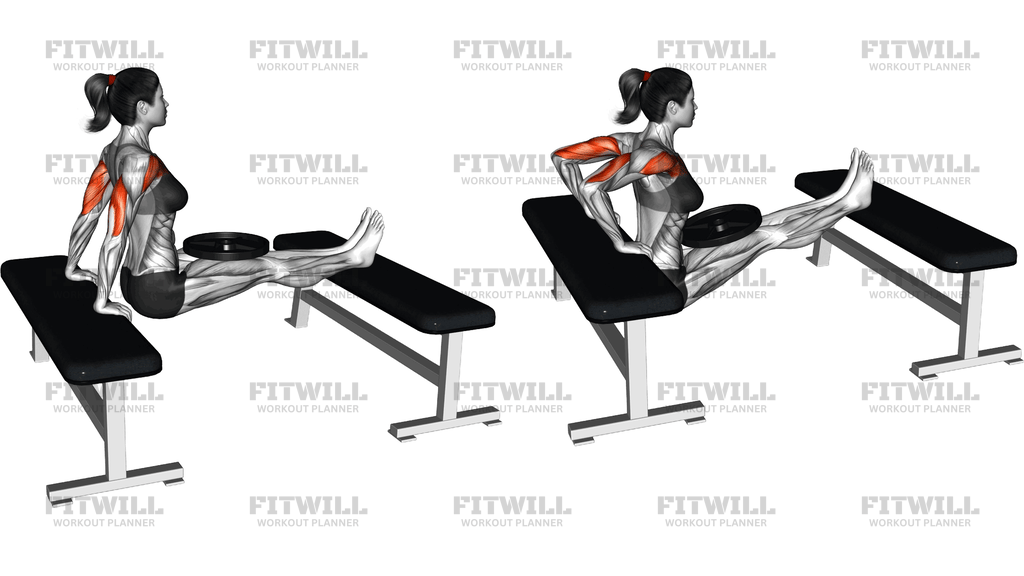
Instructions
- Place two flat benches parallel to each other, roughly the length of your legs apart, so you can sit on the edge of one and rest your heels on the other.
- Sit on the edge of the first bench and grip the front edge beside your hips with your fingers pointing forward, hands about shoulder-width apart.
- Extend your legs straight out and place your heels on the second bench, keeping your knees soft rather than locked.
- Set a weight plate flat on your thighs just above the knees, and hold it steady with one hand while you find your balance, then brace your core.
- Slide your hips forward off the bench so your arms support your full body weight and your hips hang just in front of the bench edge.
- Inhale and lower your body by bending your elbows straight back behind you until they reach about ninety degrees; keep your back close to the bench.
- Exhale and press through your palms to extend your elbows fully, squeezing the triceps at the top without hyperlocking the joint hard.
- Keep the weight plate from sliding by keeping your thighs fairly level and your movements smooth throughout the set.
- Complete the set, then set the plate down before stepping your hips back over the bench to release your grip safely.
Tips & Tricks
- Keep your elbows pointing straight back, not flaring out wide, or your shoulders will take over the load and the joint will feel pinched at the bottom.
- If the plate slides down your thighs mid-set, move it higher toward your hips and press your thighs slightly up to pin it in place.
- Do not descend until your shoulders ache or click; stopping at ninety degrees of elbow bend is deep enough for most people and keeps the shoulder in a safer range.
- Keep your hips within a few inches of the bench. Drifting forward turns the movement into a hybrid that loses triceps tension and strains the front of the shoulder.
- Start with a small plate you can control for twelve or more reps. The leverages here make even a light plate feel heavy at the bottom.
- Breathe out on the way up rather than holding your breath, especially since the plate on your thighs adds pressure to your torso.
- If your wrists ache, grip the bench edge with your fingers slightly wrapped over the front and press through the heel of your palm instead of the palm center.
- Reposition the second bench so your heels sit securely on it; if your feet can slide off, you will lose balance the moment the weight plate shifts.
- Warm up with a set of unweighted dips first so you can judge how the added load feels before committing to heavier plates.
Frequently Asked Questions
Which muscles does the Weighted Bench Dip work hardest?
The triceps are the prime movers, with the front shoulders and chest assisting on the way up. The muscles that stabilize the shoulder blades also work throughout to keep your torso from sagging.
Should beginners do the Weighted Bench Dip?
Beginners are better off building strength with unweighted bench dips first. Once you can control a solid set of fifteen or so bodyweight reps with good elbow tracking, adding a small plate is a sensible next step.
How do I keep the weight plate from falling during Weighted Bench Dips?
Place the plate flat on your thighs just above the knees and keep your thighs close to level. If it slides, it is usually because you are dropping too fast or your hips are drifting forward away from the bench.
How deep should I go on the Weighted Bench Dip?
Lower until your elbows reach roughly ninety degrees or slightly less if your shoulders feel uncomfortable. Going deeper increases stress on the front of the shoulder without adding much useful work for the triceps.
Why do my shoulders hurt when doing Weighted Bench Dips?
Shoulder discomfort usually comes from descending too deep, flaring the elbows outward, or letting the hips drift forward. Shorten the range, keep the elbows tracking straight back, and keep your back near the bench edge.
Can I do the Weighted Bench Dip with only one bench?
Yes. Elevating the heels on a second bench makes the movement harder and keeps the legs out of the way, but you can perform it with heels on the floor and the plate on your lap, bending the knees as needed.
What can I use instead of a Weighted Bench Dip?
Close-grip push-ups with a weight plate or vest, parallel bar dips with added weight, or cable and dumbbell pushdowns all train the triceps in a similar way with less stress on the front of the shoulder.
How much weight should I add to Weighted Bench Dips?
Start with a five to ten kilogram plate, or lighter if the movement is new to you, and only add load when you can complete your target reps without your elbows flaring or your depth shortening.
Where should my hands be placed for Weighted Bench Dips?
Grip the front edge of the bench beside your hips, about shoulder-width apart, with your fingers pointing forward. Much wider than that encourages elbow flare and strains the shoulders.