Kettlebell Hip Thrust
The Kettlebell Hip Thrust is a horizontal hip extension exercise performed with your upper back supported on a flat bench and a kettlebell loaded across your hips. From a seated position in front of the bench, you lean back onto it, plant your feet on the floor, and drive your hips upward until your torso and thighs form a straight line. It is one of the most direct ways to load the glutes in their shortened, fully contracted position, which is hard to achieve with squats or deadlifts alone.
This movement suits a wide range of lifters. Beginners can use a light kettlebell to learn what a proper hip hinge and lockout feel like, while more experienced lifters can load it heavily without placing compressive stress on the spine the way a barbell back squat does. It is especially useful for anyone whose glutes struggle to fire during squats, for runners and cyclists who want stronger hip extension, and for people rehabbing around lower back sensitivity who still need to train the posterior chain hard.
The primary muscles worked are the glutes, with the hamstrings assisting as the hips extend. Your core and lower back work isometrically to keep your ribs down and your torso stable as the hips rise, and your quads help control the knee position at the top. Because the bench supports your upper back, the arms only need to hold the kettlebell in place rather than lift it, which lets you focus entirely on the drive from the hips.
Setup matters more here than in most glute exercises. The bench edge should sit right at the base of your shoulder blades, your feet should be far enough forward that your shins are roughly vertical at the top, and the kettlebell needs to rest squarely over the crease of your hips with both hands steadying the handle. If the weight drifts toward your knees or ribs, the leverage changes and the exercise stops loading the glutes the way it should.
Execution is simple but easy to rush. Push the floor away through your heels, squeeze the glutes to lift the hips, and finish with a straight line from shoulders to knees, ribs down and chin tucked slightly. Pause for a beat at the top before lowering under control until the kettlebell hovers just above the floor, then begin the next rep. Avoid hyperextending your lower back at lockout; the lift ends when your hips are fully open, not when you arch higher.
In practice, the Kettlebell Hip Thrust fits well as a primary glute lift on lower body days, as a finishing movement after squats or deadlifts, or as a home training staple since it requires only a kettlebell and a sturdy bench or similar surface. Start conservatively with the weight, master the top-position squeeze, and progress by adding reps before adding load.
[ Workout Log & Planner ]
Put your next workout in Fitwill
Keep your plan and training log ready when you are.


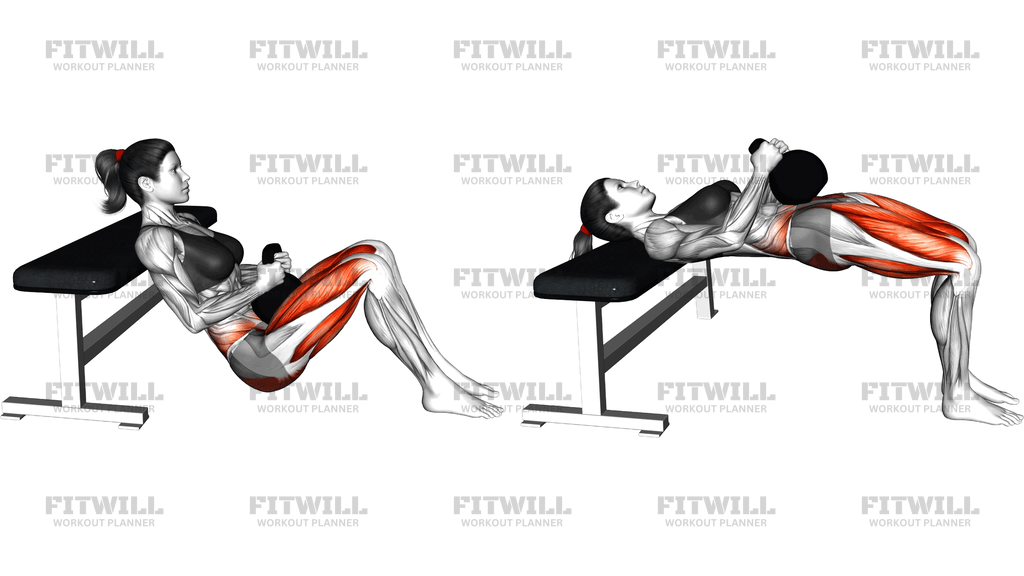
Instructions
- Sit on the floor with your upper back against the edge of a flat bench and place a kettlebell on the floor in front of you.
- Roll the kettlebell over your hips so it sits in the crease where your thigh meets your pelvis, and grip the handle with both hands to hold it steady.
- Walk your feet forward and set them flat on the floor about hip-width apart, with your knees bent so your shins will be near vertical at the top.
- Lean back so your shoulder blades rest on the bench, tuck your chin slightly, and brace your core as if bracing for a light punch to the stomach.
- Drive through your heels and squeeze your glutes to push your hips straight up toward the ceiling, keeping the kettlebell balanced over your hips.
- Continue lifting until your shoulders, hips, and knees form one straight line, with your ribs pulled down rather than flared.
- Hold the top position for one to two seconds, focusing on a hard glute squeeze instead of arching your lower back higher.
- Lower your hips under control until the kettlebell is just above the floor without letting it touch down and release tension.
- Exhale as you drive up and inhale as you lower, keeping a steady breathing rhythm through the set.
- Finish the set by lowering your hips fully, sitting forward slightly, and setting the kettlebell on the floor before standing up.
Tips & Tricks
- If your hips rise before your torso moves, your feet are usually planted too close to the bench; shift them a few inches forward until your shins are vertical at the top.
- A kettlebell that rolls off the hip crease mid-set is usually sitting too far toward your thighs or ribs; reset it directly over the hip bones before each set.
- If you feel the work in your lower back instead of your glutes, you are most likely overextending at the top; cut the lift off once your hips are level with your knees and squeeze rather than arch.
- Point your toes slightly inward and think about spreading the floor with your feet to keep your knees from collapsing together as you drive up.
- Use a folded towel or mat between the kettlebell and your hip bones if the bell digs in during heavy sets; discomfort there often causes people to shorten the range.
- Keep your hands on the handle for the whole rep. Letting go at the top shifts the load and can let the bell tip toward one hip.
- Press your upper back into the bench rather than sliding on it; if the bench moves during your reps, wedge it against a wall or rack.
- Pause for a full second at lockout before descending. Rushing the top position is the most common way to lose glute tension in this movement.
- Warm up with a set of bodyweight glute bridges first so you know what the top squeeze should feel like before adding the kettlebell.
Frequently Asked Questions
What muscles does the Kettlebell Hip Thrust work?
The glutes are the primary movers, with the hamstrings helping extend the hips. Your core and lower back stabilize the torso isometrically, and the quads assist in controlling the knees at the top.
Why use a kettlebell instead of a barbell for hip thrusts?
A kettlebell is easier to position over the hips for one, and its compact shape makes setup faster without needing a barbell pad. It is also a convenient way to progress from bodyweight glute bridges before moving to heavier barbell loading.
How high should my hips go at the top of the Kettlebell Hip Thrust?
Lift until your shoulders, hips, and knees form a straight line with your hips fully open. Going higher by arching your lower back does not add glute work and shifts stress away from the glutes.
Where exactly should the kettlebell sit during the movement?
It should rest in the crease of your hips, directly over the top of your thighs and pelvis, held in place by both hands on the handle. If it slides toward your knees or your ribs, the leverage changes and the glutes stop receiving the intended load.
How far should my feet be from the bench?
Set your feet so your shins are close to vertical when your hips reach the top. Feet too close to the bench push more work toward the quads, while feet too far forward make the hamstrings take over.
Is the Kettlebell Hip Thrust good for beginners?
Yes, it is one of the easiest loaded glute exercises to learn because the bench supports your upper body and the range of motion is short. Beginners should start light, or even unweighted, and focus on achieving a clean straight-line lockout before adding load.
What is the most common mistake in the Kettlebell Hip Thrust?
Hyperextending the lower back at the top instead of squeezing the glutes. If you finish each rep by arching taller, reset with your ribs pulled down and stop the lift the moment your hips are level with your knees.
What can I use instead of a flat bench for this exercise?
Any stable surface around knee to mid-thigh height works, such as a sturdy ottoman, a plyometric box, or the edge of a couch. Just make sure it cannot slide or tip while your shoulder blades are pressed into it.
Can I do the Kettlebell Hip Thrust if my lower back is sensitive?
Many people with back sensitivity tolerate hip thrusts well because the bench supports the torso and the load does not compress the spine. Even so, keep the range pain-free, avoid forcing extra arch at the top, and check with a qualified professional if you have a specific condition.
How does the Kettlebell Hip Thrust differ from a glute bridge?
A glute bridge is done flat on the floor with a shorter range of motion, while the hip thrust elevates your shoulders on a bench so your hips can travel through a much longer path. The extra range and height make the hip thrust easier to load progressively over time.