Kettlebell 45 Degrees Back Extension
The Kettlebell 45 Degrees Back Extension is a loaded hyperextension performed on an angled back extension bench, often called a Roman chair or 45-degree bench. Your feet are anchored under the foot pads, your hips sit against the top pad, and you hold a kettlebell against your chest or let it hang in front of you while you hinge down and pull your torso back up to a straight line. The kettlebell turns a classic bodyweight back extension into a strength exercise, letting you progressively load the erector spinae in a way that a plain extension cannot.
This movement primarily trains the lower back muscles that run along the spine, with strong support from the glutes and hamstrings as they extend the hips. Because your torso works against gravity on an incline, the upper back and traps also stay busy keeping your spine neutral and the weight under control. It is a useful choice for lifters who find bodyweight back extensions too easy, or for anyone building posterior chain resilience for squatting, deadlifting, or running.
Setup matters more here than in most back exercises. The pad height should place the top of the pad just below your hip crease so your hips can fully hinge without being blocked, and your feet must be secured under the foot plates so you can lower without your body shifting. Holding the kettlebell against your chest shortens the lever and keeps the load close; letting it hang in front of you makes the movement noticeably harder. Pick the version you can control before adding weight.
To execute well, cross your arms over the kettlebell at your chest or hold it by the horns, brace your trunk, and hinge at the hips to lower your torso toward the floor while keeping a long, neutral spine. Rise by squeezing the glutes and driving the hips down into the pad until your head, hips, and heels form a straight line. Avoid jerking, bouncing, or craning the neck up at the top.
A common use case is as a light-to-moderate accessory on lower body or deadlift days, typically for two to four sets of eight to fifteen reps. If you feel the work mostly in your hamstrings, your hips may be too low on the pad or you may be pulling with the arms instead of extending the hips. Stop the set if you feel any sharp or radiating sensation in the lower back, and progress the kettlebell weight gradually rather than jumping to a heavy bell.
[ Workout Log & Planner ]
Put your next workout in Fitwill
Keep your plan and training log ready when you are.


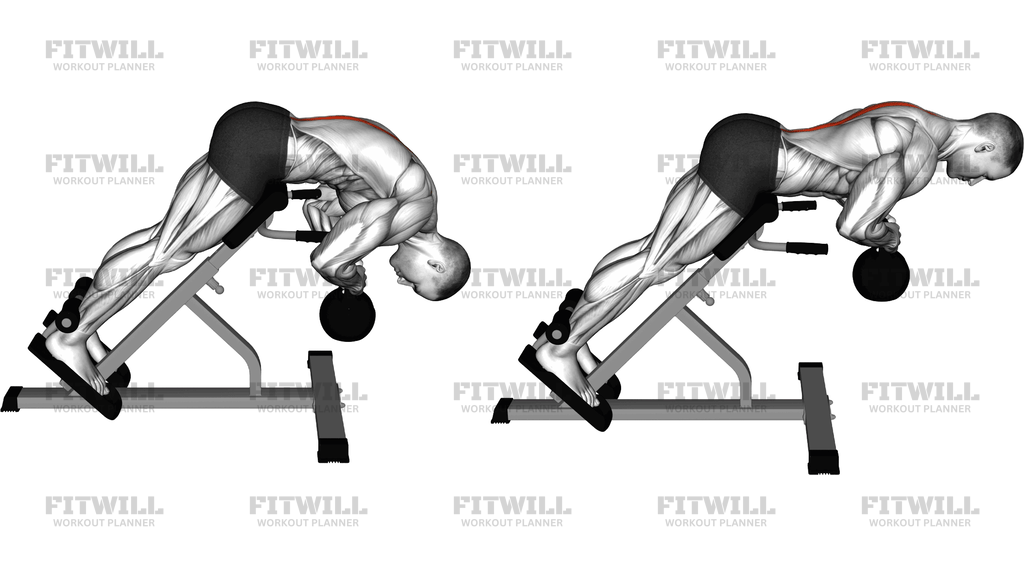
Instructions
- Set the pad of the 45-degree back extension bench so the top edge sits just below your hip crease, and hook your feet firmly under the foot plates with legs nearly straight and a slight knee bend.
- Pick up the kettlebell and hold it against your chest with both arms crossed over it, or grip it by the horns in front of your sternum if that feels more secure.
- Position your hips fully on the pad, cross your ankles or brace your heels against the pads, and let your torso hang forward at the bottom of the bench.
- Squeeze your shoulder blades gently together, brace your abs, and tuck your chin slightly so your neck stays in line with your spine.
- Hinge at the hips to lower your torso toward the floor under control, keeping the kettlebell pressed to your chest and your back long rather than rounded.
- Stop when you feel a mild stretch across the back of your hips and hamstrings, usually when your torso reaches roughly 60 to 90 degrees to your legs.
- Drive your hips down into the pad and squeeze the glutes to raise your torso until your head, hips, and heels form a straight line; do not arch past neutral.
- Exhale as you lift and inhale as you lower, keeping your breathing steady instead of holding your breath through the rep.
- Lower the next rep slowly and smoothly, avoiding any bounce at the bottom, and complete your set before unhooking your feet and stepping off the bench with the kettlebell controlled close to your body.
Tips & Tricks
- If your hamstrings cramp or do most of the work, slide your hips slightly higher on the pad so the hip crease can move freely and the glutes can extend the hips instead of the hamstrings dominating.
- Holding the kettlebell against your chest rather than at arm's reach dramatically shortens the lever; start chest-loaded and only extend the distance once every rep looks identical.
- Rounding the lower back at the bottom is the most common fault on this bench; film yourself from the side and lower only as far as you can keep a long, flat spine.
- Do not swing the kettlebell or bounce out of the stretched position, since the rebound takes tension off the lower back exactly where it needs to stay on.
- Avoid hyperextending at the top by leaning your chest back past your legs; ending in a straight line keeps the tension on the erector spinae and glutes instead of compressing the spine.
- Keep the kettlebell pressed firmly into your sternum with crossed arms; if it starts drifting away from your body, the set is over for load purposes, so drop to a lighter bell.
- Point your toes down slightly and push your heels into the foot plates so your legs stay anchored instead of your whole body rocking on each rep.
- If your lower back fatigues before you feel glutes working, slow the lowering phase to a three-second count; the extra time under tension usually reveals the hips extending too fast.
- On heavy sets, get a partner to hand you the kettlebell once you are set on the bench, rather than trying to pick it up while hanging off the edge.
Frequently Asked Questions
Which muscles does the Kettlebell 45 Degrees Back Extension work?
The lower back muscles along the spine are the primary movers, supported heavily by the glutes and hamstrings during hip extension. The upper back and traps work isometrically to hold the kettlebell and keep your spine neutral.
Should I hold the kettlebell on my chest or let it hang in front of me?
Holding it against your chest is safer and easier to control because the load stays close to your torso. Letting it hang in front greatly increases the leverage and should only be used once the chest-held version feels solid.
How low should I lower my torso on the Kettlebell 45 Degrees Back Extension?
Lower until you feel a mild stretch through the back of your hips and hamstrings, which is usually around 60 to 90 degrees from your legs. Going deeper is fine only if you can keep your spine completely neutral.
Is this exercise safe for beginners?
Beginners should first master bodyweight back extensions on the same bench, then add a light kettlebell held at the chest. The setup and pad height matter more than the weight, so take time getting the bench adjusted before loading.
Why do I only feel my hamstrings during back extensions?
Your hips are probably positioned too low on the pad, blocking full hip extension, or you are flexing and extending at the waist only. Move up so the pad sits below your hip crease and consciously squeeze the glutes at the top.
How many reps should I do with a kettlebell on back extensions?
Two to four sets of eight to fifteen controlled reps works well as an accessory movement on lower body days. If you cannot complete eight clean reps without rounding or bouncing, the kettlebell is too heavy.
What can I use instead of a kettlebell for the Kettlebell 45 Degrees Back Extension?
A dumbbell or weight plate held at the chest gives a very similar loading effect, and a weight held in a hug position works too. If no weight is available, slowing the tempo and pausing at the top increases the difficulty of bodyweight reps.
Should I arch my back at the top of the movement?
No, finish with your head, hips, and heels in a straight line and stop there. Extending beyond neutral adds compression to the lower back without meaningfully increasing muscle work.
Can I do the Kettlebell 45 Degrees Back Extension if my lower back feels sore?
Muscle soreness from previous training is usually fine, but sharp, pinching, or radiating sensations are a signal to stop and reassess your setup or load. When in doubt, reduce the weight or return to bodyweight reps and consult a professional if the discomfort persists.