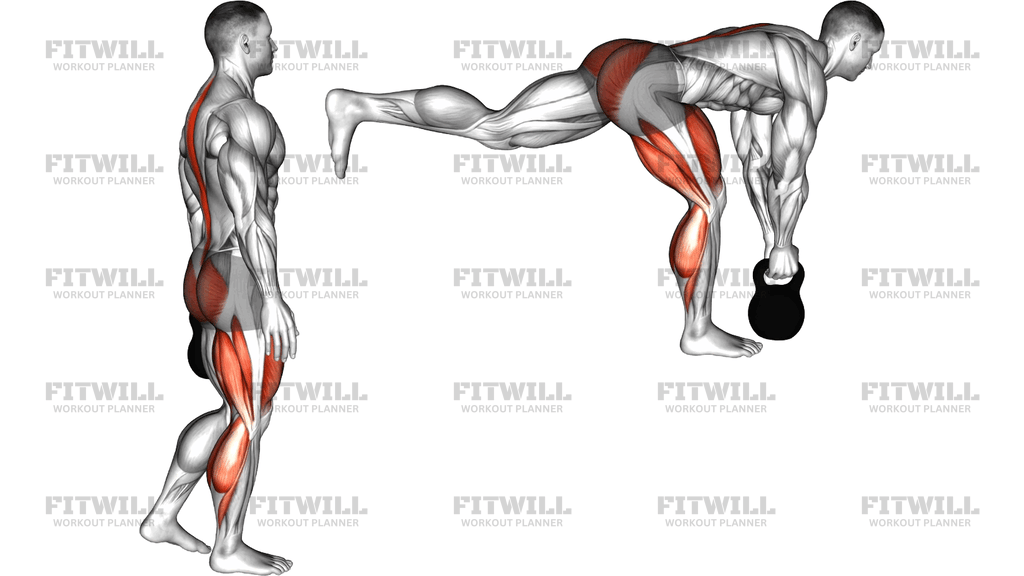
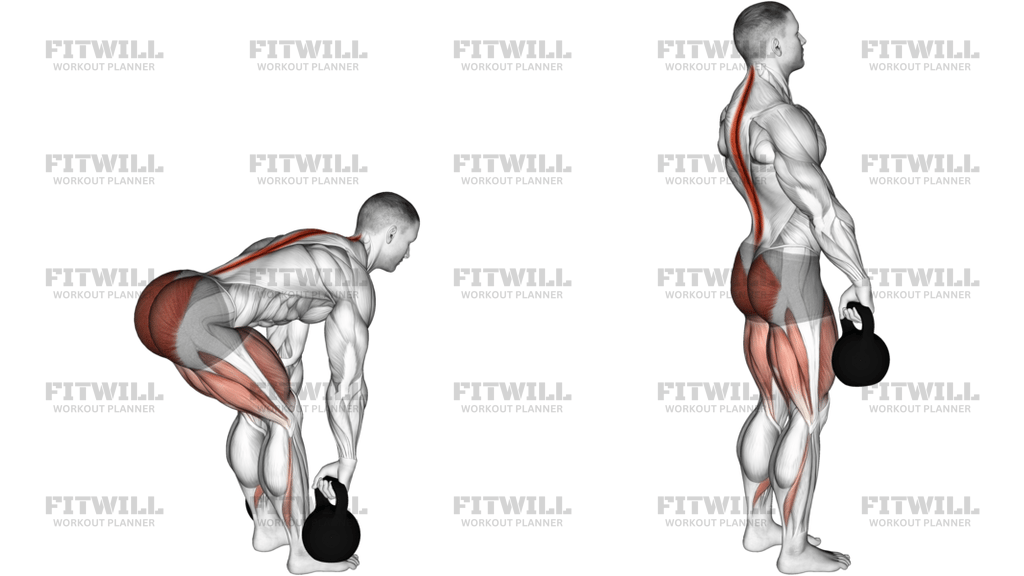
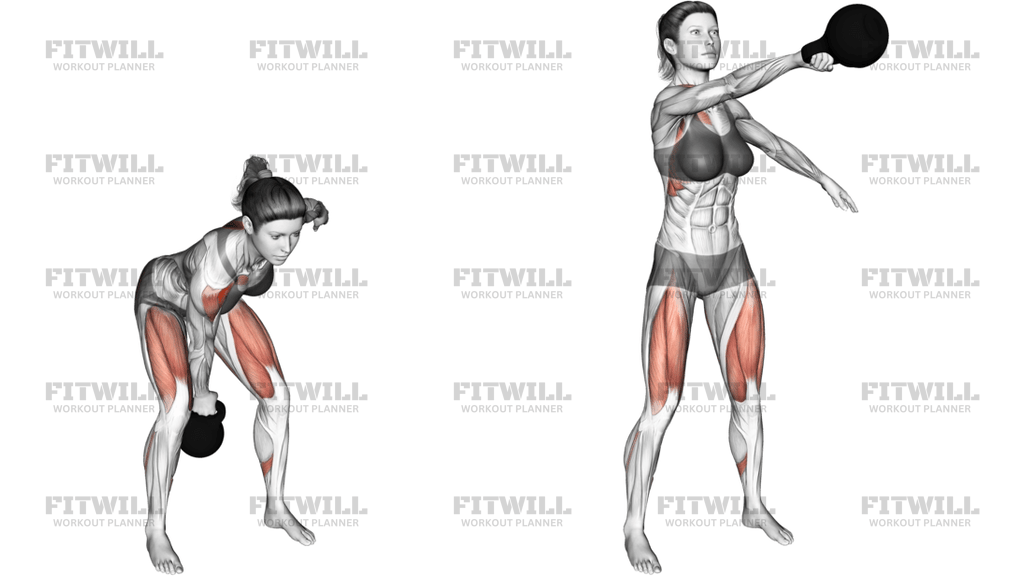
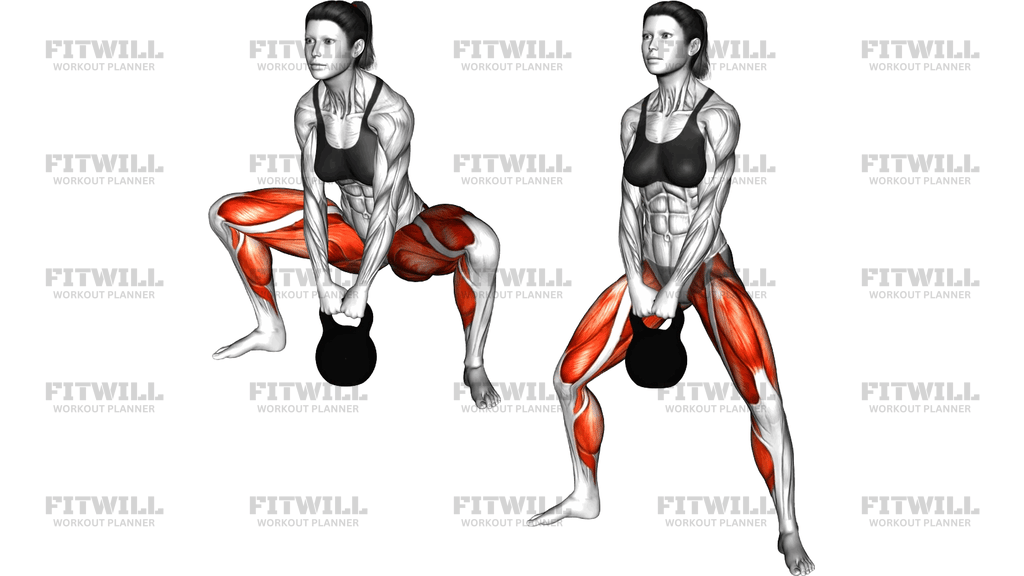
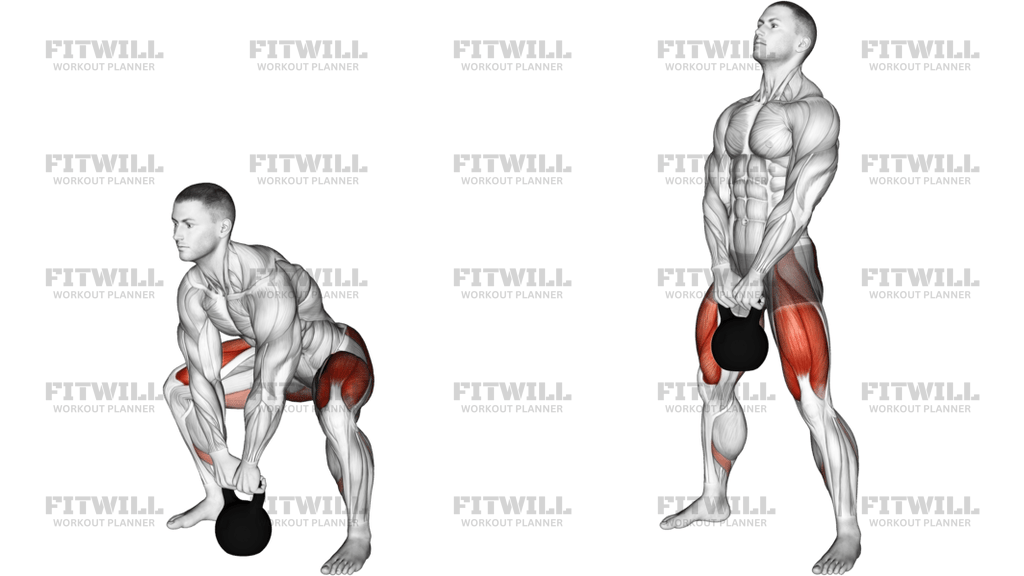
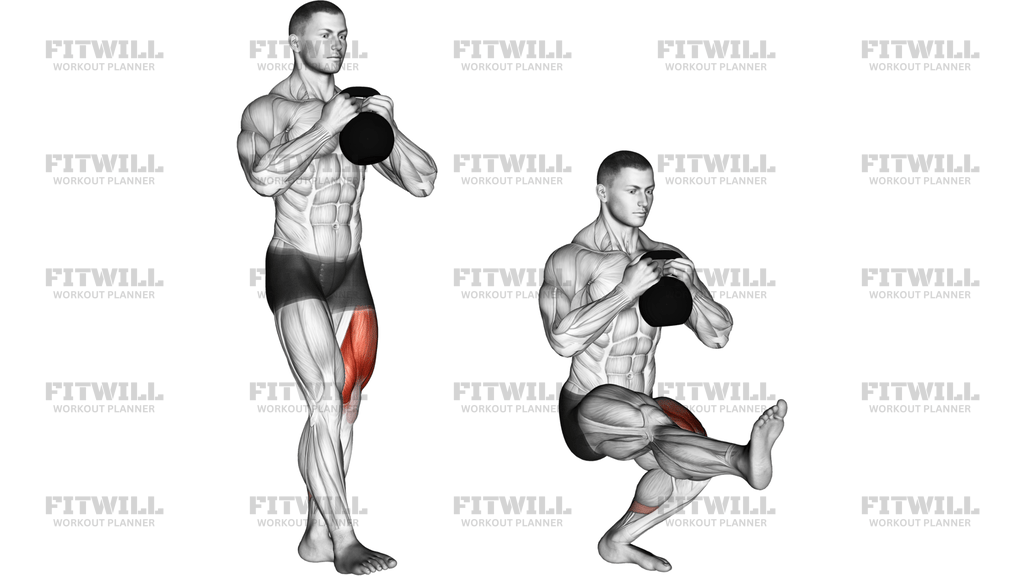
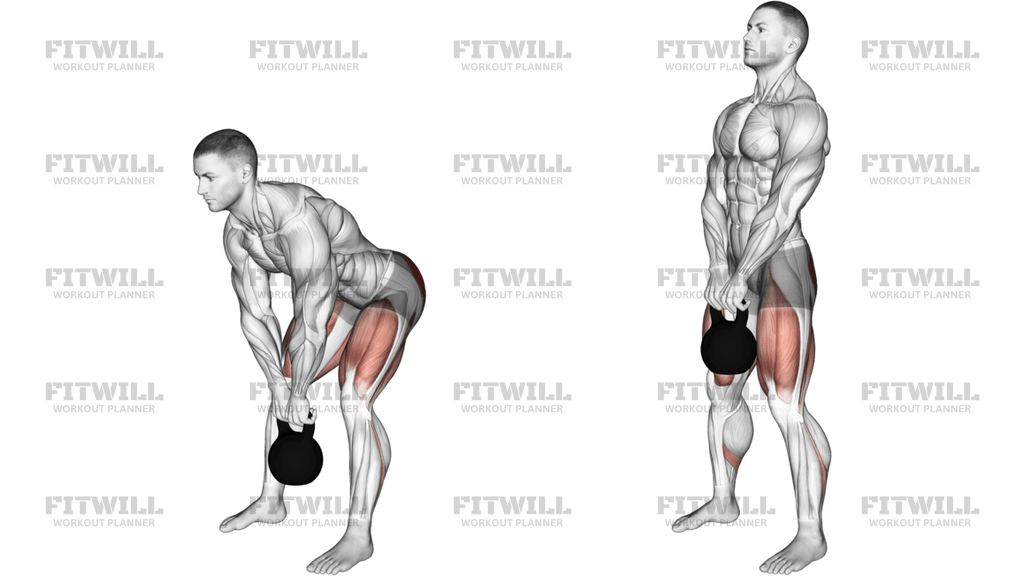
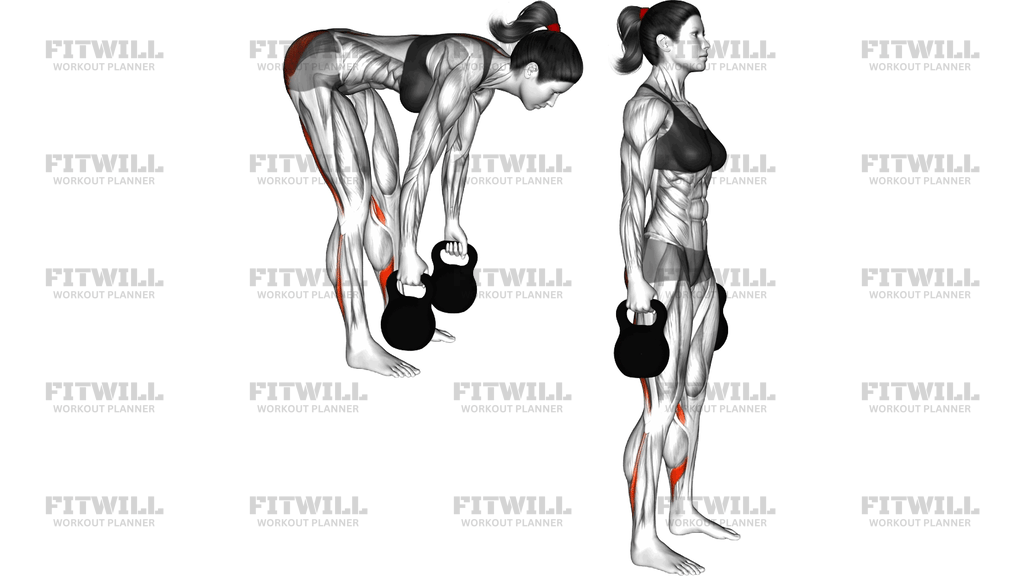
Kettlebell Stiff Leg Deadlift
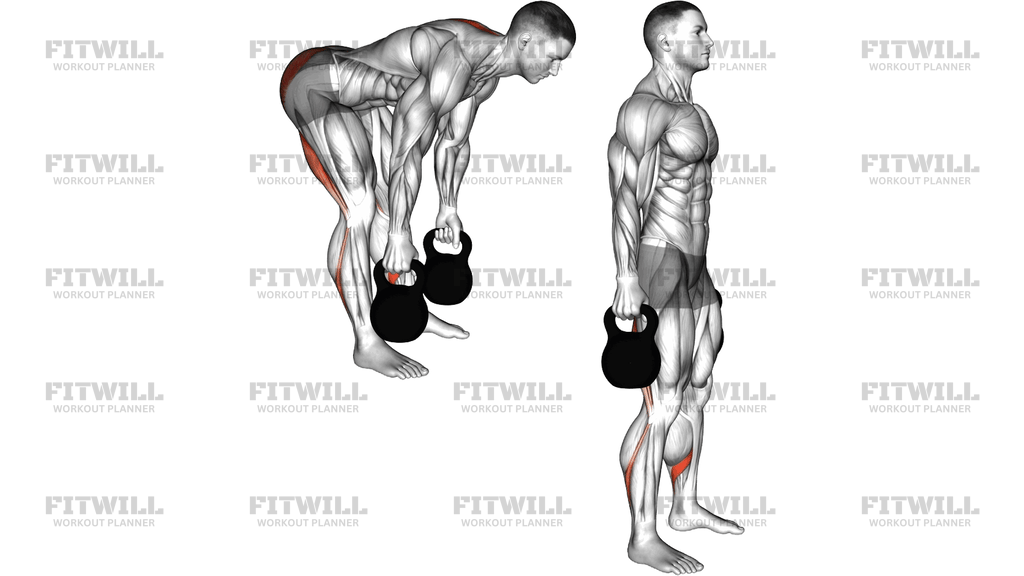
The Kettlebell Stiff Leg Deadlift is a hip-hinge pattern performed with a kettlebell held in one hand at your side. Unlike a conventional deadlift, your knees stay only slightly bent and do not travel forward, which shifts nearly all of the work into the hamstrings and glutes as they lengthen under load and then drive you back upright. Because the weight hangs from one arm, this version also demands more from your grip, lats, and trunk stabilizers than a two-handed variation.
This exercise suits anyone who wants to build posterior chain strength without loading a barbell across the back. Lifters who feel stiff through the hamstrings, desk workers whose hips have gotten tight from sitting, and beginners learning what a true hip hinge feels like can all benefit. It is also a practical accessory for stronger deadlifts, squats, and sprinting, since it trains the hamstrings in a stretched position that most gym movements never reach.
The setup matters more than people expect. Your feet, hips, and shoulder blade on the working side need to stay square and stacked, or the single-sided load will twist you toward the kettlebell. Keeping a soft bend in the knees, pushing the hips straight back, and letting the kettlebell track close to your leg creates a clean line of pull that protects the lower back.
To execute it well, stand tall with the kettlebell in one hand, brace your core, and hinge by driving the hips rearward until you feel a strong stretch along the back of the thigh. The torso lowers forward while the shoulders stay pulled down and the chest stays open. Reverse the motion by squeezing the glute on the working side and pressing the hips forward until you are standing fully upright again.
You will see this movement programmed as a main hamstring builder, as a warm-up activation drill with a light bell, or as an accessory on lower body days. Start with a moderate weight you can lower slowly for 8 to 12 reps per side, and stop each rep at the point where your back begins to round. If you cannot keep a flat back at depth, reduce the range rather than forcing the bell toward the floor.
[ Workout Log & Planner ]
Put your next workout in Fitwill
Keep your plan and training log ready when you are.


Instructions
- Stand with your feet about hip-width apart and place a kettlebell just outside your right foot.
- Hinge down with a flat back, grip the kettlebell handle with your right hand, then stand up tall so the bell hangs at your side at arm's length.
- Set your shoulders back and down, keep a slight bend in both knees, and brace your abs as if bracing for a light punch.
- Push your hips straight back, letting your torso lean forward while the kettlebell slides down close to the front of your leg.
- Keep the knee angle fixed; your shins stay nearly vertical and the knees do not bend further as you descend.
- Lower until you feel a deep stretch in the right hamstring or until your back just begins to round, whichever comes first.
- Drive your hips forward and squeeze the right glute to return to a full standing position with the bell back at your side.
- Exhale as you stand up, inhale at the top, and take a fresh breath before each heavy rep.
- Complete all reps on one side, then switch the kettlebell to your left hand and repeat.
- Set the kettlebell down on the floor with a flat back between sets rather than dropping it from a hinge.
Tips & Tricks
- Think 'push the hips back, not down.' Squatting into the rep bends the knees and steals tension from the hamstrings, which defeats the purpose of the stiff leg version.
- If your lower back rounds at the bottom, you have gone past your hamstring range. Cut the depth a few inches and build up gradually instead of chasing the floor.
- Counterbalance the single-sided load by reaching your free arm out slightly to the opposite side. This keeps your chest square and stops your torso from rotating toward the kettlebell.
- Keep the kettlebell handle brushing along your thigh and shin. When the bell drifts forward, the stress moves to your lower back and away from your hamstrings.
- Your neck is part of your spine. Pick a spot on the floor a couple of feet ahead of you and keep it there through the whole rep rather than craning up at the bottom.
- Squeeze the handle hard. A firm grip increases shoulder stability on the working side and makes the hinge feel noticeably more secure.
- Move slowly on the way down, around two to three seconds. The lowering phase is where the hamstrings get most of the benefit, and rushing it usually turns the rep into a rounded-back grab.
- If one hamstring feels tighter than the other, start with your tighter side, match the reps on the stronger side, and consider holding your free hand on a rack for balance until both sides move the same way.
Frequently Asked Questions
Which muscles does the Kettlebell Stiff Leg Deadlift work?
The hamstrings and glutes do the main work of extending the hips, while the lower back, grip, and trunk stabilizers hold your spine and shoulders in position throughout the hinge.
How is the Kettlebell Stiff Leg Deadlift different from a Romanian deadlift?
The stiff leg version keeps the knees nearly straight with the hips sitting higher, which places a greater stretch on the hamstrings, while a Romanian deadlift allows a bit more knee bend and typically loads through both hands.
Can beginners do the Kettlebell Stiff Leg Deadlift?
Yes, and it is actually a good first hinge for beginners because the light, single-handed load makes it easy to feel the hamstrings working. Start with a weight you can control for 10 to 12 slow reps and prioritize a flat back over depth.
How far down should I lower the kettlebell?
Lower only until you feel a strong hamstring stretch with your back still flat, which for most people is around mid-shin level. Forcing the bell to the floor with a rounded spine shifts the stress to your lower back.
Why does my lower back feel this exercise instead of my hamstrings?
This usually means your hips are drifting forward as you hinge, your back is rounding at the bottom, or the kettlebell is swinging away from your leg. Sit your hips further back, keep the bell close to your thigh, and stop the descent before your back rounds.
Should I do the Kettlebell Stiff Leg Deadlift with one kettlebell or two?
One kettlebell adds an anti-rotation challenge for your core and lets you spot side-to-side differences, while two kettlebells allow heavier loading with a more stable torso. Both are valid; start single-sided until your hinge feels solid.
How many reps and sets should I use?
For muscle and strength in the hamstrings and glutes, 3 to 4 sets of 8 to 12 reps per side works well. For learning the hinge pattern or warming up, 2 sets of 10 reps with a light bell is enough.
What can I use if I do not have a kettlebell?
A dumbbell works with almost identical technique, and a barbell stiff leg deadlift is a heavier two-handed option. A resistance band under your feet is another substitute for learning the hinge with minimal load.
Is it safe for people with lower back issues?
The movement is spine-friendly when the back stays neutral and the load stays modest, but anyone with an existing back condition should get clearance from a qualified professional first and begin with a very light weight or a band.