Kettlebell Deadlift From Deficit
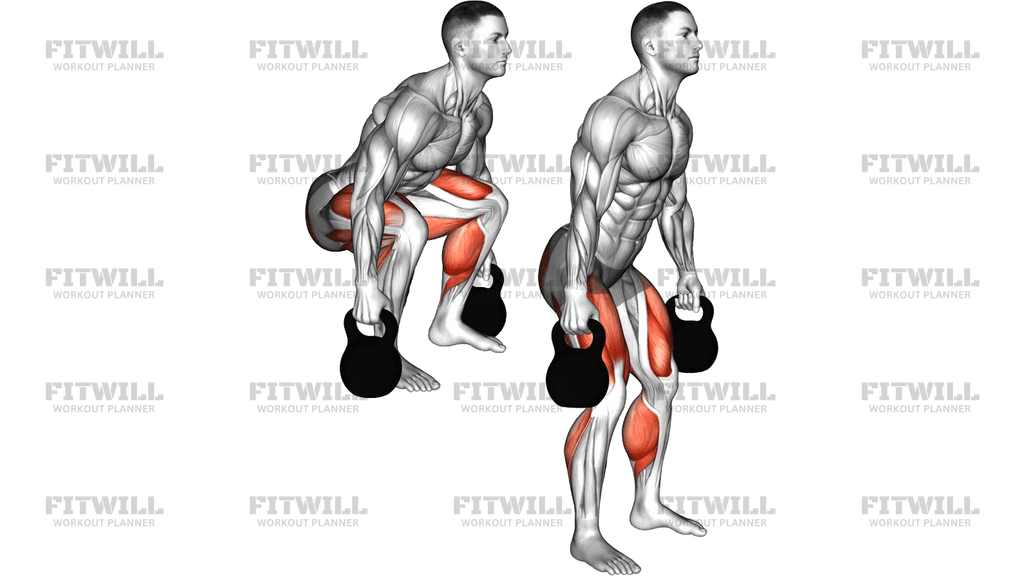
The Kettlebell Deadlift From Deficit is a hip-hinge pattern performed while standing on a raised surface, usually a weight plate or low step, with a kettlebell in each hand. The added height under your feet means the kettlebells hang lower than they would in a standard deadlift, so you have to reach deeper into the hinge before the plates touch the floor. That extra range is the whole point: it stretches the hamstrings and glutes under load and forces your back and hips to work through a longer path than a conventional kettlebell deadlift.
This variation suits lifters who already own a solid conventional hinge and want to build more strength at the bottom of the movement. It is popular for strengthening the posterior chain, improving hamstring flexibility under load, and preparing the hips for heavier barbell deadlifting. Because you hold one kettlebell in each hand, the load splits evenly side to side, which many people find friendlier for the lower back than a single heavy bell held in front.
The setup matters more here than in a standard deadlift. Standing on a deficit changes your start position: your torso will sit lower and your knees will travel slightly further forward unless you deliberately push your hips back. The platform must be stable and low to start with, since the deeper you go the more demand is placed on your hamstrings and spinal erectors to hold a flat back.
To execute it well, plant your feet firmly on the platform, hinge by sending your hips back rather than squatting down, and let the kettlebells track close to your legs the entire way. Keep the chest proud and the spine long, drive the floor away through your whole foot, and finish tall by squeezing the glutes rather than leaning back. On the way down, reverse the path with control instead of dropping into the bottom.
Common mistakes include going too deep too soon, rounding the lower back to reach the floor, and letting the kettlebells drift away from the shins. Start with a modest deficit, moderate weights, and fewer reps than a normal deadlift set, since the stretched position is more fatiguing. Anyone with limited hamstring mobility or a history of lower back irritation should build up gradually or stick to a standard kettlebell deadlift until the deeper hinge feels comfortable.
[ Workout Log & Planner ]
Put your next workout in Fitwill
Keep your plan and training log ready when you are.


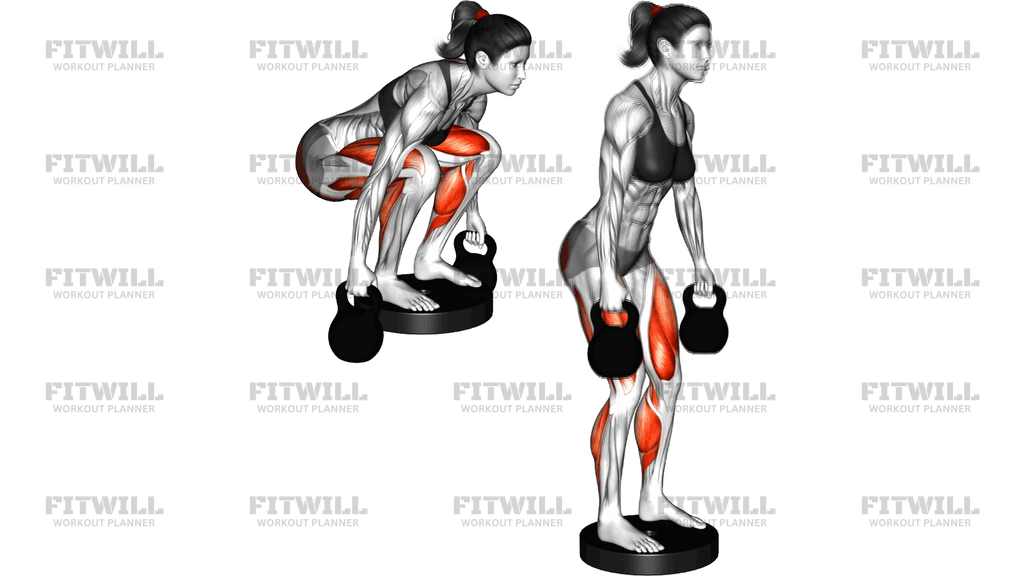
Instructions
- Place a stable weight plate or low step platform on the floor and set one kettlebell on each side of it, just outside your feet.
- Step onto the platform with your feet roughly hip-width apart, toes pointing slightly out, so the kettlebells hang beside your shins when you reach down.
- Hinge at the hips and bend your knees enough to grip each kettlebell handle with a firm overhand grip, arms hanging straight down from your shoulders.
- Pull your hips back until your shoulders sit slightly above hip height, then lift your chest, flatten your back, and brace your core as if bracing for a light punch.
- Drive your whole foot into the platform and stand up by extending your hips and knees together, letting the kettlebells slide up close to your legs.
- Finish standing tall with hips fully extended, glutes squeezed, shoulders back, and the kettlebells hanging at your sides rather than out in front.
- Lower under control by pushing your hips back first, keeping the kettlebells in contact with your legs until the bells touch the floor on either side of the platform.
- Exhale as you drive up, and take a fresh breath at the top or bottom before each rep, never holding your breath through the whole set.
- Reset your brace and stance after every rep or every couple of reps, especially once fatigue makes the bottom position harder to hold.
- Once the set is done, step off the platform carefully before setting the kettlebells down fully if the floor space is tight.
Tips & Tricks
- Keep the kettlebell handles roughly over the middle of your feet, not in front of your toes, or the weight will pull your chest down and round your lower back at the bottom.
- If your back rounds before the bells reach the floor, shrink the deficit; a 1 to 2 inch platform is plenty for most lifters starting out.
- Think hips back, not down. Lifting from a deficit tempts people to squat deeper, which turns the movement into a squat and shifts work away from the glutes and hamstrings.
- Chalk or a firm grip helps here, because two kettlebells held at full stretch will test your grip before your hips give out.
- Do not lock out by leaning back or overextending the lower back; standing tall with glutes engaged is enough.
- Warm up with a standard kettlebell deadlift from the floor first so your hips and hamstrings are ready for the deeper range.
- Lower the bells slightly slower than you lift them, but avoid crawling through the eccentric; the stretched bottom position fatigues quickly.
- If one bell drifts forward and the other back, slow down and check that your feet are even on the platform and your grip pressure is equal in both hands.
- Keep your neck neutral by looking at a spot on the floor about a metre ahead of you rather than craning up to the mirror.
Frequently Asked Questions
What does the deficit add to the Kettlebell Deadlift From Deficit compared with a regular kettlebell deadlift?
Standing on a platform makes the kettlebells hang lower, so your hips travel further back and the bells reach a deeper point. This lengthens the range of motion and puts more stretch-loaded work on the glutes and hamstrings at the bottom.
Which muscles does the Kettlebell Deadlift From Deficit work?
The glutes and hamstrings do most of the work, with strong support from the quads, lower back, and grip. Your core stays busy bracing the trunk through the longer range.
Is the Kettlebell Deadlift From Deficit suitable for beginners?
It is better treated as a step up from the standard kettlebell deadlift. Learn a flat-backed hinge from the floor first, then add a small deficit of one to two inches once the bottom position feels controlled.
How high should the deficit platform be?
Start with one standard weight plate or a low step of about one to two inches. Go only as high as you can while keeping your spine neutral and the kettlebells tracking close to your legs.
Why do my lower back and hamstrings feel stretched at the bottom of the Kettlebell Deadlift From Deficit?
That deep hinge is the intended effect of the deficit, and the hamstrings and spinal erectors work hardest there. A stretch sensation is normal, but sharp back discomfort or a rounding spine means the deficit is too tall or the weight too heavy.
Should I use one kettlebell or two for this exercise?
The setup shown uses one kettlebell in each hand, which balances the load evenly across both sides of your body. A single bell held in front of the platform is harder to position without drifting forward, so two bells make the deficit version cleaner.
What is the most common mistake in this exercise?
Rounding the lower back to reach the floor is the biggest one. The fix is a lower platform, lighter bells, and deliberately pushing the hips back so the reach comes from the hinge rather than the spine.
What can I substitute if I do not have a stable platform?
A standard Kettlebell Deadlift from the floor trains the same pattern with a shorter range, and a Romanian deadlift with kettlebells emphasises the hamstring stretch without needing any equipment under your feet.
How many reps and sets should I do?
Because the stretched bottom position is more demanding, start with 3 to 4 sets of 5 to 8 reps at a moderate weight. Add load or a small deficit only when every rep still looks identical to the first.
Is it safe to deadlift while standing on a plate?
Yes, provided the surface is stable, flat, and cannot slide, and you step off rather than across it when finished. Avoid stacking wobbly or uneven plates, and keep the movement slower than a floor deadlift while you adapt.