Dumbbell One-Arm French Press On Exercise Ball
Dumbbell One-Arm French Press On Exercise Ball is a single-arm triceps extension performed while lying with your upper back supported on a stability ball. The moving elbow stays near vertical while the forearm lowers the dumbbell behind the head and then returns to a straight-arm finish. That setup makes the triceps do the work while the ball adds a balance demand that exposes sloppy rib flare, shifting hips, and overreaching through the shoulder.
The main target is the triceps, especially the long head, with the shoulders, forearms, and core helping stabilize the arm and torso. In anatomy terms, the primary work centers on the triceps brachii, while the anterior deltoid, forearm flexors, and rectus abdominis help keep the rep organized. Because the body is supported on the ball instead of a bench, lighter loads and cleaner control usually produce a better training effect than chasing heavy weight.
The setup matters more here than on a flat bench. Your upper back should be centered on the ball, feet planted firmly, and hips lifted enough that the torso stays braced rather than sagging. Keep the working upper arm mostly vertical and let only the elbow open and close; if the shoulder drifts or the rib cage pops up, the movement turns into a less useful press and the triceps lose tension.
Use a smooth lowering phase to create a clear stretch behind the head, then drive back to the top by extending the elbow without locking hard or swinging the dumbbell. The free hand can lightly steady the ball or rest across the body, but it should not help press the weight. This is a useful accessory exercise for arm-focused sessions, upper-body split work, or core-aware strength training when you want triceps work plus a stability challenge.
Because the exercise combines a long lever, a small support surface, and a single working arm, it rewards patience and good load selection. A beginner can use it if the dumbbell is light enough to keep the ball still and the elbow path consistent. Stop the set if your hips start twisting, your lower back arches to finish the rep, or the dumbbell starts drifting toward a pullover pattern instead of a triceps extension.
Fitwill
Log Workouts, Track Progress & Build Strength.
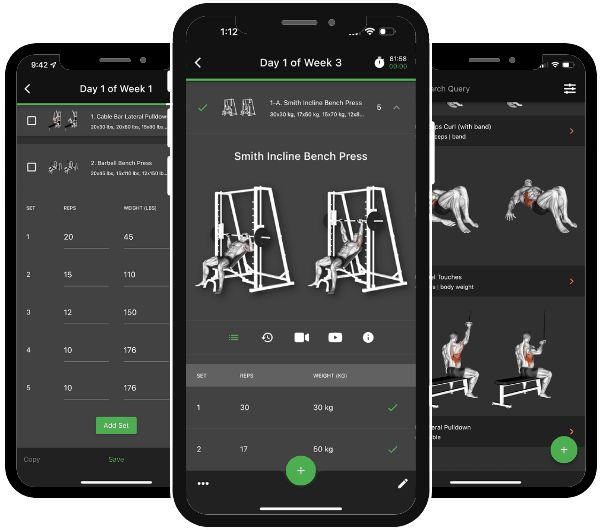
Achieve more with Fitwill: explore over 5000 exercises with images and videos, access built-in and custom workouts, perfect for both gym and home sessions, and see real results.
Start your journey. Download today!


Instructions
- Sit with a dumbbell in one hand, then lie back so your upper back is centered on the exercise ball and both feet stay flat and about hip-width apart.
- Lift your hips until your torso is roughly level, then hold the dumbbell above the working shoulder with your elbow pointing toward the ceiling.
- Keep the free hand lightly on the ball or across your torso so the rib cage and hips stay steady.
- Brace your abs and glutes, then start with the forearm nearly vertical and the wrist stacked over the elbow.
- Bend only at the elbow to lower the dumbbell in a controlled arc behind your head.
- Stop when you feel a strong triceps stretch and the upper arm is still mostly fixed in place.
- Exhale as you extend the elbow and press the dumbbell back to a straight-arm finish above the shoulder.
- Lower the weight again with control for each repetition, then switch sides after the set is complete.
Tips & Tricks
- Keep the working upper arm nearly vertical; if it starts drifting toward your face or ear, the dumbbell is probably too heavy.
- Press the upper back into the ball, but do not let the ball slide under your neck or low back.
- Squeeze the glutes lightly so the hips do not sag when the dumbbell reaches the bottom position.
- Use a neutral wrist and keep the knuckles pointed up instead of letting the dumbbell fold the wrist back.
- Lower the dumbbell slowly enough to feel the triceps stretch, then reverse the rep without bouncing out of the bottom.
- If the shoulder feels crowded, shorten the range slightly and keep the elbow from traveling too far behind the head.
- Keep both feet planted wide enough to stop the ball from rolling as the load changes side to side.
- Choose a weight that lets you keep the torso square; visible twisting is a sign the set has become too ambitious.
Frequently Asked Questions
What does Dumbbell One-Arm French Press On Exercise Ball train most?
It primarily trains the triceps, with the shoulders, forearms, and core helping stabilize the single-arm position on the ball.
Why use an exercise ball instead of a flat bench?
The ball adds an instability challenge that makes the trunk and shoulder stabilizers work harder, but it also means you should use lighter, cleaner reps.
How should my upper arm move during the rep?
The upper arm should stay mostly fixed and vertical while the elbow bends and straightens; if the shoulder is moving a lot, the load is too heavy or the setup is off.
How far should I lower the dumbbell behind my head?
Lower it until you feel a strong triceps stretch and can still keep the elbow pointed up without the rib cage flaring or the shoulder drifting forward.
Is this the same as a skull crusher?
It is a close single-arm triceps-extension variation, but the exercise ball makes the torso less stable than a bench-based skull crusher.
Can beginners do this safely?
Yes, if they start with a light dumbbell, keep both feet planted, and avoid letting the ball roll as the arm moves.
What is the most common form mistake?
The most common error is turning the rep into a shoulder-driven press or pullover instead of isolating elbow extension.
Should the free hand help me press the weight?
No. The free hand can lightly steady the ball or torso, but the working arm should do the lifting and lowering on its own.