Dumbbell Single Leg Deadlift
Dumbbell Single Leg Deadlift is a unilateral hip hinge that builds hamstring, glute, and trunk control while challenging balance at the same time. The movement asks one leg to support your body as the torso tips forward and the free leg reaches back, so the exercise is as much about control and alignment as it is about strength. It is especially useful when you want to train the posterior chain without loading both legs equally or when you need to clean up side-to-side differences in balance and hip stability.
The setup matters because the exercise works best when the pelvis stays square and the standing foot does the job. Hold the dumbbells by your sides, soften the knee of the working leg, and find a tripod foot on the floor with pressure through the heel, base of the big toe, and base of the little toe. The back leg should lift behind you as a counterbalance, not swing open to the side. If the hips rotate or the ribs flare, the movement usually turns into a balancing act instead of a clean hinge.
As you descend, send the hips straight back and let the dumbbells travel close to the standing leg. The torso and back leg should form a long line, with the spine staying neutral and the neck in line with the rest of the body. Lower only as far as you can keep the pelvis level and the standing knee steady. A brief pause near the bottom helps you own the position before you drive the floor away and stand back up by squeezing the glute of the working side.
This exercise is a strong option for accessory lower-body work, athletic prep, and warmups for people who need better single-leg stability. It teaches you to control hip flexion and extension without relying on momentum, which carries over to running, jumping, changing direction, and everyday lifting. Because balance can limit the load before strength does, lighter dumbbells with pristine positions are usually more productive than chasing heavy weight too early.
Dumbbell Single Leg Deadlift is also a useful screen for asymmetries. If one side feels shaky, you may need a shorter range, slower lowering phase, or a lighter load on that side until the hinge pattern is even. Done well, the rep should feel like a controlled stretch through the hamstrings with a strong glute drive on the way up, not like the lower back is doing the work. Keep the movement smooth, deliberate, and repeatable so each rep starts from the same balanced position.
[ Workout Log & Planner ]
Put your next workout in Fitwill
Keep your plan and training log ready when you are.


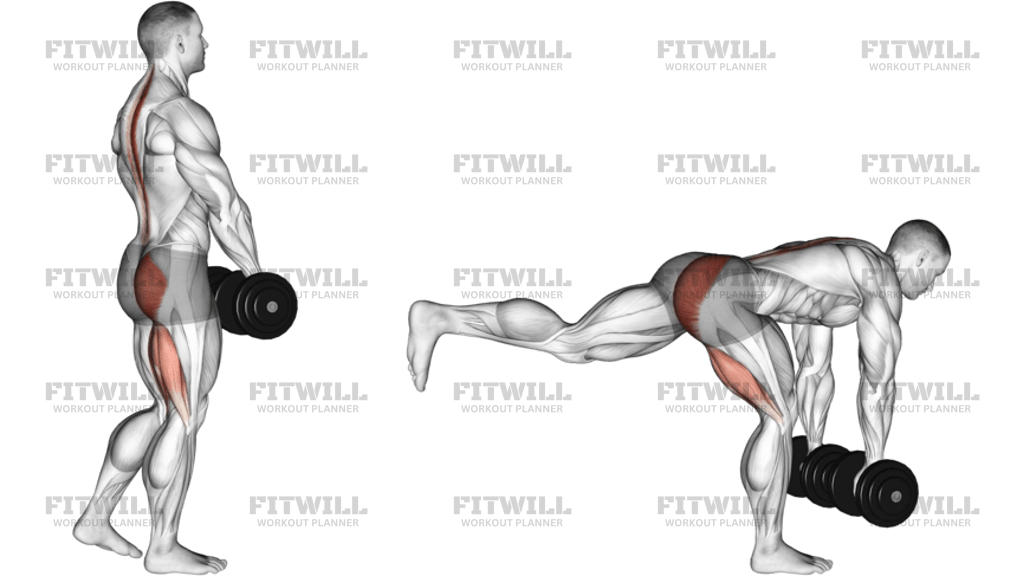
Instructions
- Stand tall with a dumbbell in each hand, feet about hip-width apart, and shift your weight onto one leg before you start the rep.
- Soften the knee of the standing leg and brace your torso while keeping both dumbbells hanging close to your thighs.
- Lift the free leg slightly behind you so it acts as a counterbalance and keep both hip bones facing the floor.
- Push the hips straight back and tip the torso forward until the dumbbells slide down the standing leg.
- Keep the standing shin nearly vertical and let the back leg reach long behind you instead of opening out to the side.
- Lower until you feel a strong hamstring stretch or until your back stays flat and your pelvis remains level.
- Pause briefly at the bottom without letting the dumbbells drift away from the leg.
- Drive through the heel and midfoot of the standing leg to return to standing, squeezing the glute at the top.
- Lower the lifted foot back to the floor only after you have fully finished the rep and reset your balance before the next one.
Tips & Tricks
- Keep the dumbbells brushing close to the standing thigh and shin so the load does not pull you forward.
- Think about sending the hips back, not reaching the chest down, to keep the hinge loaded in the hamstrings.
- A slight bend in the standing knee is useful; locking the knee usually makes the balance harder and the hinge less smooth.
- If the pelvis opens toward the lifted leg, shorten the range and slow the descent until both hip bones stay square.
- Use a wall, rack post, or fingertip support at first if the ankle of the standing leg wobbles before the hinge is strong.
- Choose lighter dumbbells than you would for a two-leg deadlift because balance will usually limit the load first.
- Stop the lowering phase before the lower back rounds, even if that means the dumbbells do not reach the floor.
- Let the back foot stay long and active behind you; do not let it swing high or twist outward.
- On the way up, drive the floor away with the standing leg instead of yanking the torso upright with the lower back.
Frequently Asked Questions
What does Dumbbell Single Leg Deadlift work most?
It primarily targets the hamstrings and glutes on the standing side, with the core and smaller hip stabilizers working hard to keep the pelvis level.
Should I hold one dumbbell or two in Dumbbell Single Leg Deadlift?
Both versions work, but the image shows a dumbbell in each hand. Two dumbbells keep the load centered, while one dumbbell can be useful if you want to practice balance with a lighter setup.
How low should the dumbbells go in Dumbbell Single Leg Deadlift?
Lower only until you can keep a flat back, square hips, and a steady standing foot. The right depth is the point where you feel the hamstring stretch without the pelvis tipping open.
Can beginners do Dumbbell Single Leg Deadlift?
Yes, but they should start with very light dumbbells or even a bodyweight hinge near a wall. The balance demand is often the hardest part, not the strength demand.
What is the most common mistake in Dumbbell Single Leg Deadlift?
Letting the hips rotate open or letting the dumbbells drift far away from the standing leg. Both errors make the movement less stable and shift stress away from the target side.
Should my back leg stay straight in Dumbbell Single Leg Deadlift?
It should stay long and active, but you do not need to lock the knee hard. Think of it as a counterbalance line behind you rather than a second working leg.
Why do I feel Dumbbell Single Leg Deadlift in my lower back?
That usually means the hinge is too deep, the dumbbells are drifting away, or the ribs are flaring. Shorten the range, keep the weights close, and push the hips back more deliberately.
Can I use Dumbbell Single Leg Deadlift in a warmup?
Yes. It works well in a warmup when you use a light load, slow tempo, and a smaller range to wake up the glutes, hamstrings, and balance system.