Cable Lying Fly
Cable Lying Fly is a flat-bench cable fly variation that keeps constant tension on the chest through a wide horizontal arc. Lying between two cable stacks lets you load the pecs without turning the movement into a press, which makes it useful for chest-focused hypertrophy work, finishers after pressing, or controlled accessory work when you want the chest to do the job instead of the shoulders and triceps.
The setup matters because the cable angle, bench position, and arm path decide where the tension lands. With the bench centered between the pulleys, the handles should travel from a stretched position out beside the torso to a meeting point over the mid-chest. That line of pull keeps the pectoralis major as the main driver while the anterior deltoids, triceps brachii, and core help stabilize the shoulders, elbows, and ribcage.
A good repetition starts before the handles move. Lie flat with your head, upper back, and glutes supported, plant your feet, and keep a slight bend in the elbows so the movement stays a fly and not a press. From there, the chest should open under control as the arms lower, then contract to bring the handles together without bouncing them off each other or shrugging the shoulders forward.
Cable Lying Fly works well when you want to isolate the chest with a smoother resistance curve than dumbbell flyes. It is also a good option for lifters who want more control in the stretched position and less need to balance free weights over the shoulder joint. The exercise still demands discipline: if the elbows drop too far, the shoulders roll off the bench, or the load is too heavy, the movement quickly turns into a shoulder-dominant grind.
Use a lighter load than you would for pressing, because the goal is a clean chest contraction, not a maximal rep. The best reps look symmetrical, deliberate, and quiet, with the handles traveling in a consistent arc and the torso staying anchored to the bench. When performed well, Cable Lying Fly gives the chest a long-range contraction and a deep stretch without sacrificing control at the bottom.
[ Workout Log & Planner ]
Put your next workout in Fitwill
Keep your plan and training log ready when you are.


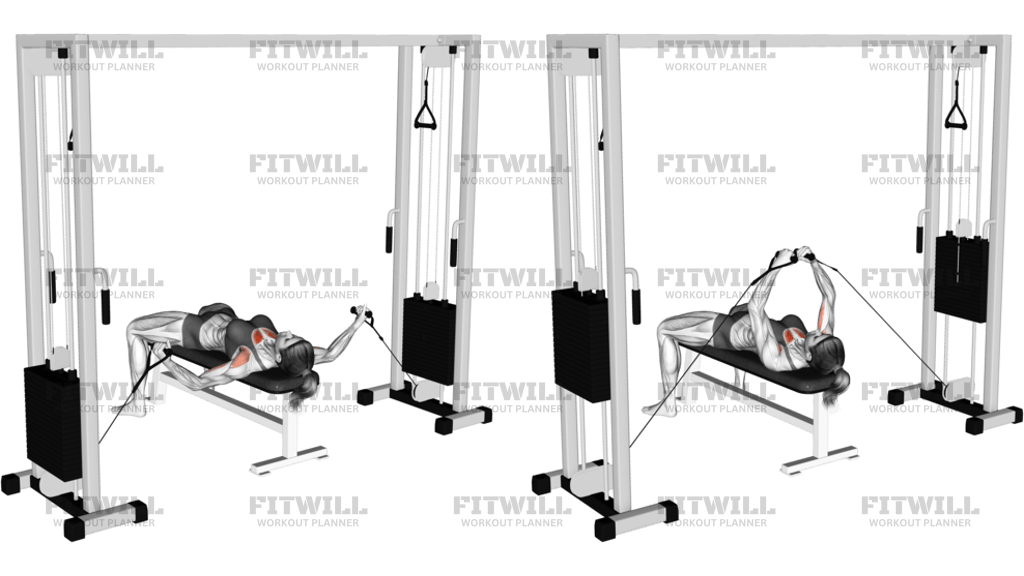
Instructions
- Place a flat bench between two low cable pulleys and clip a handle attachment to each side.
- Sit on the bench, hold both handles, and lie back with your head, upper back, and glutes supported on the pad.
- Plant both feet firmly on the floor and keep your chest open with a slight bend in each elbow.
- Start with your arms opened out to the sides so the handles are just below chest level and your palms face each other.
- Set your shoulders down and back against the bench, then brace your core before the first rep.
- Inhale as you lower the handles in a wide arc until you feel a stretch across the chest without letting the shoulders roll forward.
- Exhale as you bring the handles together over the middle of your chest, keeping the elbow angle almost fixed.
- Pause briefly at the top, then lower the handles back to the open position under control for the next rep.
- After the final rep, guide the handles back to the sides, sit up slowly, and step away from the bench safely.
Tips & Tricks
- Keep the bench centered so both cables pull evenly; if one side feels heavier, reposition before starting the set.
- Use a soft elbow bend and keep that angle mostly fixed so the movement stays a fly instead of becoming a press.
- Lower only until the chest stretches and the upper arms are roughly in line with the torso; going deeper can pull the shoulders forward.
- Choose a load that lets you bring the handles together without jerking or tapping them hard at the top.
- Keep your shoulder blades pinned to the bench instead of letting them slide up toward your ears on the way up.
- Let the cables do the work through the full arc; if your ribs pop up, the weight is too heavy.
- Move slowly on the lowering phase so the chest stays under tension instead of dropping into the bottom position.
- Keep your wrists stacked over the handles so the forearms do not collapse backward at the top.
- Stop the set when the handles start drifting unevenly or your front shoulders take over the finish.
Frequently Asked Questions
What muscle does Cable Lying Fly target most?
Cable Lying Fly mainly targets the chest, especially the pectoralis major. The shoulders and triceps help stabilize, but they should not take over the movement.
How should the bench be positioned for Cable Lying Fly?
Place the bench between two low pulleys so each handle can travel in a balanced arc beside your torso. The setup should let you lower the arms without the cables rubbing the bench or pulling you sideways.
How bent should my elbows be during Cable Lying Fly?
Keep a small, fixed bend in the elbows from start to finish. If the elbows keep changing angle, the exercise starts turning into a press and the chest loses tension.
How far down should I lower the handles?
Lower until you feel a strong chest stretch and your upper arms are near torso level, then stop before the shoulders roll forward. The bottom position should feel loaded, not strained.
Can beginners do Cable Lying Fly safely?
Yes, if they start with very light resistance and a short range of motion. A beginner should prioritize smooth control and a stable bench position before adding load.
Why do my front shoulders feel this more than my chest?
That usually means the load is too heavy, the bench is too high or low for the cable line, or the shoulders are drifting forward at the top. Reduce the weight and keep the chest open on the bench.
What makes Cable Lying Fly different from dumbbell flyes?
The cables keep tension on the chest through the whole rep, especially near the top. Dumbbells get lighter at the top, while cables stay loaded as the hands come together.
Where should I put Cable Lying Fly in my workout?
It usually fits best after compound presses or as a finishing chest isolation movement. That way you can use it to add volume without needing a very heavy load.