Dumbbell Single Leg Deadlift With Stepbox Support
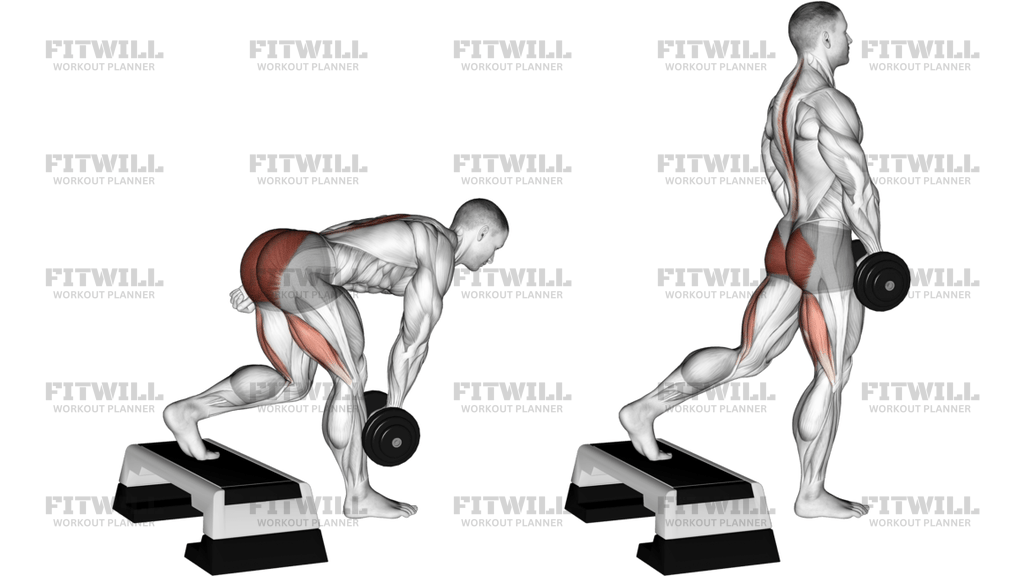
Dumbbell Single Leg Deadlift With Stepbox Support is a supported hip-hinge exercise that trains balance, posterior-chain strength, and pelvic control. One foot stays on the floor as the working leg while the rear foot rests lightly on the stepbox for stability. The dumbbell hangs in the hand on the working-leg side, which makes the hinge feel natural and helps you load the glute, hamstring, and hip of the standing leg without turning the movement into a squat.
The stepbox is there to steady you, not to carry the rep. That support lets you focus on a clean single-leg deadlift pattern: hips travel back, torso folds forward with a long spine, and the standing leg stays softly bent while the free leg reaches behind you. Because the exercise challenges balance as well as strength, small setup errors are obvious. If your stance is too narrow, your pelvis twists, or you lose the line from head to tailbone, the dumbbell will drift and the rep will turn sloppy.
Use the exercise to build single-leg strength for lower-body sessions, accessory work, or warmups that need controlled tension rather than maximum load. It is especially useful when you want more hamstring and glute work than a standard deadlift variation can give, but you still want the rear foot available as a light balance point. Keep the movement smooth and deliberate so the standing leg does the work and the back foot only helps you stay organized.
As you lower, think about sending the hips straight back and the dumbbell straight down toward the floor rather than reaching forward with your shoulders. At the bottom, your torso should be angled forward while the back leg extends behind you and the pelvis stays mostly square. Drive up by pressing through the whole foot of the standing leg and squeezing the glute to finish tall. If the dumbbell pulls you off balance, shorten the range or reduce the load instead of chasing depth.
This variation should feel challenging but controlled, with tension in the standing hamstring, glute, and hip stabilizers and very little stress in the low back. Because the rear foot on the stepbox reduces some balance demand, it is a practical bridge between bilateral deadlifts and a true unsupported single-leg deadlift. Treat each rep as a setup-and-hinge drill: stable start, clean descent, pause only if you can hold position, then stand up without rocking or twisting.
Fitwill
Log Workouts, Track Progress & Build Strength.
Achieve more with Fitwill: explore over 9600 exercises with images and videos, access built-in and custom workouts, perfect for both gym and home sessions, and see real results.
Start your journey. Download today!




Instructions
- Place the stepbox behind you and rest the top of the rear foot lightly on it while the working foot stays flat on the floor.
- Hold a dumbbell in the hand on the same side as the working leg and let it hang straight under your shoulder.
- Set your pelvis square, soften the standing knee, and lengthen your spine before you start the hinge.
- Push your hips straight back and tip your torso forward until the dumbbell lowers toward the floor.
- Keep most of your weight over the standing foot and let the rear foot stay relaxed on the box for balance only.
- Lower until you feel a strong hamstring stretch and your torso stays flat rather than rounded.
- Drive through the standing heel and midfoot to return to tall standing while squeezing the glute at the top.
- Exhale as you stand up, reset your balance at the top, and repeat for the planned reps.
Tips & Tricks
- Keep the dumbbell on the same side as the standing leg so the load tracks naturally with the hinge instead of dragging you across your body.
- Use the stepbox as a light kickstand; if you are pushing hard through the rear foot, the standing leg is not doing enough work.
- Think about moving the hips back to the wall behind you, not reaching the dumbbell forward with your shoulder.
- Let the standing knee bend slightly and stay almost fixed; turning the rep into a squat will shorten the hamstring stretch.
- Keep your ribs stacked over your pelvis so the low back does not extend when you come back to the top.
- A shorter range with perfect balance is better than chasing the floor and twisting the pelvis open.
- Choose a dumbbell that lets you pause briefly in the bottom position without wobbling or setting the weight down.
- If your torso rotates toward the loading hand, lighten the weight and square the belt line before the next rep.
Frequently Asked Questions
What muscles does Dumbbell Single Leg Deadlift With Stepbox Support train most?
It mainly trains the glute, hamstring, and hip of the standing leg, with the core and upper back working to keep you square.
Why is the rear foot on a stepbox?
The box gives you a light balance point so you can focus on the single-leg hinge without losing control or tipping the pelvis.
Should the foot on the stepbox push into the platform?
No. It should stay relaxed and only help you balance; the standing leg should control the whole rep.
Which hand should hold the dumbbell?
The dumbbell is usually held in the hand on the same side as the standing leg, which makes the hip hinge easier to organize.
How low should I go in the hinge?
Lower until you feel a solid hamstring stretch and can keep your back flat and pelvis square. Do not force extra depth.
Is this more of a deadlift or a balance exercise?
It is both, but the deadlift pattern should stay dominant. The balance demand is there to challenge control, not to replace the hinge.
What should I do if I feel it in my low back?
Shorten the range, slow the descent, and keep your ribs down as you hinge back. Back discomfort usually means you are losing position or overloading the movement.
Can beginners use this version?
Yes, if they start with a very light dumbbell and use the stepbox support to learn the hinge without wobbling.