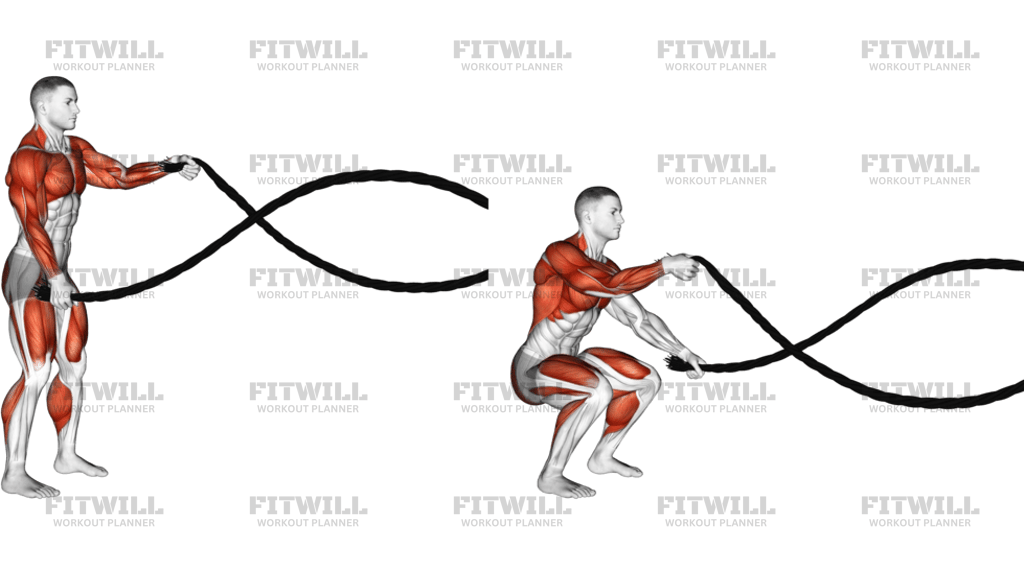
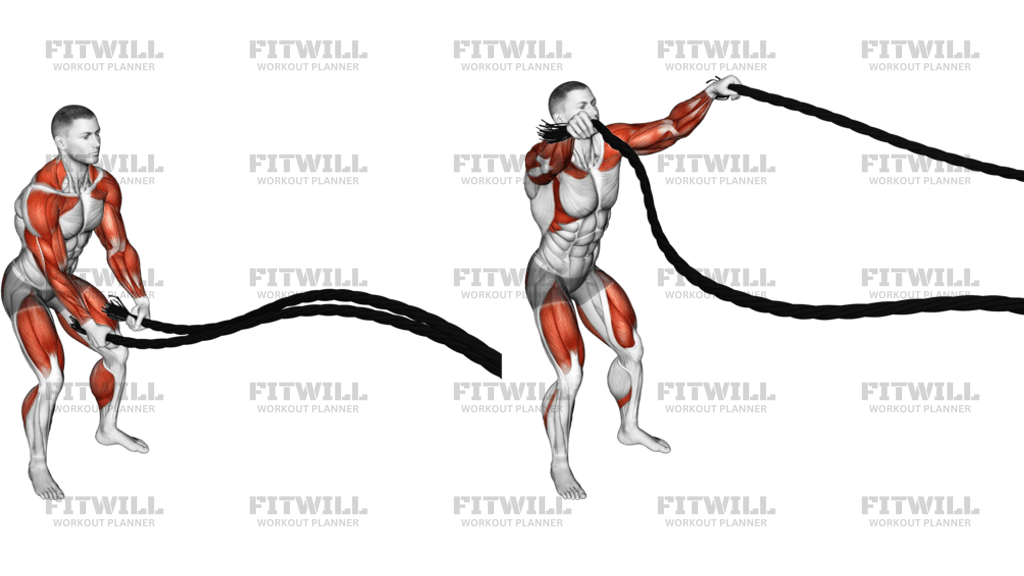
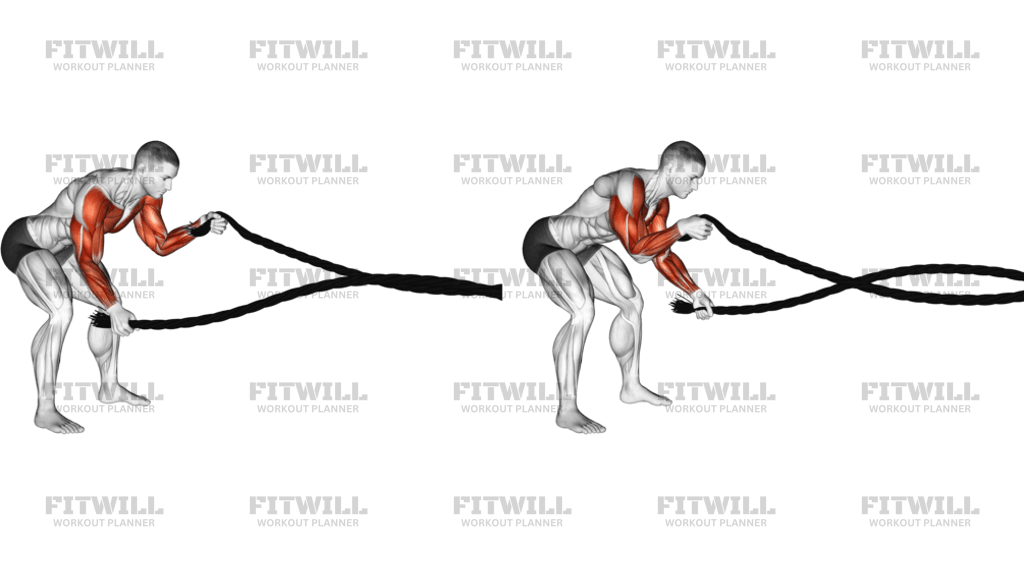
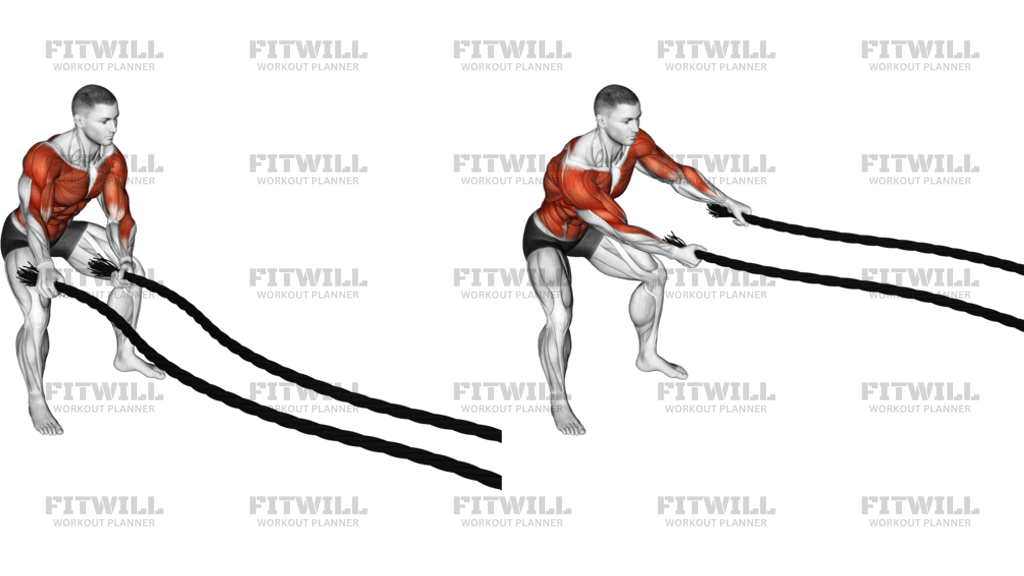
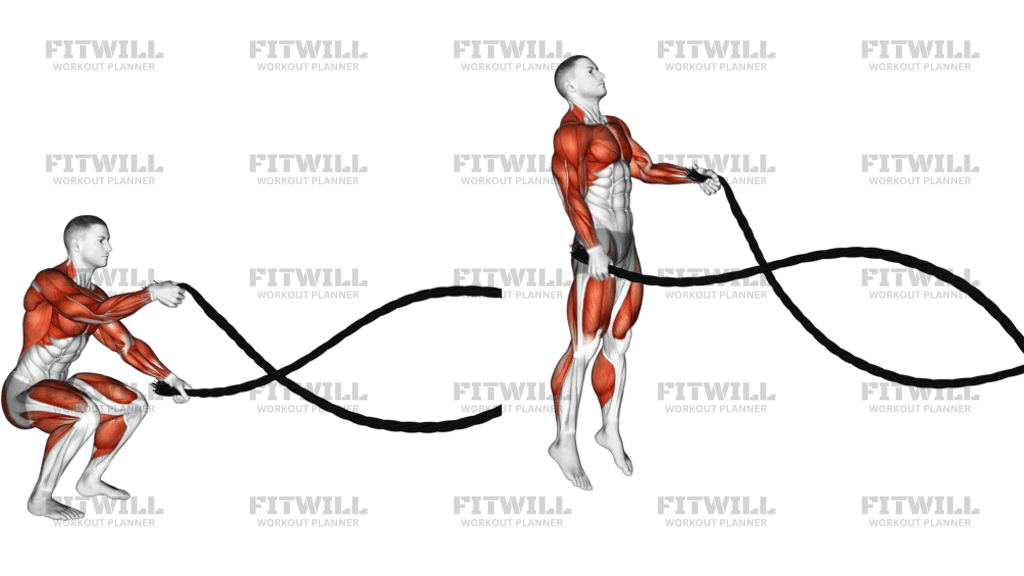
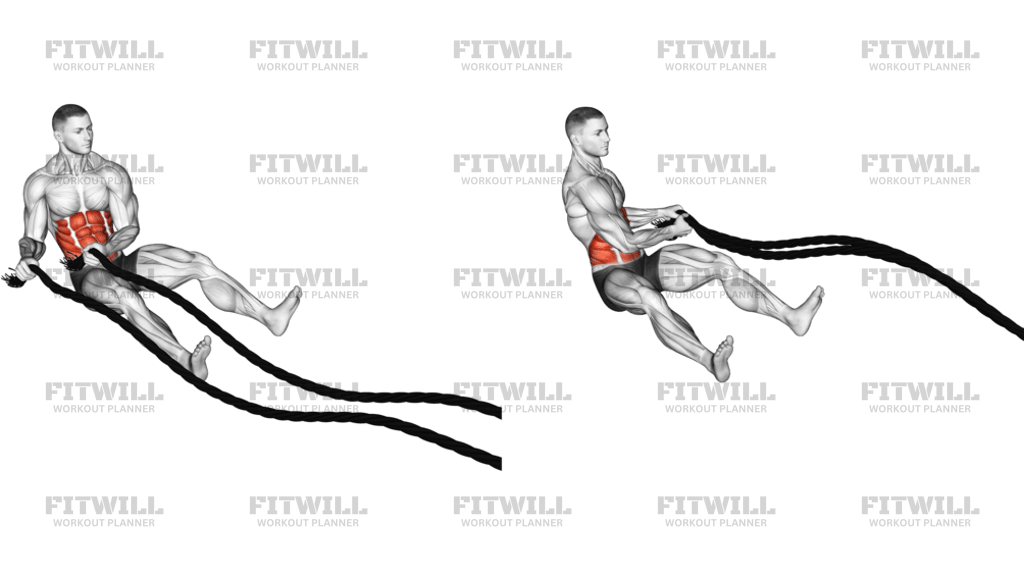
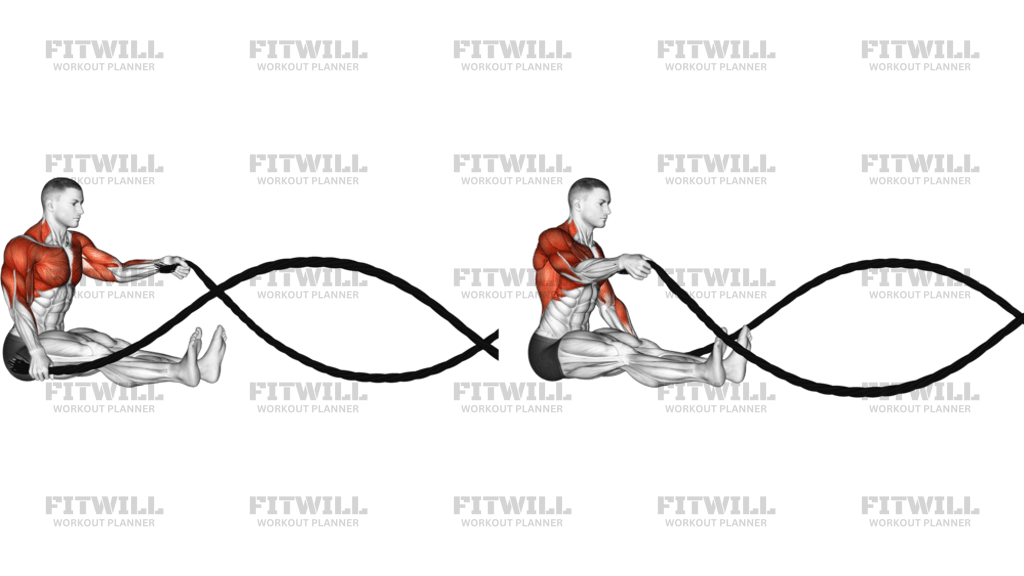
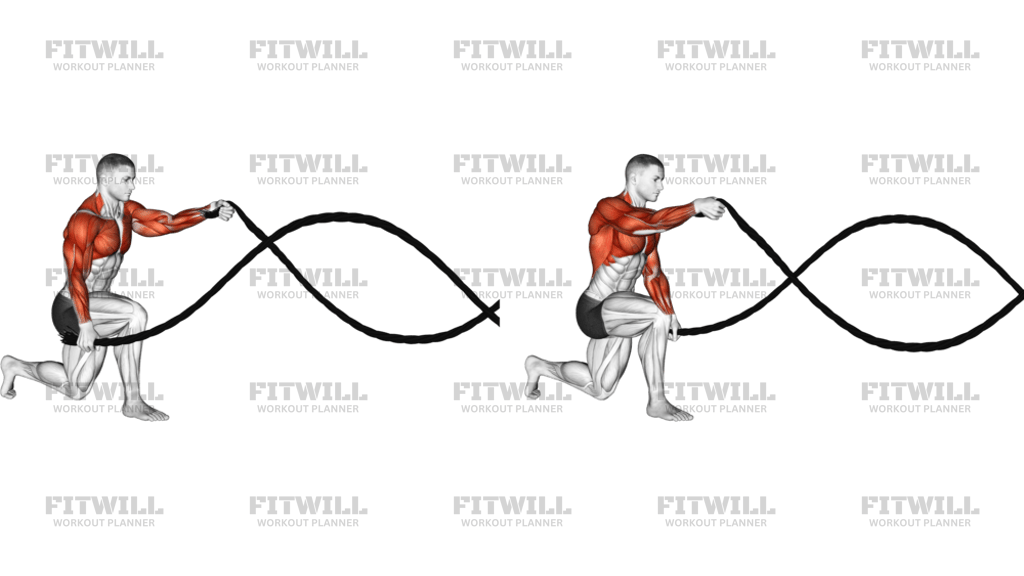
Kneeling Battling Ropes
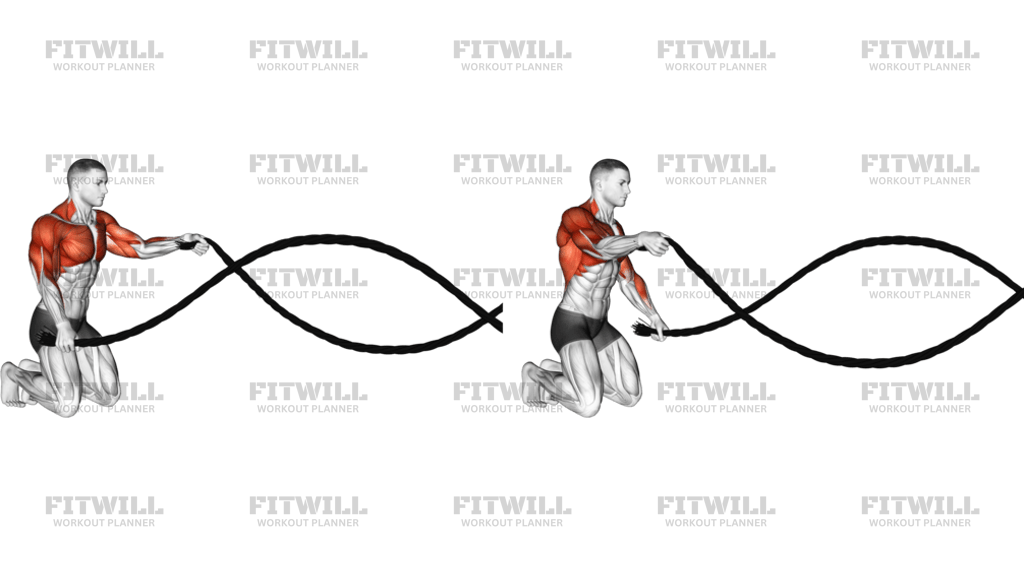
Kneeling Battling Ropes is a rope-conditioning drill that combines fast alternating arm drive with a tall kneeling base. The kneeling position removes help from the legs and makes you earn every wave from the shoulders, arms, upper back, and trunk. That also makes the exercise useful for conditioning, coordination, and trunk control when you want upper-body work without standing momentum.
The setup matters because the ropes only feel smooth when the anchor, hand spacing, and torso angle are right. Kneel on both knees with the rope running straight out from the anchor, then hold one end in each hand with the palms facing inward or down. Keep your hips stacked over your knees, ribs down, and chest slightly forward so the waves travel cleanly instead of turning into a whole-body bounce.
Kneeling Battling Ropes can be used for intervals, finishers, warmups, or conditioning blocks when you want the heart rate up without heavy joint loading. The alternating pattern usually creates a visible ripple down each rope, and the aim is to keep that rhythm even while fatigue rises. Because the lower body is fixed, the trunk has to resist side-to-side sway while the arms and shoulders keep producing force.
Good reps feel sharp, quick, and repeatable rather than exaggerated. Let each hand drive up and down on its own track, and keep the shoulders from shrugging toward your ears as the set gets harder. If the rope waves get small, the torso starts rocking, or the knees slide around, the set is usually too long, too heavy, or too fast for the current position.
Use this variation when you want a more controlled rope drill than standing waves or full-body slams. It is especially helpful for beginners who need a simpler lower-body position, and for lifters who want to train conditioning while keeping the spine organized. Finish the set by lowering the ropes with control, then come off the knees before releasing tension so the anchor and hands stay safe.
Fitwill
Log Workouts, Track Progress & Build Strength.
Achieve more with Fitwill: explore over 9600 exercises with images and videos, access built-in and custom workouts, perfect for both gym and home sessions, and see real results.
Start your journey. Download today!




Instructions
- Kneel on both knees with the battling rope anchored straight in front of you and the two rope ends hanging evenly on each side.
- Hold one end of the rope in each hand, keep your arms long but not locked out, and square your shoulders toward the anchor.
- Set your hips over your knees, tuck your ribs down, and lean your torso slightly forward so you can brace without collapsing at the lower back.
- Lift one hand while you drive the other hand down, creating an alternating wave pattern through the ropes.
- Keep the waves quick and even, letting the hands travel on separate paths instead of swinging both arms together.
- Maintain a steady kneeling base while the ropes move, and keep your chest from drifting side to side.
- Breathe in through the reset and exhale as you snap each wave down, keeping the rhythm steady for the whole set.
- Slow the rope speed, lower the handles to the floor, and rise off your knees before you let go of the ends.
Tips & Tricks
- Keep the rope anchor centered in front of your knees so the waves travel straight instead of crossing awkwardly.
- If the rope tips start slapping the floor with no clear ripple, shorten the set or slow the cadence.
- Stack your ribs over your pelvis; if your low back arches, the kneeling stance is too loose.
- Drive from the shoulders and arms, but let the trunk stay quiet so the movement does not become a torso sway.
- Keep your hands separated enough to create two clear waves rather than one big undulating swing.
- Do not shrug at the top of each wave; keep the neck long and the shoulders away from the ears.
- Use a shorter interval if your knees start sliding or if you have to sit back onto your heels to keep going.
- Exhale on the forceful downbeat of each hand so the cadence stays crisp under fatigue.
Frequently Asked Questions
What does Kneeling Battling Ropes train?
It primarily trains the shoulders, arms, upper back, and core while also driving conditioning and coordination.
Should my knees stay on the floor the whole time?
Yes. In this variation, both knees stay down so the rope work comes from the upper body and trunk instead of the legs.
How far forward should I lean in Kneeling Battling Ropes?
Lean just enough to keep tension on the rope and your ribs stacked over your pelvis. If you have to hinge hard at the hips, the setup is too aggressive.
Why do my rope waves get uneven?
Usually one hand is moving faster than the other or the anchor is not centered. Reset the hand spacing and aim for the same height and speed on both sides.
Is Kneeling Battling Ropes better for conditioning or strength?
It is mainly a conditioning drill, but the kneeling position also builds shoulder endurance and trunk control.
What is the biggest form mistake with this exercise?
The most common error is rocking the torso to fake faster waves. Keep the chest steady and let the arms do the work.
Can I use Kneeling Battling Ropes as a finisher?
Yes. Short hard intervals work well at the end of a workout, especially when you want to raise the heart rate without loading the legs heavily.
What should I do if my shoulders burn out before my breathing does?
Shorten the work interval or reduce rope speed. In this position, shoulder fatigue often comes before cardiovascular failure.