Dumbbell Lying External Shoulder Rotation
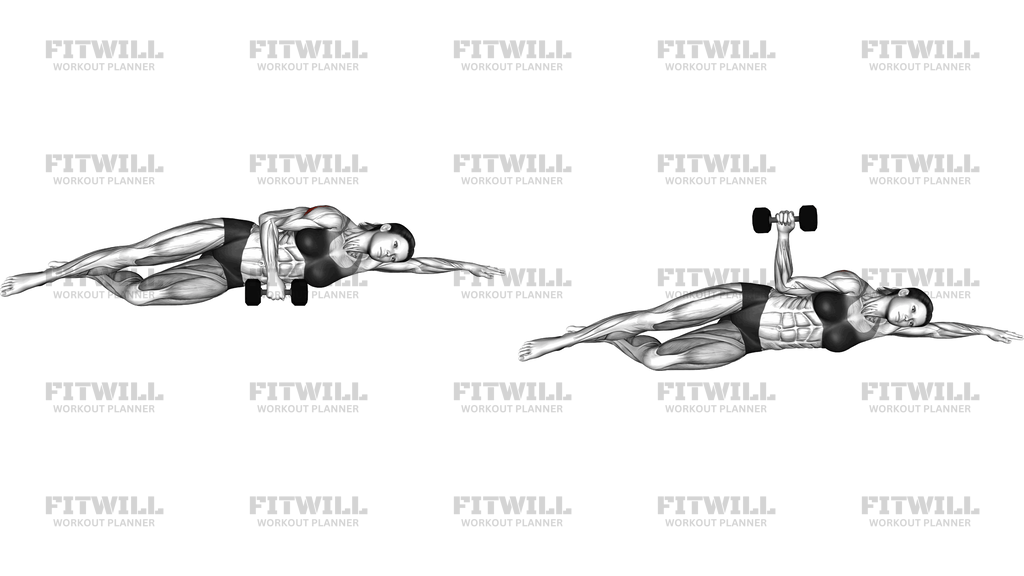
Dumbbell Lying External Shoulder Rotation is a side-lying rotator cuff exercise built to train shoulder external rotation control, not brute strength. You lie on one side with the working upper arm tucked against the body and the elbow bent to about 90 degrees. From there, the forearm moves from across the torso up toward vertical, which makes the small external rotators do the work while the rest of the body stays quiet.
This movement is commonly used to improve shoulder stability, warm up the cuff before pressing or throwing work, and strengthen the muscles that help keep the upper arm centered in the socket. It is especially useful when the shoulders need precise low-load work rather than more volume from bigger compound lifts. The exercise should feel controlled and isolated, with the elbow, ribcage, and torso staying stacked and still.
The setup matters because a drifting elbow or a rolling shoulder turns the rep into a cheat pattern. Lie on a bench or mat, support your head with the non-working hand, and keep the working shoulder relaxed but packed in place. The dumbbell should start low with the wrist neutral and the forearm moving through a smooth arc. If you need to swing the weight, the load is too heavy.
Each repetition should rotate the forearm upward while the upper arm stays glued to the side. Pause briefly near the top if you can hold the position without shrugging or twisting, then lower the dumbbell slowly back to the start. Match your breathing to the motion and stop the set before the shoulder starts to roll back, the wrist bends, or the torso starts helping out.
Use this exercise when you want clean accessory work for shoulder health, cuff endurance, or prehab-style training. It works best with very light dumbbells and strict tempo, usually in moderate-to-higher repetitions. The goal is quality range and repeatable positioning, not a big load or a fast rep count.
[ Workout Log & Planner ]
Put your next workout in Fitwill
Keep your plan and training log ready when you are.


Instructions
- Lie on one side on a bench or mat and hold a light dumbbell in the top hand.
- Bend the working elbow to about 90 degrees and tuck it against your side.
- Support your head with the other hand and keep your torso stacked without rolling backward.
- Start with the forearm across your stomach and the wrist neutral.
- Brace lightly, then rotate the forearm upward while the elbow stays pinned to your ribs.
- Lift until the forearm is near vertical or the shoulder starts to lose position.
- Pause briefly at the top without shrugging or letting the upper arm drift.
- Lower the dumbbell slowly back to the start under control.
- Repeat for the planned reps, then switch sides.
Tips & Tricks
- Use a very light dumbbell; this exercise gets sloppy fast when the load is too heavy.
- Keep the working elbow pressed into the side of your torso the whole time so the shoulder does the rotation, not the upper arm.
- Let the wrist stay in line with the forearm instead of bending it back at the top.
- Stop the ascent when the shoulder wants to roll open or the ribcage starts twisting.
- Lower the dumbbell more slowly than you lift it to keep tension on the external rotators.
- If your elbow floats away from your ribs, shorten the range and reset the setup.
- Keep the non-working shoulder relaxed so you do not brace through your neck.
- Use a smooth tempo and avoid snapping into the top position.
- Choose reps that feel precise; this is a quality drill, not a max-effort lift.
Frequently Asked Questions
What does Dumbbell Lying External Shoulder Rotation train most?
It mainly trains the shoulder external rotators, especially the rotator cuff muscles that help stabilize the humerus.
Why is the elbow kept tight to the side?
Keeping the elbow pinned to the ribs isolates shoulder rotation and prevents the movement from turning into an upper-arm swing.
How heavy should the dumbbell be?
Very light is usually best. If the wrist bends, the shoulder shrugs, or the torso rocks, the weight is too heavy.
Can I do this on a bench instead of the floor?
Yes. A bench can make the setup more comfortable, but the same rules apply: stay on your side, keep the elbow tucked, and rotate only the forearm.
Where should I feel the work?
You should feel the back and side of the shoulder working, with a small stabilizing effort in the upper arm and torso.
What is the most common mistake?
Letting the elbow drift away from the body or rolling the shoulder open to fake more range.
Is this a good warm-up exercise?
Yes. It is commonly used before pressing, throwing, or upper-body sessions that need shoulder control.
How can I progress it without losing form?
Add repetitions first, then use a slightly slower lowering phase before increasing the dumbbell weight.