Single Leg Deadlift With Knee Lift
Single Leg Deadlift With Knee Lift is a bodyweight hinge exercise that builds unilateral balance, hip stability, and control through the glutes and hamstrings. The working leg has to support your body while the torso tips forward, so the movement trains more than strength alone. It also teaches you to keep the pelvis level and the spine organized while one leg is off the floor.
The knee lift at the top changes the exercise from a simple single-leg hinge into a more demanding coordination drill. As you return to standing, the lifted knee comes forward under control, which asks the stance leg to stabilize the hip while the opposite side of the body stays quiet. That makes Single Leg Deadlift With Knee Lift useful for athletes, runners, and anyone who needs better single-leg control in squats, lunges, step-ups, or sprint mechanics.
Set the stance foot flat and rooted before you move. The standing knee should stay soft, not locked, and the torso should hinge from the hips rather than folding through the lower back. A long spine, square hips, and a slight reach through the free leg help you stay balanced while the hamstrings load on the way down. If you lose balance easily, slow the tempo and shorten the range before trying to go deeper.
At the bottom, the goal is not to touch the floor at any cost. Reach only as far as you can while the pelvis stays steady and the standing foot keeps three points of contact with the ground. On the way back up, drive through the standing heel and midfoot, bring the torso back in line, and finish by lifting the free knee without swinging it or leaning backward. The knee lift should feel like a clean balance checkpoint, not a jump.
This exercise fits well in warm-ups, accessory work, or lower-body sessions where you want posterior-chain work without heavy loading. It can also expose side-to-side differences in balance, ankle stability, hip strength, and trunk control. For safety, stop the rep if the standing knee caves inward, the low back rounds, or the lifted leg starts using momentum to finish the rep. Clean control matters more here than range or speed.
[ Workout Log & Planner ]
Put your next workout in Fitwill
Keep your plan and training log ready when you are.


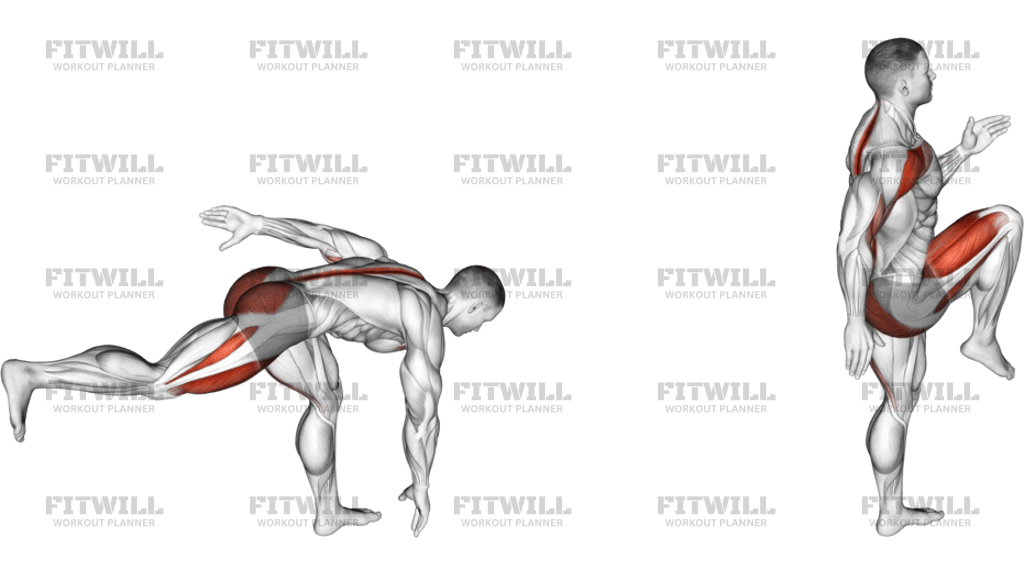
Instructions
- Stand tall on one leg with your planted foot flat, your hips square, and a slight bend in the standing knee.
- Let the free leg hover lightly behind you and keep your arms relaxed for balance before the first rep.
- Brace your trunk, then hinge at the hips and send your torso forward while the free leg reaches straight back.
- Lower until your torso and back leg form a controlled long line, or stop sooner if your pelvis starts to rotate.
- Keep the standing knee soft and the arch of the working foot active as you reach the bottom position.
- Drive through the standing heel and midfoot to bring your torso back up without twisting the hips.
- As you return to upright, lift the free knee toward your chest in a smooth knee drive.
- Pause briefly at the top with your balance under control, then lower the foot and repeat on the same side or switch sides as programmed.
Tips & Tricks
- Keep your hips level; if one hip opens toward the ceiling, shorten the hinge and slow the descent.
- Think about reaching the back heel long rather than lifting the leg high, which helps keep the pelvis square.
- Keep most of your pressure over the big toe, little toe, and heel of the standing foot so the ankle does not collapse inward.
- The knee lift should be quiet and controlled; if you have to swing the thigh forward, the hinge was probably too deep or too fast.
- Use the wall or a dowel for balance support if the standing leg works but the torso keeps drifting side to side.
- Exhale as you come back to standing and bring the knee up, then reset your breath before the next hinge.
- Stop the set when the standing foot starts wobbling so much that the glute cannot control the hip anymore.
- A slower lowering phase usually makes this movement more effective than trying to chase more reps.
Frequently Asked Questions
What muscles does Single Leg Deadlift With Knee Lift train?
It mainly trains the glutes and hamstrings on the standing leg, with the core and hip stabilizers helping keep the pelvis square.
Can beginners perform this exercise?
Yes. Beginners should keep the hinge shallow at first and use a wall or fingertip support until they can balance without twisting.
Should I touch the floor with my free hand?
No. Reach only as far as you can while the standing hip stays square and the back stays long.
Why is the knee lift at the top important?
It forces you to finish each rep with balance and hip control instead of just dropping the back leg and standing up sloppily.
What should I do if I keep losing balance?
Slow the tempo, shorten the hinge, and use a wall or rack for light assistance until the standing leg feels stable.
How do I know if I’m hinging correctly?
Your hips should move back while the torso leans forward as one unit, instead of rounding through the lower back.
Is this exercise better for strength or balance?
It does both, but the single-leg stance and knee drive make balance and hip control especially important.
What is the biggest form mistake with Single Leg Deadlift With Knee Lift?
Letting the pelvis rotate open as the back leg lifts is the most common fault; keep the hips facing forward and the movement slow.