Dumbbell Standing Single Leg Calf Raise Right Side
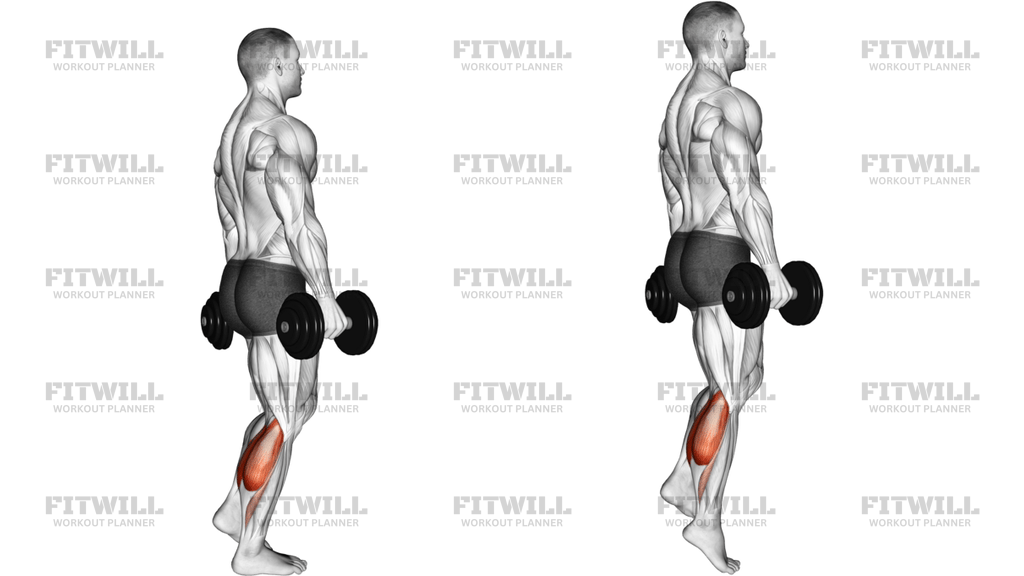
Dumbbell Standing Single Leg Calf Raise Right Side is a unilateral calf exercise that trains the right ankle and lower leg while also demanding balance through the foot, ankle, hip, and trunk. Holding a dumbbell in each hand keeps the torso loaded without changing the basic movement pattern, so the working leg has to create the lift on its own instead of letting the other side help.
The main target is the calf complex on the right side, especially the gastrocnemius and soleus, with the small stabilizers of the foot and ankle working hard to keep the heel path clean. Because you are standing on one leg, the exercise also exposes side-to-side differences in ankle strength, foot control, and lower-leg endurance. That makes it useful when you want to address asymmetries or add precise accessory work after larger compound lifts.
Setup matters a lot here. Stand tall with the dumbbells at your sides, shift all of your weight onto the right foot, and keep the left leg unweighted and out of the way. Start with the right heel lowered but not collapsed, the arch active, and the knee softly extended rather than locked. A stable torso lets the calf do the work; if you sway, lean, or bounce, the load moves away from the ankle and into momentum.
Each repetition should feel like a smooth ankle hinge: press through the ball of the right foot, rise as high as you can without rolling the ankle outward, and briefly squeeze at the top before lowering under control. On the way down, keep the heel tracking straight and let the calf stretch gradually instead of dropping fast. Controlled breathing helps keep the brace steady and makes it easier to repeat the same range on every rep.
This exercise is a good fit for calf hypertrophy, lower-leg strength, balance training, or finishing work at the end of a session. It is also easy to progress or regress by changing load, using a wall lightly for balance, or adding a short pause at the top and bottom. Keep the motion strict and the range pain-free, because the right side will only improve if the ankle remains stable enough to produce the lift cleanly.
[ Workout Log & Planner ]
Put your next workout in Fitwill
Keep your plan and training log ready when you are.


Instructions
- Stand upright with a dumbbell in each hand and place all of your weight on the right foot.
- Let the left leg hover or stay lightly bent behind you so it does not help the lift.
- Set the right foot flat with the big toe, little toe, and heel aligned, then soften the right knee slightly.
- Brace your torso and keep the dumbbells hanging still beside your thighs before you start.
- Press through the ball of the right foot and rise onto the toes as high as the ankle will allow.
- Pause briefly at the top without leaning back, rolling outward, or bouncing off the floor.
- Lower the right heel slowly until you feel a controlled stretch through the calf.
- Reset your balance, breathe, and repeat for the planned number of reps before switching sides.
Tips & Tricks
- Keep the right heel moving straight up and down; if the ankle rolls outward, the rep becomes unstable and the calf loses tension.
- Use the left foot only for balance positioning, not for pushing into the floor during the concentric phase.
- A slight knee bend shifts some work toward the soleus, while a straighter knee puts more emphasis on the gastrocnemius.
- If your balance limits the calf work, lightly touch a wall or rack with one free hand instead of leaning your body into it.
- Do not let the dumbbells swing; still hands make it easier to notice whether the ankle or the torso is producing the rep.
- Lower slowly enough to feel the calf lengthen, but stop before the heel crashes down and turns the set into a bounce.
- A short pause at the top is useful if you want cleaner ankle control and less help from momentum.
- Choose a load that lets you reach the same peak height on every rep rather than grinding through a wobbling range.
- If the toes cramp or the arch collapses, reduce the load and rebuild the foot tripod before adding weight again.
Frequently Asked Questions
What does Dumbbell Standing Single Leg Calf Raise Right Side train most?
It mainly trains the right calf complex, especially the gastrocnemius and soleus, while the foot and ankle stabilizers keep the single-leg balance.
Can beginners perform this exercise?
Yes, beginners can use a light pair of dumbbells or even body weight first, as long as they can keep the right ankle steady and avoid bouncing.
Should the left foot help at all?
No. The left leg should stay unloaded so the right calf does the work; you can hover it lightly or bend it behind you for balance.
What is the biggest form mistake on the right side?
Most people let the body lean or the ankle roll outward as they rise. Keep the torso quiet and the right heel tracking straight.
Can I do this on a step instead of the floor?
Yes, but the floor version is usually easier to control. A step increases the stretch at the bottom, so only use it if your ankle stays stable.
Why are dumbbells held at the sides?
Holding the dumbbells at your sides keeps the load simple and lets you focus on ankle motion instead of changing the exercise with a front rack or shoulder hold.
How do I know if I am using too much weight?
If the right heel cannot rise smoothly, the torso starts swinging, or the lowering phase gets fast and sloppy, the load is too heavy.
Where should I feel the working side?
You should feel the calf of the right leg working hard, with some effort in the foot and ankle to keep the balance clean.