Kettlebell Rear Delt Row
Kettlebell Rear Delt Row is a bench-supported single-arm row that shifts more attention toward the rear delts, upper back, and arm stabilizers than a standard elbow-tucked row. The setup matters because the torso angle, bench support, and elbow path decide whether the rep stays strict or turns into a twist-and-heave pull. With the right position, the kettlebell moves close to the body while the shoulder stays organized and the working side does the actual lifting.
The exercise is usually performed with one hand and one knee or shin supported on a flat bench while the other foot stays planted on the floor. The free arm hangs straight down from the shoulder, then rows the kettlebell with a slightly flared elbow path so the rear shoulder and upper back have to work hard to finish the pull. That small change in elbow angle is what makes the movement feel different from a lat-dominant row.
A good rep starts before the kettlebell leaves the bottom. Brace your torso, keep your neck long, and lock in the bench contact so the trunk does not rotate as the weight comes up. Pull smoothly toward the lower ribs or side of the chest, then briefly squeeze the top without shrugging the shoulder toward your ear. The lowering phase should be slow enough that the shoulder stays centered and the kettlebell does not drop out of position.
This movement fits well in back, shoulder, or accessory sessions when you want controlled unilateral work and cleaner rear-shoulder loading. It is useful for lifters who want better scapular control, a stronger upper-back pull, or a rowing variation that is less dominated by momentum. Keep the load moderate, the reps deliberate, and the range pain-free so the rear delt and upper back can do the work without the lower back or torso taking over.
[ Workout Log & Planner ]
Put your next workout in Fitwill
Keep your plan and training log ready when you are.


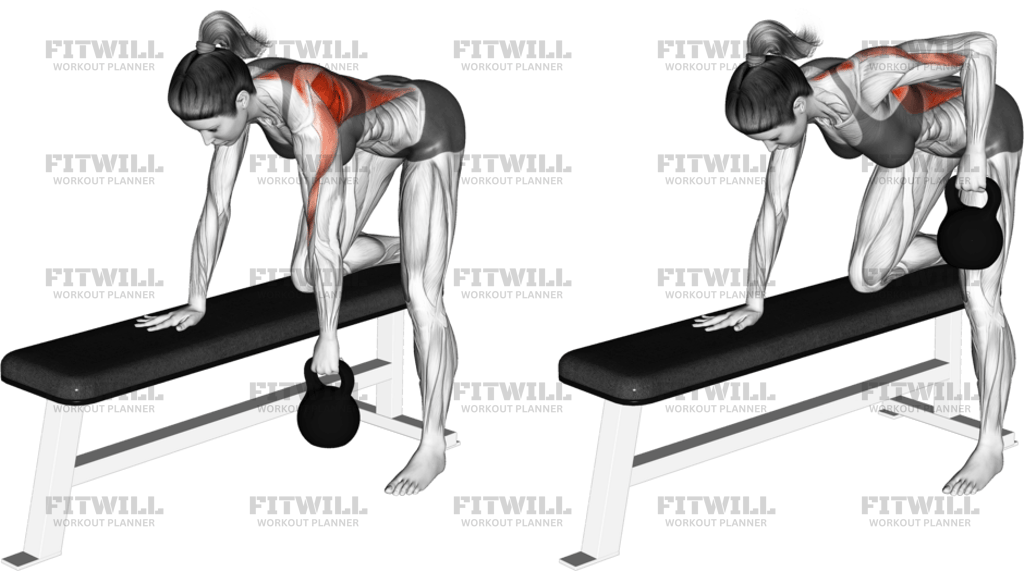
Instructions
- Set a flat bench beside you and brace one hand on it with the same-side knee or shin supported on the pad.
- Plant the other foot on the floor and hinge forward until your torso is nearly parallel to the bench.
- Let the kettlebell hang straight down from the shoulder with your working arm fully extended.
- Brace your trunk so the ribcage stays quiet before each pull.
- Row the kettlebell up toward the lower ribs or side of the chest with the elbow slightly flared.
- Pause for a beat at the top while keeping the shoulder down and back.
- Lower the kettlebell slowly until the arm is long again and the shoulder stays packed.
- Reset your breath at the bottom and repeat for the planned reps.
Tips & Tricks
- Use a kettlebell that lets you pause at the top without twisting your torso.
- Keep the rowing elbow slightly out from your ribs so the rear delt and upper back stay involved.
- Do not let the support shoulder collapse into the bench at the bottom.
- Pull the bell to the lower ribs or side of the chest, not straight up toward the armpit.
- Avoid shrugging at the top; the shoulder should stay away from your ear.
- Lower the kettlebell more slowly than you lift it so the rep stays strict.
- Keep your gaze a few feet in front of the bench to help your neck stay neutral.
- If your torso starts rotating, lighten the load and shorten the range slightly.
Frequently Asked Questions
What muscle does Kettlebell Rear Delt Row target most?
It mainly emphasizes the rear delts and upper back, especially when you keep the elbow a little flared instead of tucked tight.
Can beginners perform this exercise?
Yes. Beginners can do it well with a light kettlebell and a solid bench support so the torso stays still.
Where should the kettlebell travel during the row?
Pull it toward the lower ribs or the side of the chest, not up into a shrug or across the body.
How is this different from a standard one-arm row?
A rear-delt row usually uses a slightly wider elbow path, which shifts more work to the rear shoulder and upper back.
Should my support hand and knee stay fixed on the bench?
Yes. Keep the bench contact stable so the working side can pull without the torso rocking or rotating.
What if I feel the movement mostly in my biceps?
Reduce the load and lead with the elbow instead of the hand so the rear delt and upper back start the pull.
Do I need a bench for this exercise?
A flat bench makes the movement much stricter, but any stable support that lets you hinge and brace the torso can work.
How many reps should I use?
Most people do best with moderate reps and a controlled tempo, because the rear-delt emphasis depends on clean execution.