Dumbbell Head Supported Row
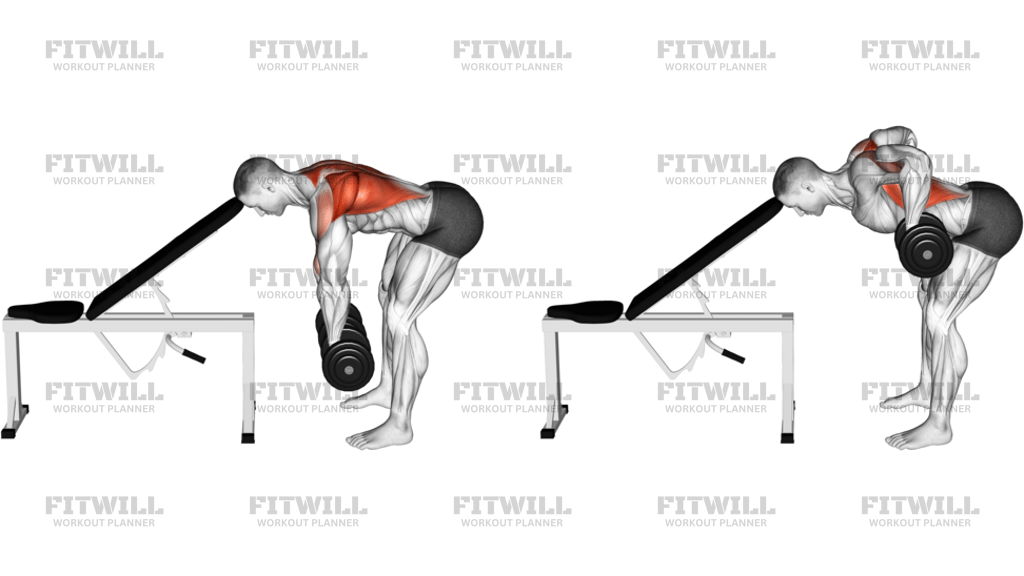
Dumbbell Head Supported Row is a strict rowing variation performed with the forehead lightly braced on an incline bench or pad while you pull a dumbbell toward your torso. The support point matters because it takes the guesswork out of posture and makes it easier to keep the torso from swinging or twisting as fatigue builds.
This exercise is usually used to train the upper back in a controlled, single-side pulling pattern. It emphasizes the lats, mid-back, rear shoulder, and elbow flexors while also challenging the muscles that keep the shoulder blade organized during the pull. Because the head is anchored, you can focus on the path of the elbow and the squeeze between the shoulder blade and spine instead of cheating the weight upward.
The setup should feel deliberate before the first rep starts. Hinge at the hips, keep a soft bend in the knees, and hold a long spine while you place your forehead on the pad. The dumbbell should hang straight down under the shoulder so the arm starts from a dead-hang stretch without the torso rotating to help the lift.
Each repetition should follow the same path. Pull the elbow back toward the lower ribs or hip, keep the wrist stacked, and stop the rep when the shoulder and upper back finish the work. On the way down, let the arm lengthen fully under control so the shoulder blade can move naturally instead of locking the weight at the top.
Use this row when you want cleaner back work than a free-standing bent-over row can provide, especially in accessory blocks, hypertrophy work, or technique-focused sessions. It is not a race for load or repetition count; the payoff comes from a stable head position, a controlled pull, and a smooth return that keeps tension on the back instead of the lower back.
[ Workout Log & Planner ]
Put your next workout in Fitwill
Keep your plan and training log ready when you are.


Instructions
- Place an incline bench or support pad in front of you and face it so you can rest your forehead lightly on the upper edge.
- Hinge at the hips, soften your knees, and set your torso long enough that the dumbbell hangs straight beneath your shoulder.
- Keep your neck neutral and let the forehead provide just enough contact to stop you from swinging through the rep.
- Start with the working arm fully extended and the shoulder relaxed, not shrugged toward the ear.
- Pull the elbow back toward your lower ribs or hip while keeping the dumbbell close to your body.
- Squeeze the upper back briefly at the top without twisting your torso or rolling the shoulder forward.
- Lower the dumbbell slowly until the arm is long again and the shoulder blade can move naturally at the bottom.
- Reset your brace and repeat for the planned reps, breathing out on the pull and in on the lowering phase.
Tips & Tricks
- Keep the forehead contact light; if you press hard into the pad, your neck will start doing the work.
- Think about driving the elbow back, not lifting the dumbbell up, so the pull stays on the back instead of the biceps.
- A path toward the lower ribs usually keeps the shoulder in a better line than flaring the elbow out wide.
- If your torso starts rocking, the load is too heavy for the strict support this variation is meant to provide.
- Let the bottom position open the shoulder blade instead of cutting the range short with a partial rep.
- Keep the wrist neutral so the handle does not fold back and turn the row into a grip and forearm fight.
- Use a tempo that makes the lowering phase look as controlled as the pull; the eccentric should not snap back to the floor.
- Choose a bench height that lets you hinge comfortably without rounding your lower back to reach the handle.
Frequently Asked Questions
What muscles does Dumbbell Head Supported Row work?
It mainly trains the upper back and lats, with the rear shoulder, biceps, and grip helping through the pull.
Why support the head on the bench?
The forehead contact reduces torso cheating and makes it easier to keep the row strict from the first rep to the last.
Where should the dumbbell move during the row?
Pull it toward the lower ribs or hip with the elbow tracking back close to your side.
Should I keep my chest glued to the pad?
No. The support should be light enough to stabilize your head and spine without turning the setup into a hard press into the pad.
Is this a beginner-friendly row?
Yes, if you start with a light dumbbell and keep the hinge, neck position, and elbow path under control.
What is the most common form mistake?
Rounding the lower back or swinging the torso to finish the rep usually means the weight is too heavy.
Can I row the dumbbell higher for more range?
Only if the elbow can still travel cleanly without the shoulder shrugging or the torso rotating.
How should I breathe on this exercise?
Brace before the pull, exhale as the dumbbell comes up, and inhale as you lower it back to the start.