Dumbbell Incline Head Supported Row
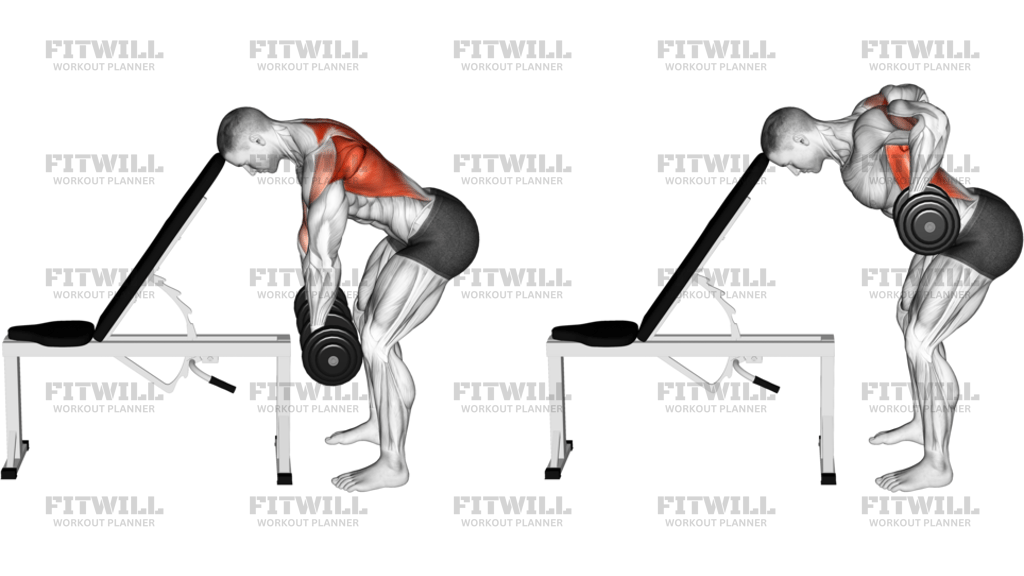
Dumbbell Incline Head Supported Row is a strict rowing variation that uses an incline bench for head support so you can keep the torso still and pull with cleaner back mechanics. The support removes a lot of the body swing that often turns a free-standing row into a half-hip-hinge, half-shrug. That makes the exercise useful when you want to train upper-back thickness, lat engagement, and rear-delt control with a deliberate rep path.
The setup matters because the bench angle and your hinge determine whether the row feels stable or awkward. With the head lightly braced on the pad, the spine stays long, the neck stays neutral, and the dumbbells can hang directly under the shoulders. From there, the row becomes a repeatable pull instead of a balance exercise. You should feel the shoulder blades move cleanly without losing the head support or changing your trunk angle from rep to rep.
This movement is especially useful as accessory work for back days, pull sessions, or any program that needs a strict horizontal row without a lot of cheating. Compared with a looser bent-over row, it is easier to keep tension on the upper back and lats while reducing stress from momentum. It also makes it easier to notice side-to-side imbalances, because the bench and head contact give you a fixed reference point for every repetition.
To perform it well, think about driving the elbows back toward the lower ribs or hip line, not yanking the dumbbells up with the hands. The weights should travel close to the body, rise to a controlled top position, then lower under tension until the arms are long again without dumping the shoulders forward. A brief squeeze at the top is useful, but only if you can keep the neck relaxed and the torso quiet.
Use a load that lets you keep the forehead or head in light contact with the pad, the lower back braced, and the rep path smooth. If you lose contact, start shrugging, or have to jerk the dumbbells off the floor, the set is too heavy or the bench position is wrong. Done correctly, this is a precise row that builds strength and muscle without relying on momentum.
[ Workout Log & Planner ]
Put your next workout in Fitwill
Keep your plan and training log ready when you are.


Instructions
- Set an incline bench to a moderate angle and stand straddling the bench with your feet about hip-width apart.
- Hinge at the hips until your forehead or upper head can rest lightly on the top of the pad while your back stays long and neutral.
- Hold a dumbbell in each hand with your arms hanging straight down under your shoulders and your palms facing each other.
- Softly bend your knees and brace your midsection so your torso stays fixed before the first pull.
- Pull both dumbbells up by driving your elbows back toward your lower ribs or hip line.
- Keep the weights close to your sides and avoid twisting, shrugging, or lifting your chest off the pad.
- Squeeze your shoulder blades together briefly at the top while keeping your neck relaxed and your head supported.
- Lower the dumbbells in a slow, controlled arc until your arms are straight and your shoulders are stretched without losing position.
- Reset your breath at the bottom and repeat for the planned number of repetitions.
Tips & Tricks
- Choose a bench angle that lets you reach the handles without rounding your upper back or overextending your neck.
- Keep only light pressure on the head pad; if you are pushing hard into it, the row is probably too heavy.
- Think about moving the elbows, not the hands, so the row stays focused on the back instead of turning into a curl.
- Let the dumbbells hang for a full stretch at the bottom, but do not relax so much that your shoulders roll forward.
- Row toward the lower ribs or hip line for more lat involvement; row a little higher if you want more upper-back bias.
- Keep the ribs down and abdomen braced so the low back does not take over when fatigue sets in.
- Use a pause at the top only if you can hold the torso still and avoid shrugging.
- Lower the weights slowly enough to feel the shoulder blades glide open under control.
- Stop the set as soon as you have to bounce off the bench, jerk the weights, or lose the head contact.
Frequently Asked Questions
What muscles does Dumbbell Incline Head Supported Row work most?
It primarily trains the back, especially the lats, mid-back, and rear delts, with the arms helping during the pull.
Why use a head-supported incline bench for this row?
The pad gives you a fixed reference point so it is easier to keep the torso still, keep the neck neutral, and avoid cheating with body swing.
Where should I pull the dumbbells on each rep?
Most people do best pulling toward the lower ribs or hip line, with the elbows tracking back close to the body.
Should my chest stay on the bench during this exercise?
No, the image shows a head-supported hinge rather than a full chest-supported row. Keep the head lightly braced and the torso fixed, but let the dumbbells hang freely below you.
Is this a good exercise for beginners?
Yes, if the load is light and the hinge is stable. The bench support makes it easier to learn strict rowing mechanics than a fully unsupported bent-over row.
What is the most common mistake with this row?
Most breakdown comes from shrugging the shoulders, twisting the torso, or using too much momentum to get the dumbbells moving.
How far should I lower the dumbbells?
Lower them until the arms are straight and the shoulders are stretched, but stop before you lose your hinge position or head contact.
Can I use this as an accessory after bigger back lifts?
Yes. It fits well after pull-ups, pulldowns, or heavier rows because it adds back volume without demanding much body English.
What should I do if the neck gets tense during the set?
Reduce the load, lower the bench angle if needed, and keep only light contact with the pad so you are not driving the head into it.