Lying Rear Lateral Raise
Lying Rear Lateral Raise is a prone floor rear-delt raise that trains the back of the shoulders with help from the upper back. You lie face down and lift the arms away from the floor in a wide arc, which makes it a useful bodyweight option when you want shoulder work without standing momentum, heavy loading, or complicated setup. The movement is small, but the quality of each rep matters: if the chest, ribs, and neck stay quiet, the rear delts and scapular stabilizers do the work.
The setup changes the exercise more than most people expect. On the floor, your torso is supported, so the lift should come from shoulder abduction and horizontal abduction rather than from arching the low back or throwing the hands upward. That makes this a good choice for accessory rear-delt volume, warm-up activation, or a controlled finisher after pressing or rowing work. It also helps reinforce shoulder control in the position where many lifters cheat most: the top half of the raise.
In anatomy terms, the main emphasis is on the deltoids, especially the rear portion, with the trapezius and rhomboids helping stabilize and guide the shoulder blades. If the movement turns into a shrug, the traps start to dominate and the rear delts stop getting a clean stimulus. The best reps feel like the upper arms sweep out and slightly back while the neck stays long and the ribs stay heavy on the floor.
Use a slow, deliberate tempo and stop the lift as soon as the shoulders start to roll forward, the lower back starts to assist, or the hands rise by momentum instead of muscular tension. This exercise is especially useful for beginners learning scapular control, for athletes who need a low-fatigue shoulder accessory, and for anyone who wants a simple prone variation of the reverse fly pattern. If the floor feels restrictive, the same mechanics can later be adapted to a bench or incline surface, but the base version should stay strict and quiet.
[ Workout Log & Planner ]
Put your next workout in Fitwill
Keep your plan and training log ready when you are.


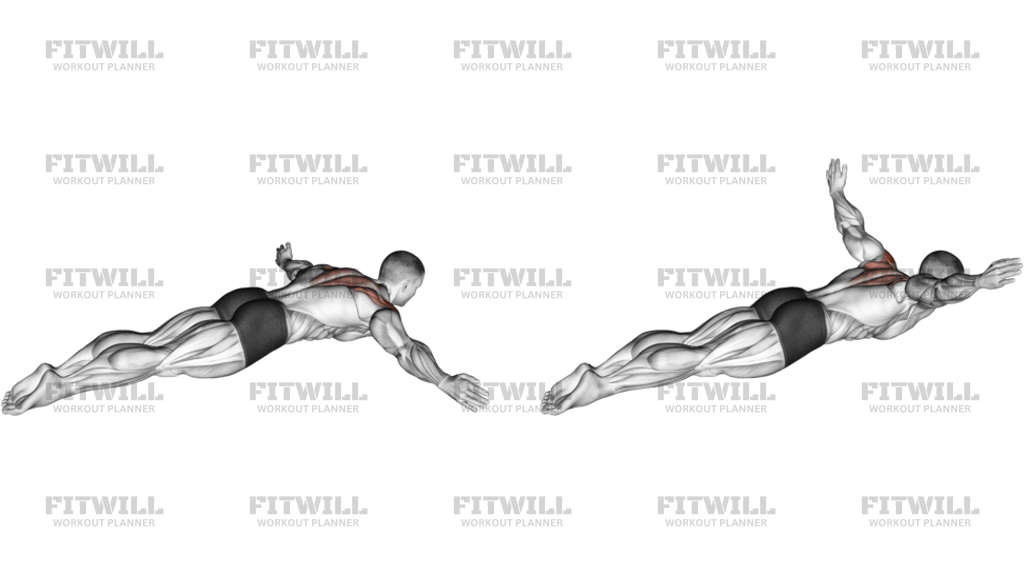
Instructions
- Lie face down on the floor with your legs long, forehead resting on a towel or stacked hands, and your arms reaching out in a low T or shallow V just off the floor.
- Turn your palms down or slightly thumbs-up, keep your elbows softly bent, and let your shoulders reach long away from your ears before you start.
- Brace your ribs and glutes so your torso stays glued to the floor instead of arching to help the lift.
- Lift both arms in a wide arc until your upper arms are level with your torso or until you feel the rear delts and upper back tighten.
- Keep the hands traveling slightly back and out rather than straight up, and avoid shrugging your shoulders toward your neck.
- Pause for a brief squeeze at the top without letting the low back or head pop up.
- Lower the arms slowly until they hover just above the floor, keeping tension in the shoulders instead of dropping them completely.
- Reset your breath at the bottom and repeat for smooth, even reps.
Tips & Tricks
- Keep the forehead down and the back of the neck long so you do not crane upward to fake more range.
- Think about reaching the arms wide, not high; the movement should feel like a rear-delt sweep, not a trap shrug.
- A small elbow bend is fine, but do not turn the rep into a bent-arm row.
- If your low back starts lifting, shorten the range until the torso stays pinned to the floor.
- Lead the lift with the elbows and upper arms so the hands do not take over the motion.
- Use a slow lowering phase; the eccentric is where the rear delts stay under the best tension in this version.
- Keep the shoulders away from the ears at the bottom and top to avoid upper-trap dominance.
- Stop each set when you can no longer keep both sides moving evenly or the top position starts looking jerky.
Frequently Asked Questions
What muscles do lying rear lateral raises train most?
They mainly target the rear delts, with the mid traps and rhomboids helping stabilize the shoulder blades.
Is this the same as a prone reverse fly?
Yes, this floor version is very similar to a prone reverse fly, with the torso supported so the shoulders have to do the work.
Where should I feel the exercise?
You should feel it mostly in the back of the shoulders and between the shoulder blades, not in the neck.
Should my arms stay straight or bent?
A slight elbow bend is fine, but the angle should stay nearly the same throughout the rep instead of turning into a row.
Can beginners do this exercise?
Yes. The floor setup makes it beginner-friendly as long as the range stays small and controlled.
Why is the floor position useful?
Lying prone takes away most body sway, so it is easier to isolate the rear delts and keep the lower back from cheating.
What is the most common mistake?
Shrugging the shoulders or lifting the chest off the floor to create fake range are the biggest form errors.
How can I make it harder without changing the exercise?
Slow the lowering phase, add a brief pause at the top, or increase the number of strict reps before you progress to a loaded variation.