Dumbbell KAS Glute Bridge
Dumbbell KAS Glute Bridge is a bench-supported glute bridge variation that keeps constant tension on the hips instead of resting at the bottom. With your upper back anchored on a bench and a dumbbell across the hip crease, the exercise uses a short, controlled range to load the glutes hard near the top of the rep. It is especially useful when you want a glute-focused movement without needing a heavy barbell setup.
The KAS style changes the feel of the bridge by keeping the hips working through the middle and top portion of the range. That shorter path reduces the temptation to bounce or relax on the floor, so the rep stays honest and the glutes keep producing force the whole time. The bench position also makes torso angle and foot placement important: if your feet are too far out, the hamstrings tend to take over; if they are too close, the knees and lower back can get crowded.
Set the dumbbell securely across the crease of the hips, plant the feet flat, and keep the ribs stacked over the pelvis before you lift. The rep should start from a controlled stretch, rise until the torso and thighs are close to one line, and then come back down only partway so tension never disappears. A small pause at the top helps the glutes finish each rep without leaning on momentum or lumbar extension.
Because the movement is small, quality matters more than load. The exercise fits well in glute-focused sessions, lower-body accessory work, or as a higher-rep finisher after heavier compound lifts. It can also be a practical option for lifters who want direct glute work with less spinal loading than a heavy barbell hip thrust. Use smooth breathing, steady tempo, and a setup that keeps the dumbbell stable on the hips.
If the bench edge, dumbbell position, or foot placement feels awkward, reduce the load and clean up the setup before adding weight. The best reps feel like the glutes are doing most of the work while the trunk stays quiet and the neck stays relaxed. Stop short of any position that turns the movement into a lower-back arch or a bounce off the bottom.
[ Workout Log & Planner ]
Put your next workout in Fitwill
Keep your plan and training log ready when you are.


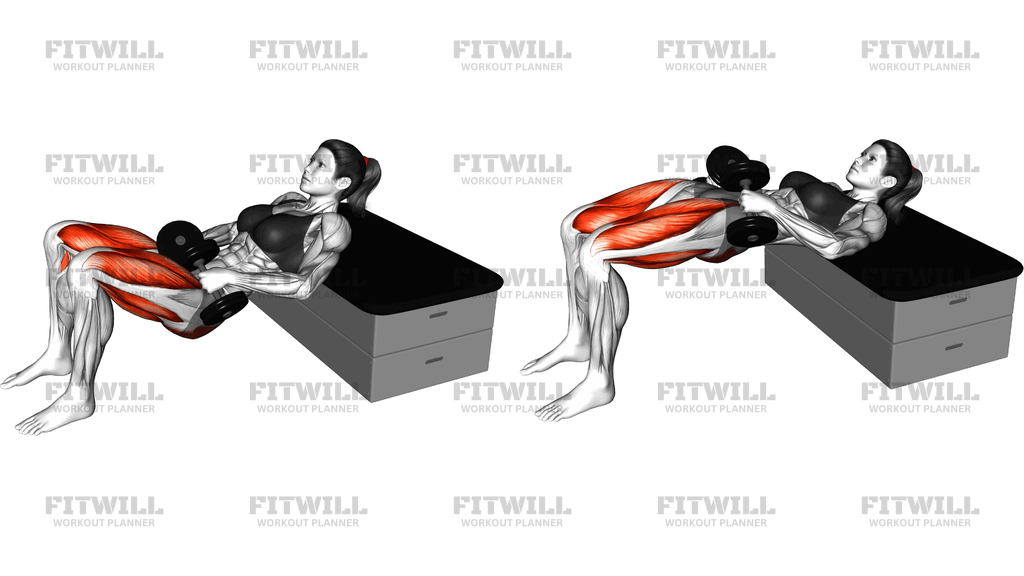
Instructions
- Sit on the floor in front of a flat bench and roll the dumbbell into the crease of your hips.
- Lean back until your shoulder blades are supported on the bench edge, then bend your knees and place both feet flat about hip-width apart.
- Square your feet so your shins are close to vertical at the top and keep your toes pointed slightly out if that feels natural.
- Tighten your midsection, tuck your pelvis slightly, and keep your ribs down before the first rep.
- Drive through your heels and lift your hips until your torso and thighs are nearly in line.
- Squeeze the glutes at the top for a brief pause without arching your lower back.
- Lower the hips only partway to keep tension on the glutes and avoid resting at the bottom.
- Repeat for the planned reps, then lower the hips to the floor and remove the dumbbell carefully.
Tips & Tricks
- Keep the dumbbell centered in the hip crease; if it slides, reduce the load or use a pad/towel.
- Use a bench height that lets your shoulder blades stay planted without your head being forced into the pad edge.
- Place your feet so the shin is nearly vertical at lockout; that usually keeps the glutes doing more work than the hamstrings.
- Stop the rep before your ribs flare upward. The top should feel like hip extension, not a low-back crunch.
- Think about tucking the tailbone under slightly at the top to keep the pelvis from dumping forward.
- Keep the descent short and controlled. In KAS-style reps, letting the hips fully relax turns the set into a different exercise.
- If the neck feels strained, look straight ahead instead of forcing your chin toward your chest.
- Use moderate reps and a deliberate tempo; this variation usually works better with tension and control than with maximal loading.
- A small pause at the top is useful, but do not bounce off the bench or chase extra height by overextending the spine.
Frequently Asked Questions
What makes a KAS glute bridge different from a regular hip thrust?
The KAS version uses a shorter, constant-tension range and keeps the hips working near the top instead of relaxing at the bottom.
What muscles does the dumbbell KAS glute bridge train most?
It mainly targets the glutes, with the hamstrings and core helping stabilize the pelvis and torso.
Where should the dumbbell sit?
It should rest in the crease of the hips, centered and secure so it does not roll or press into the stomach.
How far should I lower each rep?
Lower only partway until you still feel tension in the glutes. If the hips completely relax, you lose the point of the KAS style.
How do I know my feet are in the right spot?
At the top, your shins should be close to vertical. If your knees drift too far forward or back, move the feet a few inches and test again.
Can beginners use this exercise?
Yes. It is usually beginner-friendly if the dumbbell is light enough to stay stable and the bench setup feels comfortable.
Why does my lower back feel it more than my glutes?
That usually means you are finishing by arching the spine instead of extending the hips. Keep the ribs down and stop the rep a little lower.
Can I use this instead of a barbell hip thrust?
Yes, it can work as a lower-load glute accessory or a higher-rep alternative when you want a simpler setup than a barbell.
Should I pause at the top of each rep?
A brief pause helps keep tension on the glutes, but it should be short enough that the set still feels smooth and controlled.