Kettlebell Side Plank
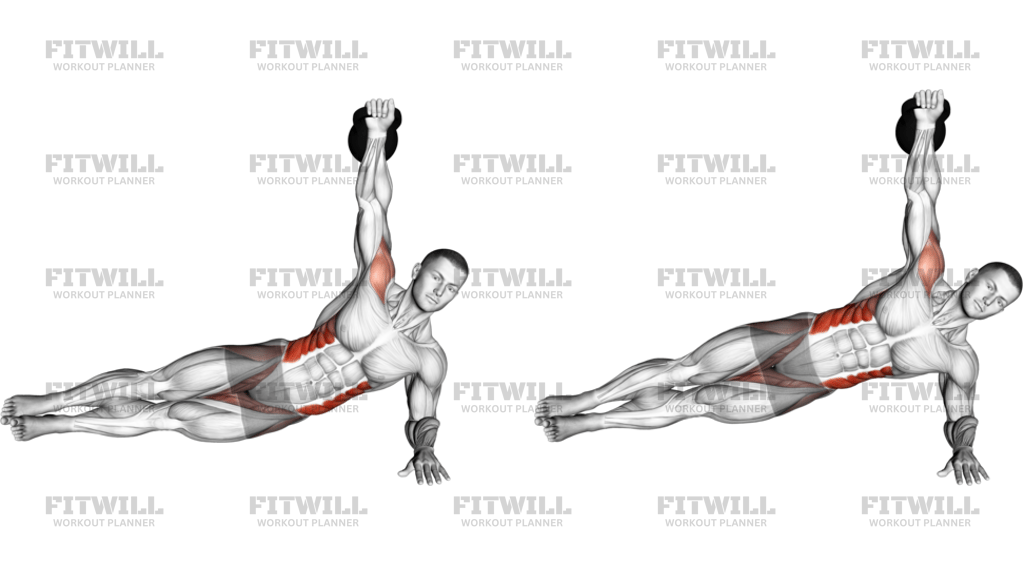
Kettlebell Side Plank is a loaded side-plank hold that challenges the obliques, deep core, glute medius, shoulder stabilizers, and the grip of the upper arm holding the kettlebell. The body stays mostly still while you fight sideways collapse, rotate less, and keep the rib cage, pelvis, and shoulders stacked. That makes it a useful exercise for building trunk stiffness and cleaner shoulder control at the same time.
The kettlebell changes the demand in a meaningful way. With the top arm locked out overhead, the shoulder has to stay packed and stacked while the torso resists bending toward the floor. That makes setup important: the lower elbow or hand needs to be directly under the shoulder, the feet should be stacked or staggered for balance, and the kettlebell should stay above the shoulder instead of drifting forward. If the load pulls you out of alignment, the exercise stops training the right pattern.
A good rep is really a clean hold. Press the floor away, lift the hips until the body forms one straight line from ankles to shoulders, and keep the top arm vertical the whole time. The ribs should stay down, the neck long, and the hips level rather than rolling forward or backward. Breathing should stay controlled so you can keep pressure in the trunk without losing position.
Use this movement for core strength work, shoulder stability, or as an accessory after heavier lifting when you want anti-lateral-flexion work without spinal movement. It is best treated as a timed hold or short-quality set, not an exercise to rush. Beginners can simplify it by using a bent-knee side plank, a lighter kettlebell, or by holding the top arm without load until the position stays steady. Stop the set if the shoulder shrugs, the hip drops, or the kettlebell starts pulling the torso out of line.
[ Workout Log & Planner ]
Put your next workout in Fitwill
Keep your plan and training log ready when you are.


Instructions
- Lie on one side with your lower elbow or hand directly under your shoulder and your legs stacked or staggered for balance.
- Hold the kettlebell in the upper hand and press it straight overhead so the wrist, elbow, and shoulder stay stacked.
- Before lifting, set your ribs down, tighten your midsection, and keep your neck long.
- Press the floor away with the support arm and lift your hips until your body forms a straight line from ankles to shoulders.
- Keep the kettlebell vertically above the shoulder instead of letting it drift forward or back.
- Hold the side plank without letting the top shoulder shrug or the hips roll toward the floor.
- Breathe steadily through the hold while keeping the trunk braced and the pelvis level.
- Lower with control, reset your side plank, and switch sides for the next set.
- Use a timed hold or short-quality set instead of chasing speed or wobbling through extra time.
Tips & Tricks
- If the kettlebell pulls you out of alignment, lighten the load before you lose the shoulder stack.
- A straight top arm matters more than a high hand position; keep the bell over the shoulder, not in front of it.
- Keep the lower shoulder active by pushing the floor away so you do not sink into the supporting side.
- Squeeze the glutes on the upper side to help keep the pelvis from dropping or rotating.
- Stacking the feet makes the exercise harder; staggering the feet gives more balance and is useful for beginners.
- Do not let the rib cage flare just to keep the hold alive, because that turns the rep into lumbar extension instead of core work.
- If your neck tightens, slightly tuck the chin and keep your gaze neutral instead of looking up at the kettlebell.
- Short, crisp holds with perfect position are better than long holds with hip sag and shoulder drift.
- Switch sides only after the body lowers under control, not by dropping out of the hold.
Frequently Asked Questions
What does the kettlebell add to a side plank?
The kettlebell increases the demand on shoulder stability and trunk stiffness because the top arm has to stay stacked while the torso resists side bending.
Which muscles work hardest in this exercise?
The obliques, deep core, glute medius, and shoulder stabilizers do most of the work, with the upper grip and arm helping to keep the kettlebell stable.
Is this a hold or a rep-based exercise?
It is usually best programmed as a timed hold, then repeated on the other side for the same duration.
Can beginners do a kettlebell side plank?
Yes, but they should start with a bodyweight side plank, a bent-knee version, or a very light kettlebell until they can keep the shoulder and hips stacked.
Should the kettlebell be directly over the shoulder?
Yes. The bell should sit over the shoulder line so the arm stays vertical and the load does not pull the torso forward.
What are the most common form mistakes?
Letting the bottom shoulder collapse, letting the hips drop, and allowing the kettlebell to drift forward are the main breakdowns.
Can I bend my knees to make it easier?
Yes, a bent-knee side plank shortens the lever and is a good regression if full-leg support is too challenging.
How do I know the load is too heavy?
If your top shoulder shrugs, your torso twists, or you cannot keep the bell stacked over the shoulder for the full hold, the load is too heavy.
Where should I feel the exercise most?
You should feel it mainly in the side of the waist, the outer hip of the support side, and the shoulder working to keep the arm steady.