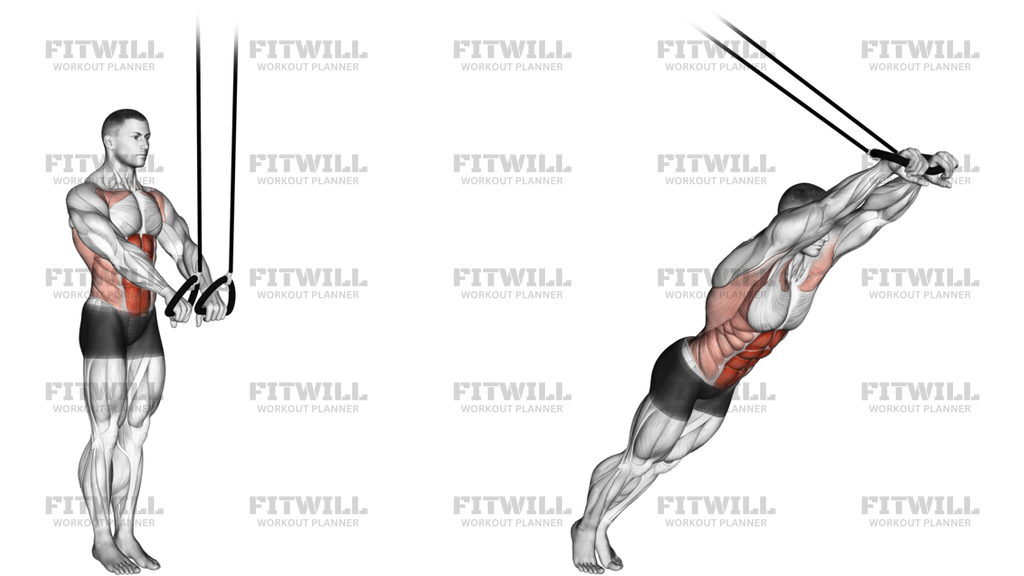
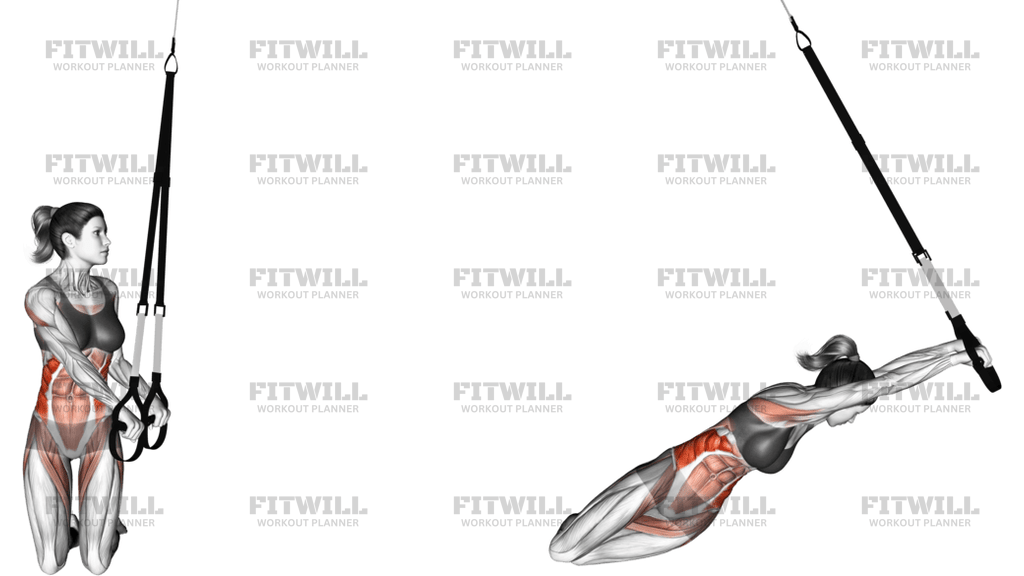
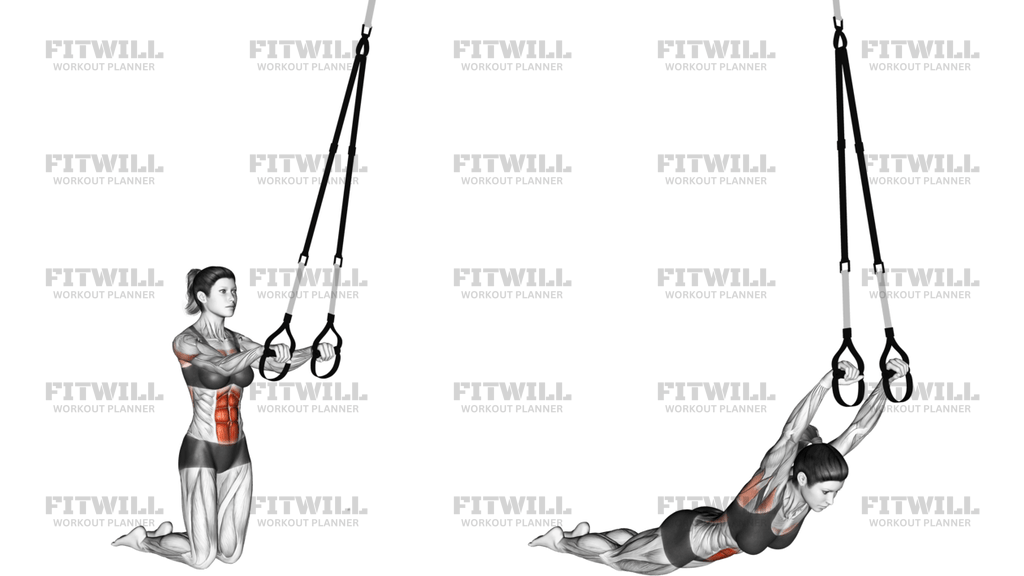
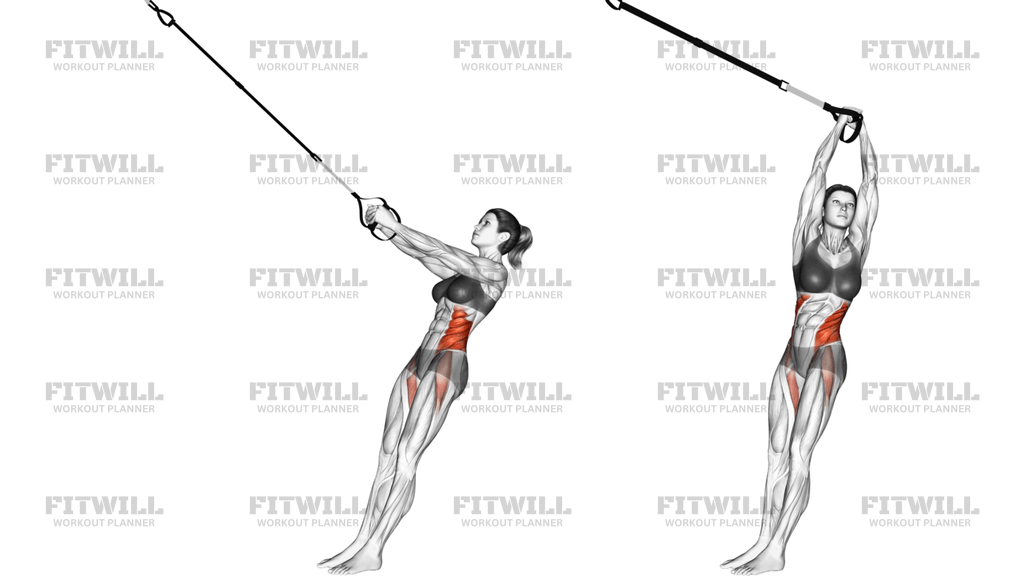
Suspender Bicycle Crunch
The Suspender Bicycle Crunch takes the classic bicycle crunch and moves your feet into suspension straps anchored above you. You lie on your back with each foot settled into its own foot cradle, legs extended and hovering, then drive the pedal-like knee-and-elbow pattern while your heels stay supported by the straps. That suspended support changes the exercise in two ways: it removes some of the balance struggle of a floor bicycle crunch, and it lets you keep tension on the abs through the whole set instead of dropping your legs to the ground between reps.
This version suits people who already handle regular bicycle crunches comfortably and want a harder, more continuous challenge. Because your legs never touch the floor, the deep core has to work the entire time to keep your lower back from arching off the mat. The straps also allow a longer, straighter leg position than many people can hold unsupported, which increases the lever arm on the abdominals and brings the hip flexors in as working helpers.
The main muscles trained are the rectus abdominis and the obliques, which rotate and flex the trunk as you bring opposite elbow toward opposite knee. The hip flexors assist on every knee pull, and the deep stabilizers work isometrically to hold your pelvis steady while your legs move. Expect the lower abs to feel particularly loaded during the extended-leg phases.
Setup quality matters more here than in a standard bicycle crunch. The straps should hang at an even length and the foot cradles should sit under the arch of each foot, not on the toes, so your heels stay secure when the straps go slack mid-rep. Lie far enough back that the straps hold your legs slightly above parallel to the floor; too close and the straps hang loose, too far and you fight the anchor instead of training your core.
To execute well, keep the movement driven by the ribs rotating toward the hip rather than the elbow chasing the knee. One leg extends long and low while the other draws in, then they switch. Slow the tempo down and aim for full rotation on each side instead of speed, since momentum is the easiest way to make this exercise look busy while doing very little.
Common use cases include advanced core circuits at home or in the gym with a suspension trainer, athletic programs that need anti-extension and rotational control, and breaking through a plateau on floor-based ab work. If your lower back lifts off the mat when your legs extend, bend the extended knee slightly or shorten the range until your trunk control catches up.
[ Workout Log & Planner ]
Put your next workout in Fitwill
Keep your plan and training log ready when you are.


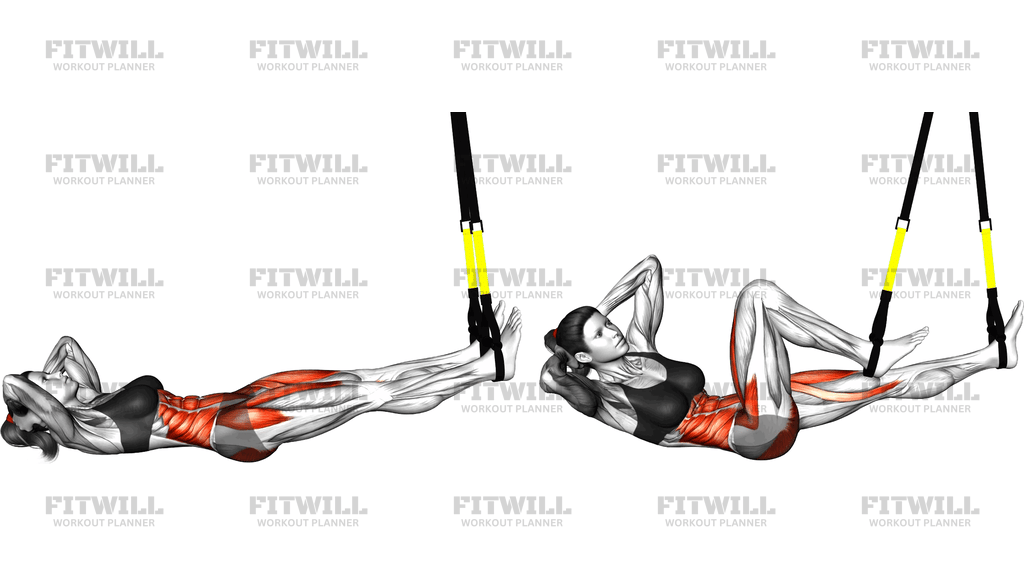
Instructions
- Anchor a suspension trainer overhead and adjust both straps to equal length so the foot cradles hang roughly knee height off the floor.
- Lie on your back on an exercise mat and place one foot into each foot cradle, straps running under the arches of your feet with heels settled in.
- Slide your body back until the straps are taut and your legs are extended straight out, hovering just above the floor.
- Place your hands lightly behind your head with elbows flared wide, and brace your abs so your lower back presses gently into the mat.
- Exhale as you curl your shoulders off the mat and draw your left knee in toward your chest while the right leg stays extended in the straps.
- Rotate your torso so your right elbow travels toward the left knee, twisting from the ribs rather than forcing the elbow forward.
- Switch sides in a smooth pedaling motion: extend the left leg back into the straps as you draw the right knee in and bring the left elbow toward it.
- Keep the straps under light tension throughout so your heels stay supported and your legs never touch down between reps.
- Inhale on each extension and exhale on each rotation, keeping the breathing rhythm steady as you alternate.
- Finish your set by bending both knees, lowering your hips and legs to the mat, and sliding your feet out of the cradles before standing up.
Tips & Tricks
- The most common mistake is pulling on your head with your hands, which strains the neck; rest your fingertips behind your ears and let the abs lift your shoulders instead.
- If the straps go slack mid-rep, you have scooted too close to the anchor; slide back until the straps hold your legs with light tension even at full extension.
- Resist the urge to speed up the pedaling. On this suspension version, a slow two-second rotation per side keeps tension on the obliques, while rushing turns it into a hip flexor swing.
- Watch your lower back during the long-leg phase: if it arches away from the mat, shorten the range by letting the extended knee bend a few degrees.
- Keep the working knee and the opposite elbow aiming at each other rather than the elbow dropping across to the chest, which flattens the rotation and halves the oblique work.
- Point your toes toward your shins in the foot cradles so the straps stay snug under your arches; curling the toes can let the cradle slip off mid-set.
- If your hip flexors cramp before your abs fatigue, extend the legs slightly less far out and focus on lifting the shoulders higher on each rotation.
- Place a folded towel under your hips if the mat feels thin, since the suspended position concentrates pressure on the tailbone during the set.
Frequently Asked Questions
What muscles does the Suspender Bicycle Crunch work?
The rectus abdominis and obliques do the main flexing and rotating, while the hip flexors assist each knee pull and the deep core stabilizes your pelvis the whole time your legs are suspended.
How is the Suspender Bicycle Crunch different from a regular bicycle crunch on the floor?
Your feet stay supported in the straps, so your legs never touch the floor between reps and your abs stay under continuous tension. The straps also let you hold a longer leg position than most people can manage unsupported, which raises the difficulty.
Can beginners do the Suspender Bicycle Crunch?
It is an advanced variation, so beginners should master floor bicycle crunches and dead bugs first. A good stepping stone is shortening the range so the extended knee stays bent, or performing only the leg movement in the straps with shoulders resting on the mat.
Why do my hip flexors burn more than my abs during this exercise?
When the legs extend far from the body or the torso stays flat, the hip flexors take over the work. Curl the shoulders higher, rotate fully so the ribs move toward the hip, and reduce how far the extended leg reaches to shift the load back onto the abs.
How long should the suspension straps be set for the Suspender Bicycle Crunch?
Adjust the foot cradles to hang around knee height and position yourself so the straps are taut with your legs extended and hovering just off the floor. If the straps hang loose during reps, slide your body back until tension returns.
How many reps should I do?
Because tempo drives the challenge, count slow, controlled rotations rather than fast reps. Eight to twelve full rotations per side with a deliberate pace is a solid working set.
Can I substitute the Suspender Bicycle Crunch if I do not have a suspension trainer?
A standard floor bicycle crunch is the closest substitute, or you can perform the same pattern with hands gripping a stable object behind your head for support. Resistance bands looped under the feet offer another way to add controlled tension.
Is it safe for my lower back?
It can be, as long as your lower back stays pressed toward the mat and you do not extend the legs beyond the point where your pelvis starts to tilt. If you feel strain in the lumbar area, bend the extended knee or reduce the set length.
Should my feet ever touch the floor during the set?
No. Keeping the legs suspended with light strap tension is what makes this variation distinct, so if your heels drop down, bend the extended knee slightly or reduce the reps until you can complete the set airborne.