Dumbbell Goblet Sumo Squat
The Dumbbell Goblet Sumo Squat combines two proven ideas into one accessible squat variation: the goblet hold, where a single dumbbell is cradled vertically against your chest, and the sumo stance, a wide foot position with toes turned outward. The result is a squat that hits the quads and glutes while placing extra emphasis on the inner thighs, which work hard to control your knees as they track out wide and pull you back up from the bottom.
This is one of the most beginner-friendly ways to learn squatting. Holding the weight at your chest acts as a counterbalance, letting you sit back and down without tipping forward, and it naturally encourages an upright torso. At the same time, the wide stance opens the hips and gives many lifters more depth than a narrow-stance squat allows. People with stiff ankles, longer femurs, or a history of feeling squats in their lower back often find this version immediately more comfortable.
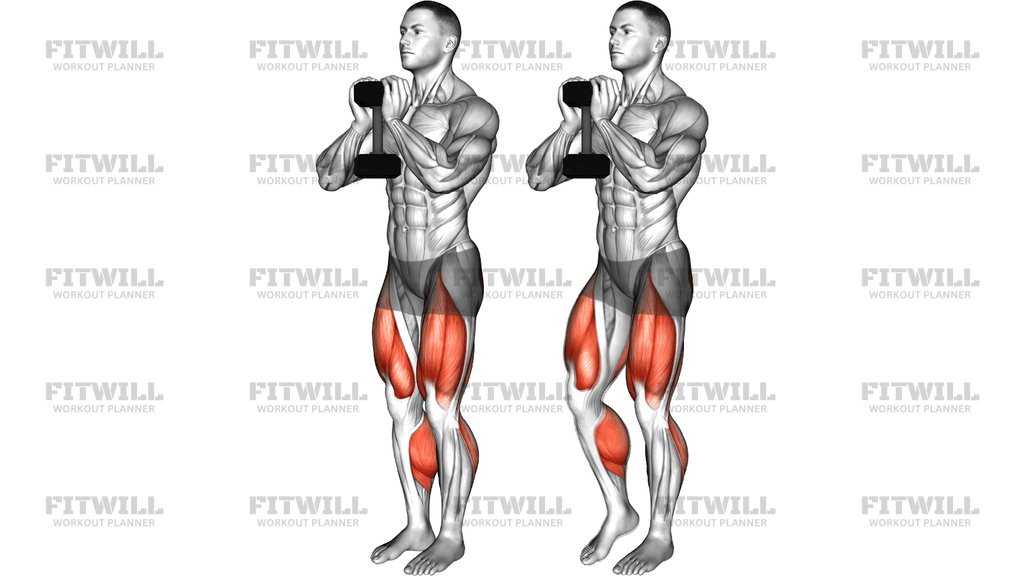
The primary muscles at work are the quadriceps and glutes, with heavy involvement from the adductors along the inner thigh. The hamstrings and calves assist, your core stabilizes the trunk against the forward load, and the upper back and shoulders work isometrically to keep the dumbbell in position. Because the weight stays light relative to your body and sits close to your midline, the stress on the spine is modest compared with back-loaded squats.
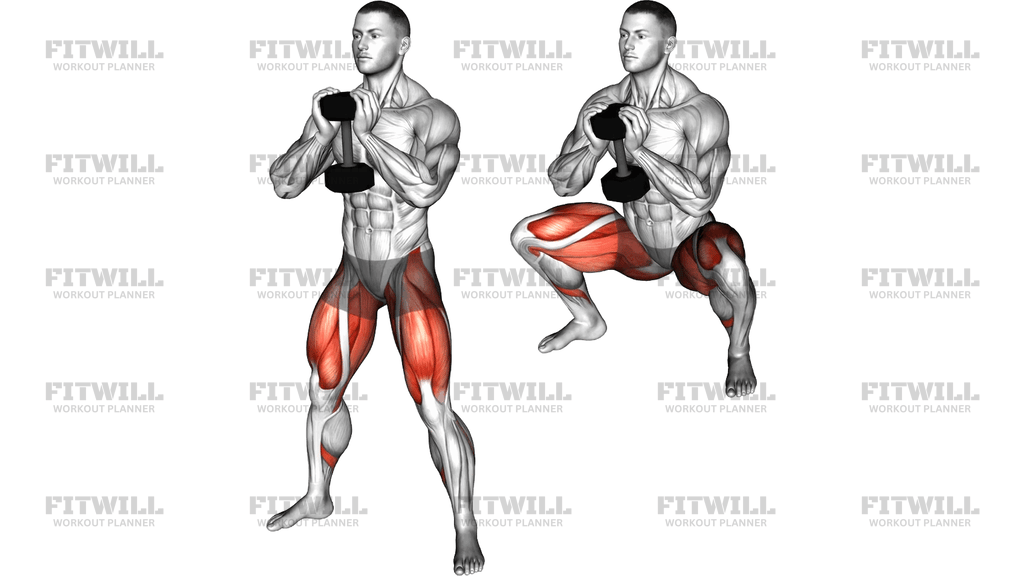
To set up, hold one dumbbell by one end with both hands so it stands vertically against your chest, your elbows tucked beneath it. Set your feet noticeably wider than shoulder width, toes angled out around 30 to 45 degrees. From there, descend by pushing your hips back and letting your knees travel out over your toes, sinking until your thighs are at least parallel or as deep as your mobility allows with a neutral spine.
Common uses for this exercise include general lower-body strength work, warm-ups before heavier squats, rehab-friendly leg training, and home workouts where only dumbbells are available. It also works well as a high-rep finisher, since the goblet position becomes a surprisingly demanding test of upper back and grip endurance when fatigue sets in.
The main form priorities are keeping your knees following the line of your toes, maintaining a braced and tall torso, and avoiding the temptation to let the dumbbell drift away from your chest. Keep the load honest: if you have to round your back or lean heavily forward to reach depth, reduce the weight or squat to a shallower depth while you build mobility.
[ Workout Log & Planner ]
Put your next workout in Fitwill
Keep your plan and training log ready when you are.


Instructions
- Hold a single dumbbell vertically by one end with both hands, cupping the top head underneath so it rests snugly against your upper chest, elbows pointing down.
- Set your feet wider than shoulder width, roughly one and a half times your shoulder width, with toes turned out at about 30 to 45 degrees.
- Brace your core by taking a breath into your belly and tightening your trunk, then pull your shoulders back gently so the dumbbell stays pressed to your chest.
- Shift your weight slightly into your heels and the middle of your feet, keeping your whole foot in contact with the floor.
- Push your hips back and bend your knees out in the same direction as your toes, descending until your thighs reach parallel or just below, as long as your back stays neutral.
- At the bottom, keep your knees pushed wide and your chest up, with the dumbbell still touching your chest rather than resting on it.
- Drive through your whole foot to stand back up, squeezing your glutes as your hips return under your shoulders.
- Exhale as you rise, then take a fresh breath at the top before starting the next rep.
- Complete your set, then step the dumbbell down to the floor by hinging at the hips rather than rounding over to reach it.
Tips & Tricks
- The most common fault is letting the knees cave inward as you fatigue. Cue yourself to spread the floor with your feet and track your knees over your little toes throughout every rep.
- If the dumbbell pulls you forward and rounds your upper back, the weight is too heavy or your grip is too loose. Cradle it actively against your sternum and keep your elbows under it, not flared out to the sides.
- Turning your toes out more does not replace actively pushing your knees out. The outward knee travel should come from your hip muscles, not just from foot angle.
- If your heels lift at the bottom, widen your stance slightly or reduce depth for now; forcing depth on stiff ankles pushes you onto your toes and strains the knees.
- Keep the descent controlled for two to three seconds. Dropping quickly into a wide stance makes the adductors absorb a stretch they may not be prepared for.
- Exhaling sharply at the top and losing core tension between reps is a frequent cause of a soft, leaning torso. Reset your brace at the top of every rep instead of only the first one.
- A half squat with a flat back beats a deep squat with a rounded lower back. Add depth gradually as your hip mobility improves.
- Because the goblet hold taxes your grip and upper back before your legs give out, rest 60 to 90 seconds between sets on heavier work rather than rushing into the next set with a slipping hold.
Frequently Asked Questions
What muscles does the Dumbbell Goblet Sumo Squat work?
It primarily targets the quadriceps and glutes, with strong involvement from the inner thigh adductors because of the wide stance. Your core, upper back, and forearms also work to hold the dumbbell against your chest.
How does the sumo stance change the squat compared with a normal goblet squat?
The wide, toes-out stance shifts some demand toward the adductors and glutes and lets many lifters sit deeper with a more upright torso. A standard stance places comparatively more emphasis on the quads alone.
Is the Dumbbell Goblet Sumo Squat good for beginners?
Yes, it is one of the best starting squats. The front-loaded counterbalance makes it easier to keep your chest up and find depth, and the light spinal load lets you practice the pattern before moving to barbell variations.
How do I hold the dumbbell in the goblet position?
Stand the dumbbell on end and cup the top head with both hands, fingers wrapped around the underside of one end, pressing it against your sternum with your elbows pointing down and close to your body.
Why do my inner thighs get sore after this exercise?
The wide stance places your adductors under a long stretch and makes them work hard to control your knees on the way down. That soreness is normal and typically fades as the muscles adapt; manage depth and load if it is excessive.
Should my knees go past my toes?
With a wide sumo stance, your knees should travel outward over and slightly past your toes in line with them. That is a natural joint path; the thing to avoid is knees collapsing inward or heels lifting off the floor.
How deep should I squat on the Dumbbell Goblet Sumo Squat?
Aim for thighs at least parallel to the floor while keeping a neutral spine, and go deeper if you can maintain control. Depth should progress as your hip and ankle mobility allow, never at the cost of a rounded lower back.
What can I use instead of a dumbbell?
A kettlebell held by the horns works almost identically, and a weight plate or sandbag hugged to the chest is a reasonable substitute. With no equipment at all, a bodyweight sumo squat with arms extended forward mimics the counterbalance.
Is this exercise safe if I have knee discomfort?
The wide stance and upright torso are often easier on the knees than narrow squats, but you should still work within a pain-free range, keep knees tracking over toes, and consult a professional if discomfort persists.
How heavy should the dumbbell be?
Pick a weight you can hold against your chest for all reps without your upper back rounding or the dumbbell sliding, often 10 to 25 kg for many adults. Once your legs outgrow the load your grip allows, transition to heavier goblet-friendly implements or barbell variations.