Dumbbell Goblet Bulgarian Split Squat
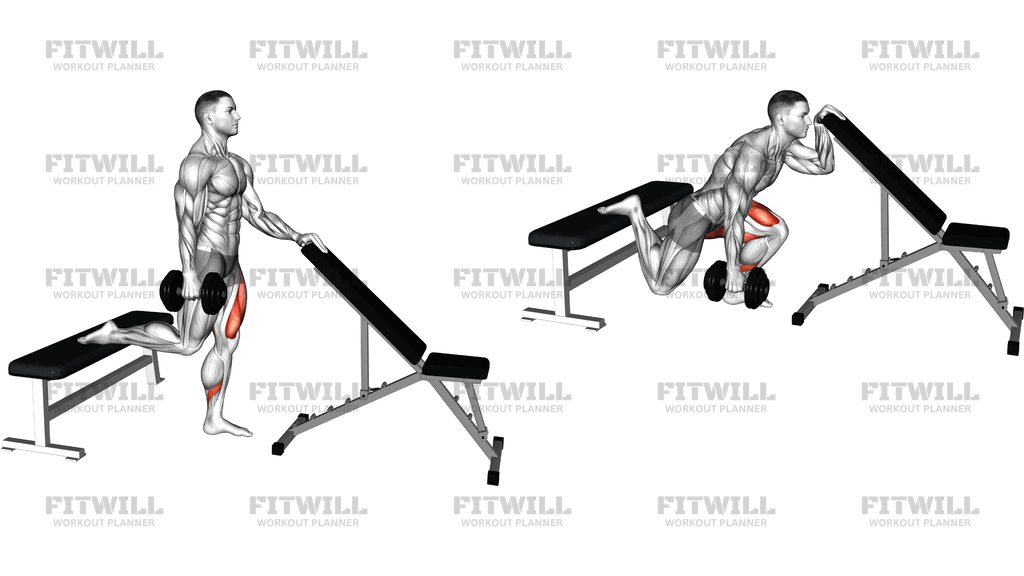
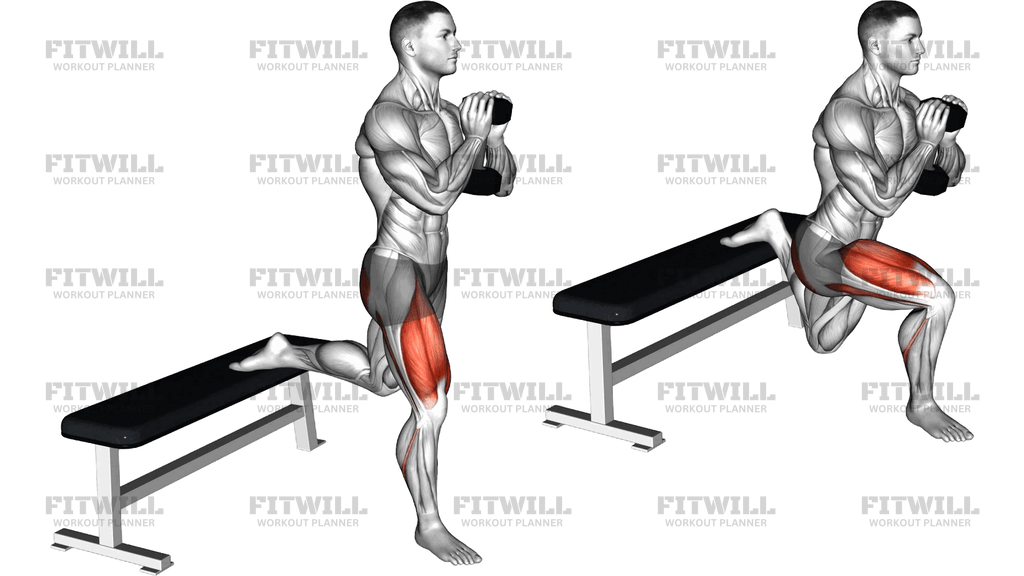
The Dumbbell Goblet Bulgarian Split Squat is a single-leg strength exercise where the rear foot is elevated on a flat bench behind you while you hold a dumbbell vertically against your chest in the goblet position. The front leg does almost all of the work as you lower into a deep split squat and drive back up, and the chest-held weight shifts the load forward so the front thigh, especially the quadriceps, takes the brunt of the effort.
This movement earns its place in nearly any lower body program. Because each leg works independently, it exposes and helps correct side-to-side strength differences that bilateral squats can hide. It also demands balance and trunk control, so your core works to keep you upright while the standing hip stabilizes through the entire range. Compared with a back-loaded Bulgarian split squat, the goblet position is easier on the lower back and lets you stay more vertical through the torso.
Setup matters more here than in most squat variations. Your front foot needs to be far enough forward that your knee can travel over your toes without your heel lifting, and your rear foot should rest comfortably on top of the bench with the laces down. If the stance is too short, you will feel it jamming in the front of the hip and the knee will shoot forward; too long, and you turn it into more of a hamstring stretch with a strained groin.
To perform it well, brace your trunk, hinge slightly at the hips, and descend under control until your rear knee hovers just above the floor and your front thigh reaches at least parallel. Press through the whole front foot, with a natural bias toward the mid-foot and heel, and stand back up without letting the knee cave inward. Keep the dumbbell tucked close to your chest so it does not pull you forward.
This is a go-to exercise for lifters who want big quad development without heavy barbell spinal loading, for runners and field-sport athletes building single-leg strength, and for anyone rehabbing back into squatting patterns after a layoff. Start with a light dumbbell or body weight only until the footwork feels automatic, then add load gradually. Expect your balance to be the limiting factor early on, not your leg strength, and treat wobbly early sessions as normal skill acquisition rather than a problem to fix.
[ Workout Log & Planner ]
Put your next workout in Fitwill
Keep your plan and training log ready when you are.


Instructions
- Place a flat bench behind you and stand about two to three feet in front of it, facing away from the bench.
- Reach back with one foot and rest the top of that foot and toes on the bench, laces down, letting the rear knee bend naturally.
- Hold one dumbbell vertically by one end with both hands at chest height, elbows tucked close to your ribs, in the goblet position.
- Position your front foot so that when you descend, your shin stays roughly vertical and your full foot stays planted; adjust now, not mid-set.
- Brace your core, lift your chest, and shift a slight backward hinge into your hips so your weight sits over the front leg.
- Inhale, then lower straight down until your rear knee is just above the floor and your front thigh is at or below parallel.
- Exhale and drive through the mid-foot and heel of the front leg to stand back up, keeping the knee tracking over or slightly outside the toes.
- Complete all reps on one leg, then set the dumbbell down, switch legs, and repeat on the other side.
- Between sets, reset your front foot position before starting the next set so your stance stays consistent.
Tips & Tricks
- If your front heel lifts at the bottom, your stance is too short; step the front foot forward two or three inches and retest.
- Point the toes of both your front foot and your elevated rear foot forward. A twisted rear leg on the bench is a common source of knee and hip discomfort in this movement.
- Keep the dumbbell pressed lightly against your sternum. Letting it drift forward as you fatigue is the fastest way to lose your upright torso.
- Do not bounce the rear knee off the floor. A light touch at most, or stopping just above it, keeps tension on the front leg where you want it.
- Most people stand too close to the bench. If your rear leg feels like it is being yanked at the hip or quad at the bottom, move your front foot farther forward.
- If you wobble side to side, cut the weight in half before changing anything else. Balance usually catches up within a few sessions.
- Let the front knee travel forward over the toes naturally. Forcing it to stay behind the toes turns this into an awkward partial squat and robs the quads of range.
- A slight forward lean of the torso is fine and actually increases glute involvement; a rounded lower back is not. If you round, lighten the load and re-brace.
- Do your weaker leg first and match the reps with your stronger leg rather than the other way around.
Frequently Asked Questions
Which muscles does the Dumbbell Goblet Bulgarian Split Squat work the most?
The quadriceps of the front leg are the primary movers, with the glutes contributing strongly as you stand up out of the deep position. The hamstrings, calves, and core work in supporting and stabilizing roles throughout.
Why hold the dumbbell in the goblet position instead of at my sides?
Holding the dumbbell vertically against your chest keeps the weight centered and slightly forward, which helps you stay upright and biases load toward the quads. Many people also find it easier on grip and balance than holding dumbbells at arm's length at the sides.
How high should the bench be for the Dumbbell Goblet Bulgarian Split Squat?
A standard flat bench, roughly knee height or slightly lower, works well. Higher surfaces tilt your torso and stress the rear hip and knee more, so stick with knee height or below until your mobility is solid.
Can beginners do the Dumbbell Goblet Bulgarian Split Squat?
Yes, and it is one of the better single-leg exercises to learn early because the goblet load counters balance. Start with no weight or a very light dumbbell for sets of 6 to 8 per leg until the footwork and depth feel consistent.
My back leg cramps on the bench during this exercise. What should I change?
That usually means your front foot is too close to the bench, which over-flexes the rear hip and quad. Slide your front foot forward, keep only the top of the rear foot on the bench, and shorten the range slightly for a few sessions.
Should my front knee go past my toes?
Yes, that is normal and expected in a deep split squat as long as the heel stays down and the knee tracks in line with the foot. Trying to keep the knee behind the toes forces an unnatural upright shin and limits depth.
What can I use instead of a bench to elevate my rear foot?
Any stable surface around knee height works, such as a sturdy chair, a plyometric box, or a smith machine bar set at the right height. Avoid anything that rolls or shifts, since your rear foot needs a secure footing for the whole set.
How heavy should the dumbbell be?
Pick a weight you can control for 8 to 12 reps per leg without your torso pitching forward or your heel lifting. Because each leg works alone and balance is involved, most lifters use noticeably less than their bilateral squat loads.
Is knee discomfort during the Dumbbell Goblet Bulgarian Split Squat normal?
Mild muscular effort in the thigh is normal, but sharp or pinching knee pain is a signal to adjust. Check that your heel stays planted, your knee tracks over the foot rather than caving inward, and that your stance is not too short, and reduce the load or depth if it persists.
Should I do one leg fully and then the other, or alternate?
Finish all reps on one leg before switching. Alternating mid-set forces you to reset your stance every rep and breaks the rhythm and tension that make this exercise effective.