Dumbell Bulgarian Split Squat From Deficit
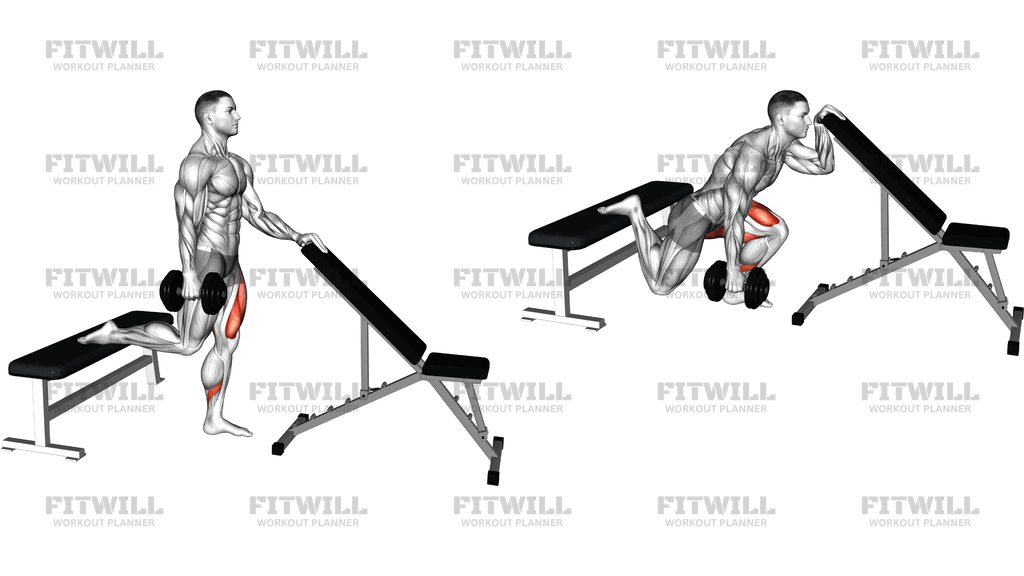
The Dumbbell Bulgarian Split Squat From Deficit is a single-leg squat variation where your front foot stands on a raised step platform and your rear foot rests on a flat bench behind you. Holding a dumbbell in each hand at your sides, you lower your back knee toward the floor until your front thigh is roughly level with the step, then drive back up. The deficit under the front foot extends the range of motion beyond what a standard Bulgarian split squat allows, letting the front knee travel deeper over the toe at the bottom.
This movement is one of the most demanding unilateral leg exercises you can program. The deep range places a strong stretch and load on the quadriceps, while the glutes and hamstrings of the front leg work hard to extend the hip out of the hole. The rear-foot-elevated position also shifts weight onto the front leg, which challenges balance, hip stability, and the small stabilizing muscles around the ankle and knee far more than a regular two-legged squat.
Setup matters more here than in most squat variations because the deficit adds height and instability. Your front foot should be fully planted on the step with your whole foot in contact, not just the toes, and the bench should be stable and roughly knee height. The distance between your front foot and the bench determines whether the emphasis leans toward quads (closer) or glutes and hamstrings (farther), so take a moment to find your stance before loading weight.
This exercise suits intermediate to advanced lifters who already own the standard Bulgarian split squat and want more depth, more quad tension, and greater hip flexor mobility demand. It is a staple in lower-body hypertrophy programs, a useful tool for addressing left-right strength differences, and a way to load one leg heavily without a barbell compressing the spine.
To execute it well, keep your torso slightly leaned forward with a braced core, and let the front knee track over or slightly beyond the toes as you descend. Control the lowering phase, briefly pause at the bottom without bouncing, and push the floor away through your whole front foot. Common mistakes include rushing the descent, letting the front heel lift off the step, and standing too close to the bench, which crams the knee and makes the bottom position uncomfortable.
Because the deficit increases knee flexion, build up gradually with lighter dumbbells or no weight at first. If your front heel rises or your knee pinches at depth, shorten the range or remove the deficit until your mobility catches up.
Fitwill
Log Workouts, Track Progress & Build Strength.
Achieve more with Fitwill: explore over 9600 exercises with images and videos, access built-in and custom workouts, perfect for both gym and home sessions, and see real results.
Start your journey. Download today!




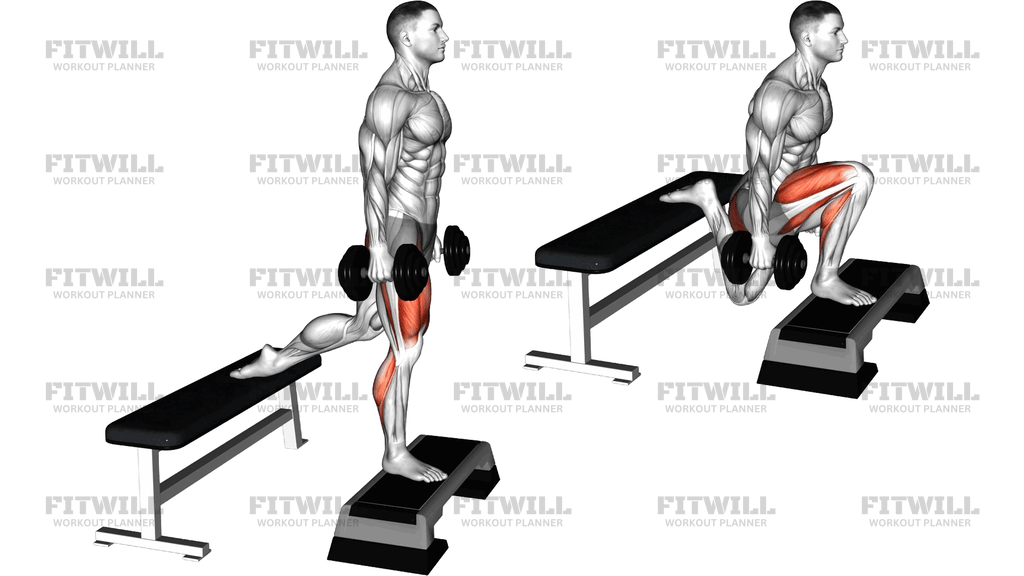
Instructions
- Place a stable step platform on the floor and position a flat bench roughly knee height about two feet behind it.
- Stand facing away from the bench, set the top of your rear foot on the bench pad with the laces down, and plant your entire front foot flat in the center of the step platform.
- Pick up a dumbbell in each hand and let your arms hang straight down at your sides with a neutral grip, shoulders back and down.
- Brace your core and set your gaze on a fixed point ahead of you to keep your balance steady.
- Bend your front knee and hip to lower your body straight down, letting the rear knee drop toward the floor while the front knee tracks over your toes.
- Descend until your front thigh reaches at least parallel with the step and your rear knee hovers just above the floor.
- Pause briefly at the bottom, then drive through your whole front foot to push back up to the full standing position.
- Exhale as you rise and inhale as you lower, keeping the dumbbells still at your sides throughout the rep.
- Complete all repetitions on one leg, then step down carefully, switch legs, and repeat on the other side.
Tips & Tricks
- If your front heel peels off the step at the bottom, the deficit is too aggressive for your ankle mobility—use a lower platform or spend time on calf and ankle mobility first.
- Keep about 70 to 80 percent of your weight on the front leg; pushing hard off the rear foot on the bench steals tension from the working leg.
- A slight forward torso lean is fine and actually helps hip depth, but avoid rounding your lower back as the dumbbells pull you down.
- Stop the descent just before your rear knee touches the floor so the working muscles stay under continuous tension instead of unloading at the bottom.
- If your knee aches at full depth, shift your front foot slightly farther from the bench to reduce how far the knee travels over the toes.
- Hold the dumbbells with a relaxed grip; squeezing the handles hard tends to raise your shoulders and throw off your balance.
- Keep your hips square to the front—many lifters let the trailing hip open outward as fatigue builds, which reduces glute work on the front leg.
- Master bodyweight reps on the deficit first; the added range of motion makes this version significantly harder than the standard bench setup at the same load.
Frequently Asked Questions
Which muscles does the Dumbbell Bulgarian Split Squat From Deficit work?
The quadriceps of the front leg are the primary movers, with strong contributions from the glutes and hamstrings as they extend the hip from a deep position. The calves, adductors, and hip stabilizers work to keep you balanced on the raised step.
What does the deficit actually add compared to a regular Bulgarian split squat?
Elevating the front foot on a step platform increases the range of motion, especially knee flexion at the bottom, which places the quads under a longer stretch and makes the same load noticeably harder.
Is this exercise suitable for beginners?
It is better suited to lifters who are already comfortable with a standard Bulgarian split squat. Beginners should start with a bodyweight version on the floor, then add the bench elevation and finally the deficit as balance and mobility improve.
How far should my front foot be from the bench?
A good starting point is roughly two feet, or about one shin length, between the step and the bench. A shorter distance biases the quads, while a longer stance shifts more work to the glutes and hamstrings.
Why does my front heel lift off the step at the bottom?
This usually points to limited ankle dorsiflexion or too large a deficit. Try a lower platform, move your front foot slightly farther from the bench, and work on calf and ankle mobility between sessions.
How heavy should the dumbbells be?
Choose a weight you can control for 8 to 12 controlled reps per leg without losing balance or heel contact. Most people need far less load here than they expect, because the single-leg deficit position is demanding on its own.
Should my front knee travel past my toes?
Yes, some forward knee travel is normal and expected with this movement, particularly with the added depth of the deficit. The key is that the knee stays tracking in line with the foot rather than collapsing inward.
What can I use instead of a step platform?
Any stable, low, non-slip surface such as a weight plate, a low plyo box, or a stacked mat can create the deficit. The rear foot still needs a knee-height bench or similar sturdy elevation.
Is it safe for my knees?
When performed with controlled tempo, a stable stance, and a depth your mobility allows, it is a well-tolerated leg exercise for healthy knees. If you have a current knee issue or feel sharp pain at depth, reduce the range, remove the deficit, or consult a qualified professional first.
How should I breathe during the movement?
Inhale and brace before you descend, keep the air in through the lowering phase, and exhale as you drive up. Avoid holding your breath for multiple reps, especially with heavier dumbbells.