Dumbell Contralateral Glute Dominant Bulgarian Spl
The Dumbbell Contralateral Glute Dominant Bulgarian Split Squat is a rear-foot-elevated split squat performed with a deliberate forward hinge at the hips and a single dumbbell held in the hand opposite your working front leg. Your free hand grips a rack post or bar in front of you for light balance support, which lets you tilt the torso forward without losing stability. That combination — the hinge, the offset load, and the elevated rear foot — shifts the demand away from the front of the thigh and onto the glutes and hamstrings of the front leg.
This variation suits lifters who want serious unilateral glute work without standing balance being the limiting factor. The rack grip acts like a spotter for your torso angle, so you can load the pattern more heavily than you could a freestanding single-leg hinge. It is also a good choice for people who feel Bulgarian split squats mostly in their quads, for athletes addressing left-to-right strength differences, and for anyone whose knees tolerate a more vertical-shin, hip-dominant squat pattern better than a deep upright one.
The main work comes from the gluteus maximus and hamstrings of the front leg as they extend the hip out of the bottom position, with the gluteus medius and adductors stabilizing the front hip and knee throughout. Holding the dumbbell on the opposite side from the working leg lengthens the load path across the body, which both biases the glute line of pull and forces the obliques and deep core to resist side bending. The rear leg contributes very little force here — it exists mostly to anchor you to the bench.
Setup quality decides everything in this movement. A bench around knee to mid-shin height, a front-foot distance that lets your shin stay close to vertical, and a genuine hip hinge of roughly 30 to 45 degrees are what separate a glute-dominant rep from a quad-dominant one. If you stand too upright, or let the dumbbell drift forward of your shoulder line, the exercise quietly becomes a front-knee split squat. Recheck your torso angle every few reps, because fatigue tends to pull people upright.
To execute well, lower with control until your rear knee nearly touches the floor and your front hip is fully flexed, keeping your weight stacked through the front heel and mid-foot. Drive the floor away and finish tall by squeezing the front glute, rather than by leaning back or pushing off the bench with the rear toes. Exhale on the way up, inhale on the way down, and keep a light — not death-grip — hold on the rack.
Program it for 6 to 12 reps per side with a weight you can control through the full range, always starting with your weaker or non-dominant leg and matching reps on the other side. Stop the set the moment your torso rises or your front knee starts caving inward; those are signs the working glute is done, not signs to grind out two more ugly reps.
[ Workout Log & Planner ]
Put your next workout in Fitwill
Keep your plan and training log ready when you are.


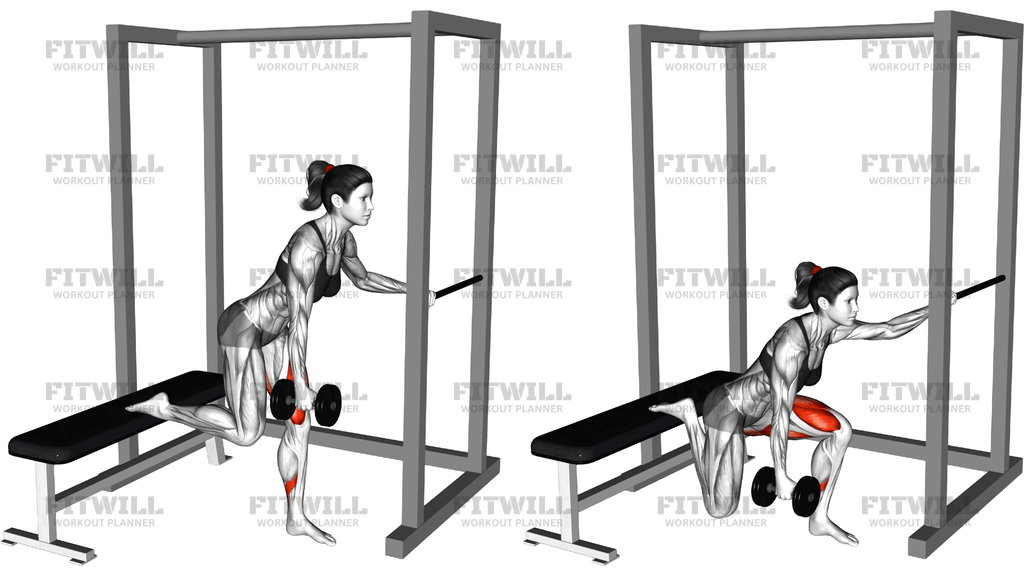
Instructions
- Place a flat bench or sturdy box behind you at about knee to mid-shin height and clear enough space to step forward comfortably.
- Rest the top of your rear foot on the bench, shoelaces down, and hop your front foot forward until you can lower with your front shin close to vertical and your knee tracking over your mid-foot.
- Hinge forward from the hips by roughly 30 to 45 degrees, keeping your back flat, chest angled toward the floor, and your weight loaded through the front heel and mid-foot.
- Hold a dumbbell in the hand opposite your front leg, letting it hang straight down beside your ribs, and grip a rack post or bar at roughly waist height with your free hand.
- Brace your core, pull your ribs down, and create light tension between your front foot and the floor as if gently spiraling your front knee outward.
- Lower under control, bending the front knee and letting the rear knee travel down until it is just above the floor, holding the same forward torso angle the whole way.
- Pause briefly in the stretched position, then drive through the front heel and mid-foot to stand back up, finishing with a firm squeeze of the front glute.
- Exhale as you rise, inhale as you descend, and keep the rack grip light so the front leg, not your arm, does the lifting.
- Complete all reps on one side, then set the dumbbell down, switch legs, and repeat the same number of reps with the dumbbell in the other hand.
- Reset your hinge and foot position before each set if you felt the previous set drift upright or lose depth.
Tips & Tricks
- If you feel this mostly in the front of your thigh, you have likely lost the hinge — push your hips back until your chest is angled toward the floor and your front shin is closer to vertical.
- A common mistake is placing the front foot too close to the bench, which forces the front knee far past the toes; step farther out until the descent feels like a hinge, not a knee slide.
- Keep the rear foot on the bench purely for anchoring — if you feel your rear calf and toes pushing hard off the bench, you are stealing work from the front glute.
- Let the dumbbell hang vertically under your shoulder; letting it drift forward turns the offset load into a lever that pulls you out of the hinge.
- Use a fingertip or loose grip on the rack post — pulling yourself up with the hand turns this into an assisted movement and removes tension from the working leg.
- If your lower back rounds at the bottom, you are chasing depth your hips do not have yet; stop the descent just before the rounding starts and build range gradually.
- Always start with your weaker leg and match the reps on the stronger side, so the imbalance narrows instead of grows.
- Choose a dumbbell you can control for the target reps on the weaker side — the contralateral hold also challenges your obliques, and a weight that makes you side-bend defeats the purpose.
- Wear flat, stable footwear or go barefoot; a soft, compressible sole makes the front foot wobble on this hinged single-leg setup.
Frequently Asked Questions
What does "contralateral" mean in the Dumbbell Contralateral Glute Dominant Bulgarian Split Squat?
It means the dumbbell is held in the hand opposite your working front leg, while your free hand grips the rack for balance. This offset placement lengthens the load path across your body and biases the glute and hamstring line of the front leg.
Which muscles does this exercise target?
The glutes of the front leg are the primary movers, supported by the hamstrings and quads. The gluteus medius and adductors stabilize the front hip, and the obliques work to stop the offset dumbbell from pulling you into a side bend.
Why does this version have me leaning forward and holding a rack?
The forward hinge lengthens the glutes and hamstrings of the front leg, shifting work away from the quads. Gripping a rack post keeps that torso angle stable so balance, not strength, is never the limiting factor.
How far should my front foot be from the bench?
Far enough that your front shin stays close to vertical at the bottom. A good check: when you descend, your knee should stack over your mid-foot rather than shooting well past your toes.
How deep should I lower?
Lower until your rear knee is just above the floor and your front hip is fully flexed, as long as your lower back stays neutral. If your pelvis tucks and your back rounds at the bottom, reduce the depth and work on hip mobility over time.
Is this exercise suitable for beginners?
Beginners should first master a bodyweight glute-dominant Bulgarian split squat with the same forward hinge and rack support. Once the foot positions and hinge feel automatic, add a light dumbbell and build from there.
Why do I feel this in my rear leg's calf instead of my front glute?
Your rear foot is likely pressing hard into the bench to help you up. Keep the rear leg relaxed and for balance only, and consciously drive all your force through the front heel and mid-foot.
What can I substitute if I don't have a bench?
You can rest your rear foot on any stable knee-height surface, or perform a dumbbell contralateral reverse lunge with the same forward hinge. The lunge version adds a balance demand but trains the same glute-dominant pattern.
How heavy should the dumbbell be, and how many reps should I do?
Pick a weight you can control for 6 to 12 reps per side without your torso rising or your grip on the rack doing the lifting. The light rack support means you can often load this heavier than a freestanding single-leg variation, but progress gradually.
Are there any safety concerns with this movement?
The main risks are losing the hinge and straining your lower back, or letting the front knee collapse inward under load. Keep the rack grip available for balance, stop the set when your torso angle degrades, and make sure the bench behind you is stable before you start.