Landmine Squat
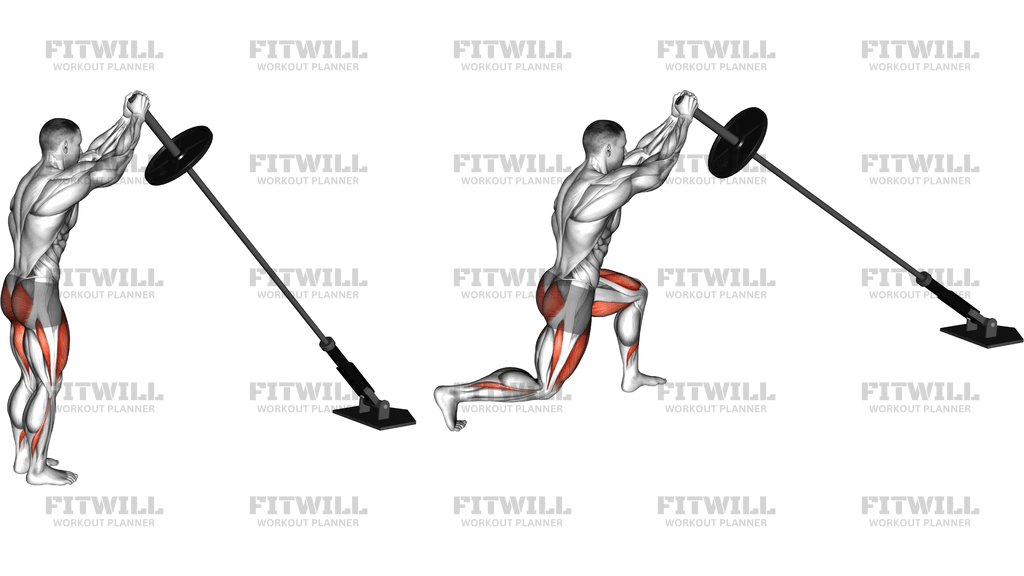
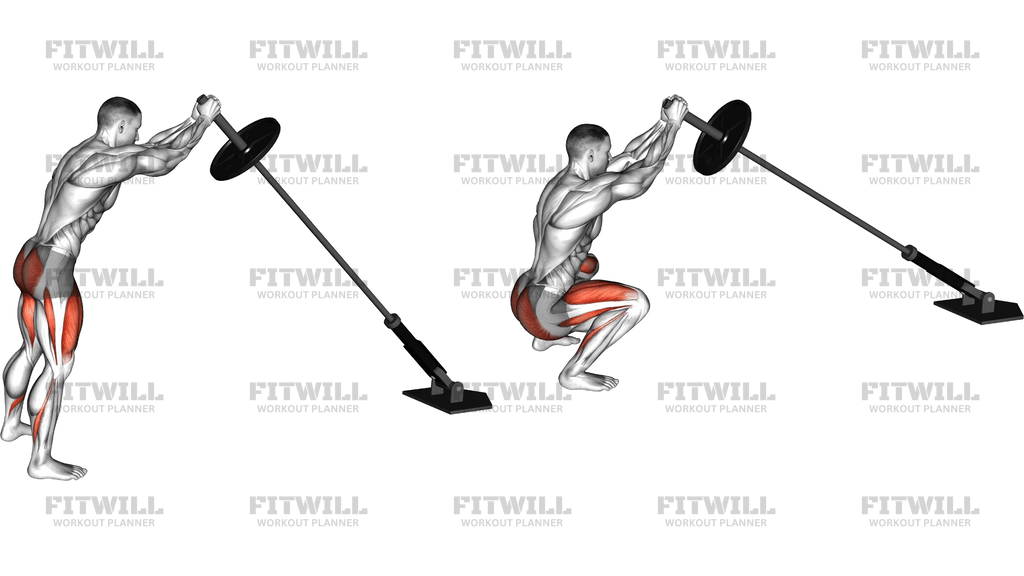
The Landmine Squat is a barbell squat variation performed with one end of the barbell anchored in a landmine attachment or wedged into a corner, while you hold the free end with both hands in front of your chest or above shoulder height. As you descend into the squat, the anchored bar creates a natural forward lean with the arms extended, which shifts the emphasis toward the quadriceps and glutes while sparing the lower back from heavy axial loading. Because the bar pivots on a fixed point instead of sitting across your spine, the resistance stays partially supported by the ground, making the movement feel smoother and more forgiving than a traditional back squat.
This exercise suits a wide range of lifters. Beginners often find it easier to learn a proper squat pattern here than with a bar on their back, since the landmine gives them something to reach toward and helps counterbalance the hips. More experienced lifters use it as a lower-back-friendly squat alternative, a way to add squat volume without spinal compression, or a rehab-friendly option when overhead or back-loaded positions are uncomfortable.
The setup matters more than people expect. Your distance from the anchor point determines how much forward lean the bar forces on you: standing too close turns it into an almost upright front squat, while standing too far back makes it feel like a leaning good morning. The goal is to find the distance where you can sit straight down between your feet, keep your arms extended, and let the bar travel in a gentle arc rather than pulling you forward onto your toes.
To execute it well, grip the sleeve with both hands at chest height, brace your trunk, and squat by pushing your hips back and bending your knees until your thighs reach at least parallel or as deep as your mobility allows. Keep the bar path close to your body and let your arms rise naturally as you descend, resisting the urge to shrug or bend your elbows. Drive through your whole foot to stand back up, finishing with your hips and knees together.
Common use cases include home gym training where a rack is unavailable, teaching squat mechanics to novices, higher-rep hypertrophy work for the quads and glutes, and conditioning circuits where quick weight changes matter. The lift also loads the core meaningfully, since your trunk has to resist the forward pull of the bar throughout every rep.
From a safety standpoint, keep the sleeve securely seated in the anchor before loading, start lighter than you think you need, and make sure your feet stay flat with knees tracking over them. If your heels lift or your lower back rounds at the bottom, shorten the range slightly and work on ankle and hip mobility rather than forcing depth.
Fitwill
Log Workouts, Track Progress & Build Strength.
Achieve more with Fitwill: explore over 9600 exercises with images and videos, access built-in and custom workouts, perfect for both gym and home sessions, and see real results.
Start your journey. Download today!




Instructions
- Place one end of a barbell in a landmine attachment or securely wedge it into a corner at floor level, and load plates onto the free end.
- Face the anchor and stand far enough back that you can hold the sleeve at chest height with both hands clasped together, arms extended, and your feet about shoulder-width apart with toes turned out slightly.
- Take a full breath and brace your trunk as if preparing for a light punch to the stomach, keeping your chest tall and shoulders relaxed.
- Push your hips back and bend your knees to lower into a squat, letting your arms extend up and forward so the bar travels in a smooth arc as you descend.
- Keep your weight distributed across your whole foot, with heels planted and knees tracking in line with your toes.
- Descend until your thighs are at least parallel to the floor, or as deep as you can go without your heels lifting or lower back rounding.
- Drive through your feet to stand back up, extending your hips and knees together while keeping the bar close to your body.
- Exhale as you rise, then reset your brace at the top before starting the next rep.
- Complete all reps on one set, then carefully lower the sleeve back to the anchor and step away from the bar before unloading plates.
Tips & Tricks
- If the bar pulls you onto your toes, you are standing too far from the anchor; take a half-step closer until you can sit straight down between your feet.
- Keep your elbows mostly extended and let the shoulders move, rather than pulling the bar down with your arms as you tire.
- A common mistake is letting the chest collapse and the bar drift forward at the bottom; cue yourself to reach up and slightly back with the bar as you descend.
- Wedge a small plate or wedge under your heels only if ankle mobility genuinely limits depth, and treat it as a temporary fix while you work on mobility.
- Do not rush the eccentric; a controlled two-count descent keeps the bar arc smooth and stops the plates from bouncing you out of the bottom.
- Grip the sleeve with one hand stacked over the other rather than side by side, which gives you a more secure hold as the sleeve angle changes.
- Check that the anchored end cannot slip before every heavy set, especially if you are using a corner instead of a proper landmine attachment.
- If your knees cave inward at the bottom, think about spreading the floor with your feet; this is the most frequent side-effect of fatigue on this lift.
- Keep reps at moderate range (8-15) when learning the movement, since the balance demand grows quickly as the set progresses.
Frequently Asked Questions
What muscles does the Landmine Squat work?
The quadriceps and glutes do most of the work, with the hamstrings and calves assisting. Your core, especially the trunk stabilizers, works hard the whole time to resist the forward pull of the bar.
Is the Landmine Squat good for beginners?
Yes, it is one of the easiest squat variations to learn because the bar acts as a counterbalance and the anchored setup limits how far forward you can lean. Beginners can groove the squat pattern with light load before progressing to back or front squats.
How far should I stand from the landmine anchor?
Stand at a distance where you can hold the bar at chest height with slightly bent arms and squat straight down without being pulled forward. A good starting point is roughly an arm's length from the anchor, then adjust by small steps until the bar path feels smooth.
Why does the Landmine Squat feel easier on my lower back than a barbell squat?
The bar pivots on the ground-anchored end, so part of the load is supported by the floor and never rests across your spine. This removes most of the direct axial compression, though you should still keep your trunk braced throughout each rep.
Should my arms stay straight during the Landmine Squat?
Your arms should stay mostly extended and simply follow the arc of the bar as you squat down and up. Actively pressing or pulling with the arms shifts work away from your legs and destabilizes the bar path.
What can I use if I don't have a landmine attachment?
You can wedge the bare end of the barbell firmly into a corner, ideally over a towel to protect the wall, or place it under a heavy dumbbell to keep it from sliding. Check that it cannot slip before adding plates.
How deep should I squat on the Landmine Squat?
Aim for thighs at least parallel to the floor, or deeper if you can keep your heels down and your lower back neutral. Depth you cannot control adds risk without adding much benefit.
Why do my heels lift at the bottom of the movement?
This usually points to limited ankle mobility or standing too far from the anchor, which exaggerates your forward lean. Step slightly closer, reduce the depth a little, and consider ankle mobility work to fix it at the source.
Can I use the Landmine Squat as my main squat exercise?
It can serve as a primary squat pattern for general strength and hypertrophy, but the pivoting bar limits how much absolute load you can handle compared with a back squat. Many lifters use it for volume, technique work, or as a deload-friendly main lift.