Duck And Forward Punches
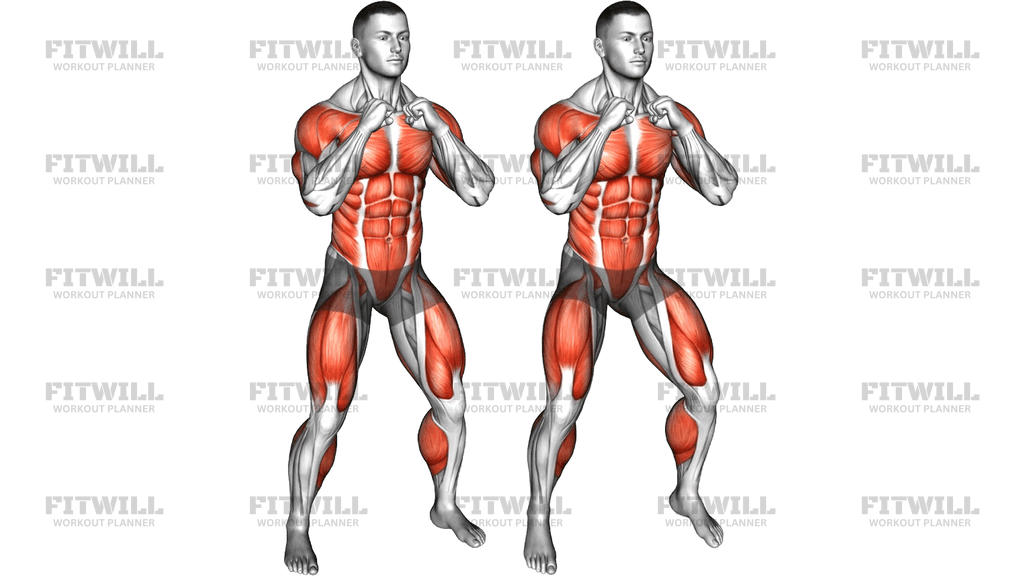
Duck And Forward Punches is a body-weight boxing drill that combines a level change with straight punches thrown from a guard position. You stand in a staggered fighting stance with both fists raised to chin height, dip your body down by bending the hips and knees, then rise back up while driving alternating punches straight out in front of you. The result is a movement that trains coordination between your lower and upper body while keeping your heart rate high.
This drill suits anyone who wants the conditioning and rhythm benefits of boxing work without a bag, pads, or a partner. It is common in warm-ups, circuit training, and boxing-style fitness classes, and it translates well to small spaces because you only need room to stand and extend your arms. Because the punch is unloaded, you can focus entirely on speed, mechanics, and breathing rather than on moving a resistance.
The movement challenges the shoulders, chest, and triceps through the punching action, while the duck demands controlled work from the quads, glutes, and calves as you lower and drive back up. Holding the guard position between punches keeps the arms, upper back, and core under constant tension, and rotating slightly with each punch brings the obliques into play. The steady rhythm also makes it an effective aerobic effort when repeated for time or for higher repetitions.
Setup matters more than most people expect. A staggered stance with your weight balanced over both legs gives you a stable base for the dip, and keeping the fists high protects your face position and prevents the shoulders from creeping up. If your stance is too narrow or too upright, the duck turns into a forward lean and the punches lose their power transfer from the legs.
To execute the drill well, think of the duck and the punch as one flowing sequence rather than two separate actions. Lower smoothly, exhale as you punch, and let the legs drive you back to standing height with each strike. Keep the punches straight and at chest to chin height, retracting the hand immediately after each one. Avoid snapping to full lockout at the elbow, and keep your knees tracking over your toes as you dip so the movement stays comfortable for the joints.
Common uses include timed rounds of 30 to 60 seconds, high-repetition sets inside a circuit, or active recovery between heavier strength exercises. The intensity is easy to scale: shorten the duck, slow the tempo, or reduce the round length when you are learning, and lengthen the rounds or add speed once the pattern feels automatic. If you have knee discomfort in a deep dip, stay in a shallower range and prioritize the punching rhythm instead.
[ Workout Log & Planner ]
Put your next workout in Fitwill
Keep your plan and training log ready when you are.


Instructions
- Stand with one foot staggered slightly in front of the other, about hip-width apart, knees soft and weight balanced across both feet.
- Raise both fists to chin height with elbows tucked close to your ribs, forming a compact guard position.
- Brace your abdominal muscles lightly and keep your chest tall and gaze forward.
- Duck by bending your hips and knees and lowering your torso a few inches, keeping your back straight and heels down.
- As you rise from the duck, extend one fist straight forward at chest to chin height, rotating the fist so the palm turns downward at full extension.
- Retract that hand immediately back to the guard and punch with the opposite arm, alternating smoothly with each rep.
- Exhale sharply through the mouth on each punch and inhale during the dip and reset.
- Continue the duck-and-punch rhythm for your target time or repetitions, keeping the dip consistent rather than collapsing deeper as you fatigue.
- To finish, stand fully upright, drop the hands, and shake out the shoulders and legs before your next set.
Tips & Tricks
- A frequent mistake is leaning the chest forward instead of dropping the hips during the duck; cue yourself to bend the knees and keep the torso vertical.
- Do not let the fists drift down between punches — a dropping guard is the most common breakdown once fatigue sets in, so check your hand height every few reps.
- Power in the punch should come from the legs driving you up, not from arm strength alone; if your arms tire first, you are likely rushing the dip.
- Keep the punching arm from snapping into a hard elbow lockout; retract the hand as soon as it reaches full extension.
- If your knees cave inward during the duck, widen your stance slightly and think about spreading the floor with your feet.
- Stay light on the balls of your feet so you can transition between the dip and the punch without a dead stop at the bottom.
- Exhaling on each punch keeps the breathing rhythm steady and prevents you from holding your breath through longer rounds.
- Start with a shallow duck until your timing is consistent; a deep dip with sloppy punches teaches a worse pattern than a modest dip done cleanly.
Frequently Asked Questions
What muscles does Duck And Forward Punches work?
The punching action primarily uses the shoulders, chest, and triceps, while the duck loads the quads and glutes and the constant guard position keeps the arms and core engaged. Slight trunk rotation with each punch adds oblique involvement.
Is Duck And Forward Punches good for beginners?
Yes. It requires no equipment and can be scaled by using a shallower duck, slower punches, or shorter rounds. Beginners should master the alternating punch rhythm before adding speed or a deeper dip.
How deep should I duck during the movement?
A few inches of controlled lowering is enough for most people, similar to a quarter squat. Going deeper is fine if your knees track over your toes and your heels stay down, but depth should never come at the cost of a rounded back or dropped guard.
Should I punch straight forward or alternate arms?
Alternating straight punches is the standard version, with each fist extending at chest to chin height and retracting immediately. Alternating keeps the rhythm continuous and balances the work between both arms.
What is the most common mistake in this exercise?
The most common errors are leaning the torso forward instead of dropping the hips, letting the guard fall as fatigue builds, and locking the elbows hard at the end of each punch. All three are fixed by slowing the tempo and resetting your stance.
Can I use Duck And Forward Punches as cardio?
Absolutely. Performed in continuous 30 to 60 second rounds with minimal rest, it elevates the heart rate quickly and works well in circuits, warm-ups, or as a standalone conditioning drill.
What can I substitute if ducking bothers my knees?
Keep the duck very shallow or replace it with a small hip hinge while continuing the alternating punches. You lose some leg work but keep the shoulder, arm, and conditioning benefits.
Do I need a punching bag or gloves for this drill?
No. The movement is performed unloaded in the air, so no bag, gloves, or partner is needed. If you want extra resistance later, light hand weights can be added, but learn the pattern with body weight first.
How should I breathe during Duck And Forward Punches?
Exhale sharply as each punch extends and inhale as you duck and reset. This keeps oxygen flowing through longer rounds and helps maintain a steady rhythm between the lower and upper body.