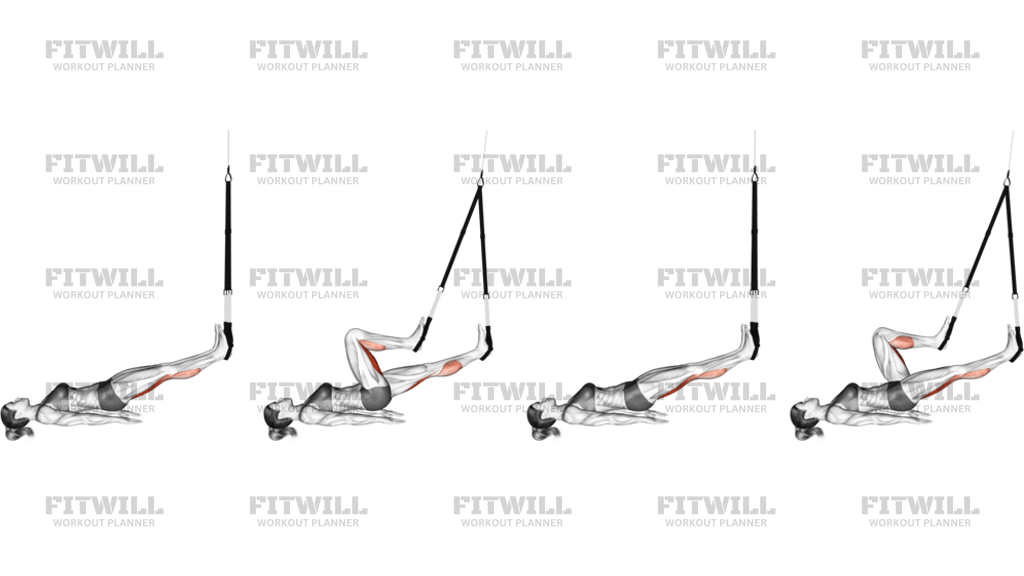
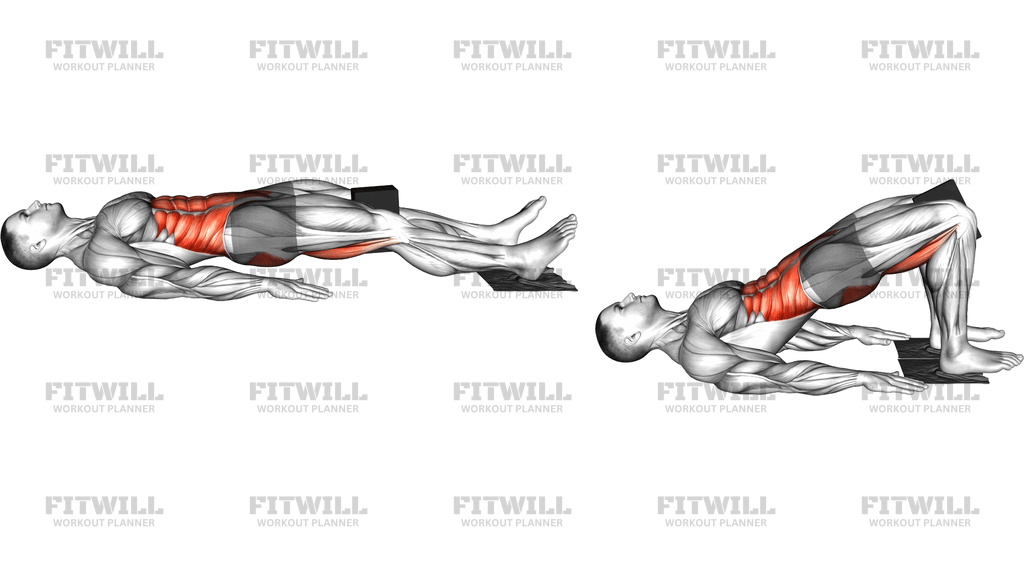
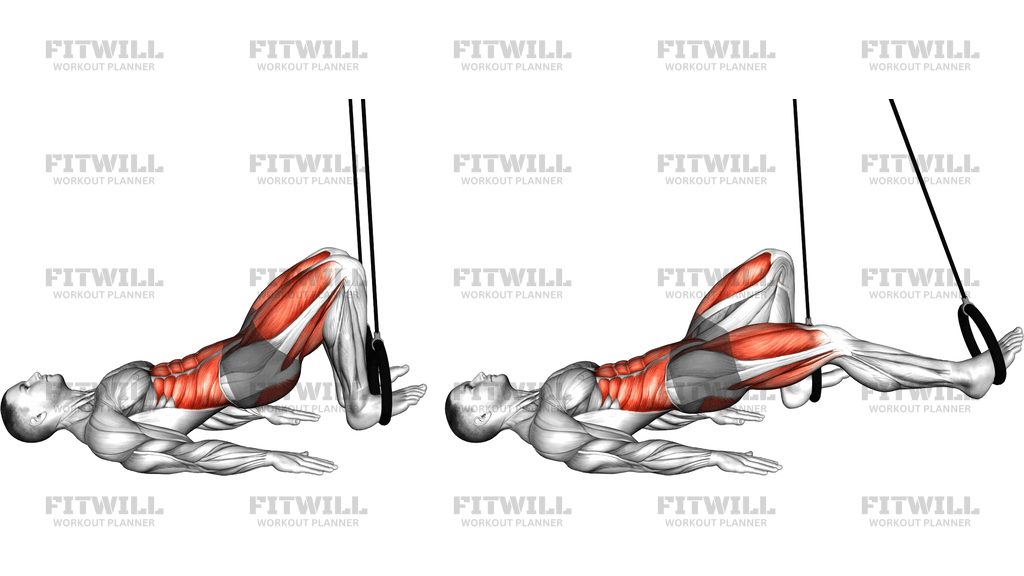
Ring Leg Curl With Yoga Block
The Ring Leg Curl With Yoga Block is a supine hamstring exercise performed with your feet resting in gymnastic rings suspended from an anchor point above you. You lie on your back with a yoga block squeezed between your knees, then curl your heels down and under your body while lifting your hips into a bridge position. The block between the knees is the key detail: it keeps your legs from drifting apart and forces the hamstrings and inner thigh muscles to work together under tension.
This movement sits between a glute bridge and a full Nordic-style leg curl in difficulty. Because the rings are free-moving, your feet are not locked into a machine path, so your hamstrings have to control both the bending of the knees and the stability of the ankles as they slide and rotate slightly through the arc. That instability is what makes ring versions harder than the same curl on a machine or slider, and it also builds ankle and knee stability as a side effect.
The primary work comes from the hamstrings, which bend the knees and help extend the hips as you lift. The glutes contribute strongly to the hip lift, the core works hard to keep your ribs down and your lower back from arching, and the calves and foot muscles stabilize your feet against the rings. The squeeze on the block also lightly recruits the adductors on the inside of the thighs.
The setup matters more than most people expect. The rings should hang low enough that your legs can extend fully with your heels resting in them while your arms lie flat at your sides. If the straps are too long or too short, you either lose range at the top of the curl or start with slack in the system. Starting with a flat lower back, ribs down, and gentle pressure on the block before you move keeps the work in the hamstrings instead of the lower back.
This exercise suits intermediate lifters who already own a solid bodyweight glute bridge and want a loaded-feeling hamstring curl without a leg curl machine. It is popular in home and minimal-equipment training because a pair of rings and a block replace an entire machine. People recovering general hamstring strength after a layoff, or athletes who sprint and jump, get good mileage from it, though it should be programmed with care since the eccentric loading on the hamstrings is real.
Practically, keep the reps slow and the sets modest. The temptation is to let the hips sag or push through the lower back as fatigue sets in, and both shift stress away from the hamstrings. Stop the set when you can no longer keep the block squeezed and the hips extended together, and progress by slowing the tempo or adding reps rather than rushing toward harder variations.
[ Workout Log & Planner ]
Put your next workout in Fitwill
Keep your plan and training log ready when you are.


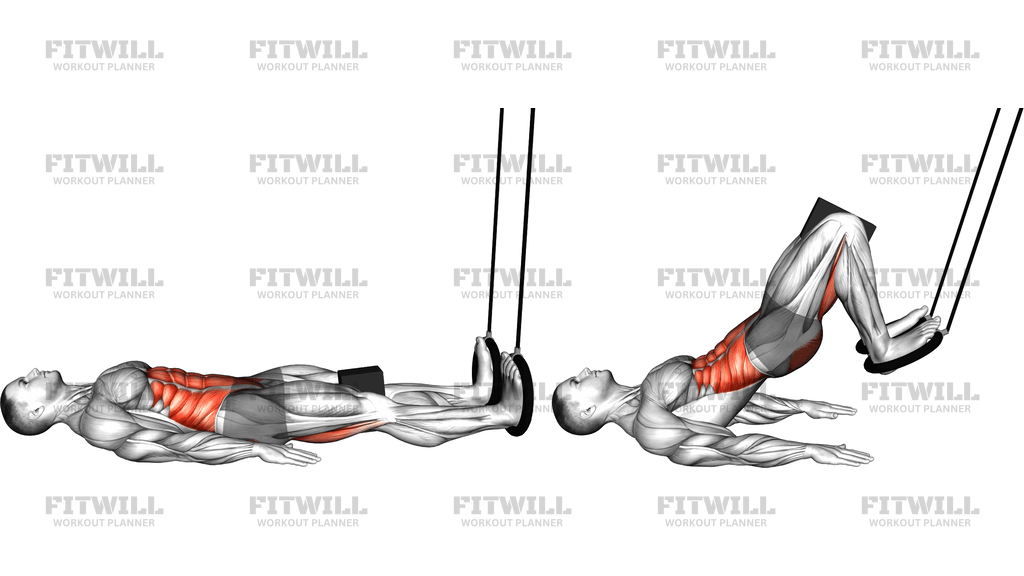
Instructions
- Set two gymnastic rings on their straps so they hang roughly knee height above the floor, close enough together that your feet can rest in them side by side.
- Lie on your back with your head away from the anchor, arms flat at your sides with palms down, and place one heel in each ring with your legs fully extended.
- Place a yoga block between your knees and squeeze it gently so your knees stay roughly hip-width and tracking forward throughout the set.
- Brace your core, press your lower back toward the floor, and take a breath in before the first pull.
- Exhale as you curl your heels down and in toward your hips, letting your knees bend while your hips lift off the floor into a bridge position.
- At the end of the curl, your knees should be bent past 90 degrees, hips fully extended, with the block still firmly squeezed between your knees.
- Pause briefly at the top, keeping tension in your hamstrings and glutes rather than resting on your lower back.
- Inhale as you lower your hips first, then slowly extend your knees, sliding your heels back out until your legs are long and your hips return to the floor.
- Reset your breath and re-squeeze the block before starting the next rep.
- Repeat for the planned reps, then carefully slip your feet out of the rings one at a time while your legs rest on the floor.
Tips & Tricks
- If your hips sag as your knees bend, shorten the range: curl halfway for a few sessions and build up to the full bridge position rather than grinding through a collapsed rep.
- A common mistake is letting the rings drift outward as the knees bend, which releases the block and shifts work away from the hamstrings. Press your knees slightly inward toward the block for the whole rep.
- Keep your arms passive on the floor. Pushing hard into your hands turns this into a hip thrust and quietly steals work from the hamstrings.
- Point your toes gently toward your shins as your heels curl in; this lengthens the calves slightly and makes the hamstring contraction easier to feel.
- If your lower back arches at the top of the bridge, you are extending through the spine instead of the hips. Cue ribs down and finish the bridge with glute squeeze, not back extension.
- Slow the lowering phase deliberately. The eccentric stretch under load is the most demanding part for the hamstrings and where uncontrolled reps usually go wrong.
- Wear smooth-soled shoes or use bare feet carefully; the rings can pinch or slide on bare ankles at the top of the curl if your heels sit too deep.
- Place the block at the lower thigh just above the knee. A block gripped mid-thigh or at the ankle gives you a leverage advantage and removes most of the adductor and hamstring co-contraction challenge.
- If ring height is awkward, adjust the straps so your legs are almost straight but the rings still take the weight of your heels with light tension, never slack.
- Stop the set when the block squeeze or hip extension breaks down, not when your hamstrings merely burn; form failures here usually load the lower back.
Frequently Asked Questions
Which muscles does the Ring Leg Curl With Yoga Block work hardest?
The hamstrings do the main work by bending the knees and assisting hip extension, with strong support from the glutes. The core stabilizes your trunk, and the adductors stay active because of the constant squeeze on the yoga block.
Why is a yoga block squeezed between the knees during this leg curl?
The block keeps your knees from splaying apart as your heels curl in, which maintains hamstring tension and adds an adductor co-contraction. It also gives you immediate feedback: if the block slips or drops, your leg alignment has broken down.
Is the Ring Leg Curl With Yoga Block suitable for beginners?
It is a step up from a standard glute bridge because the rings are unstable, so most beginners should master floor glute bridges and sliding hamstring curls first. If you try it early, use a partial range with a slow tempo and keep the block squeeze intact.
How high should the rings be for this exercise?
Hang the rings low enough that your legs can extend fully with your heels resting in them while you lie flat, with light tension in the straps. Too high and your feet lift off early; too low and the straps go slack, removing stability.
Can I do this exercise without gymnastic rings?
Yes, the closest home substitute is a sliding leg curl with towels or furniture sliders under your heels, using the same bridge-and-curl pattern with a block between the knees. The rings simply add instability, which makes the version slightly harder.
My hips drop as my knees bend — what is going wrong?
That usually means the hamstrings are not strong enough through that range yet, or the glutes disengage at the start of the curl. Regress to a partial-range curl, squeeze the block harder, and think about driving your hips up as your heels pull in rather than afterward.
Where exactly should I feel the Ring Leg Curl With Yoga Block?
You should feel the back of your thighs working hardest, with your glutes and mid-back of the hips sharing the bridge. If you mostly feel your lower back, your ribs are flaring and your hips are extending through the spine instead of the hip joints.
How many reps and sets should I use?
Because the movement is hard to control under fatigue, 2 to 4 sets of 6 to 12 slow reps works well for most people. Prioritize a controlled lowering phase and a clean block squeeze over chasing higher numbers.
Is it safe for the lower back?
It is generally safe when your core stays braced and the bridge is driven by the glutes, but arching at the top or letting the hips sag mid-rep shifts load to the lumbar spine. Keep the range honest and stop the set when form breaks.
How do I make the Ring Leg Curl With Yoga Block harder once it feels easy?
Slow the eccentric to a 4 or 5 second count, add a pause at the top of the bridge, or progress toward single-leg versions. Adding reps first is wiser than jumping straight to single-leg work, which raises the stability demand sharply.