Dumbbell Goblet Walking Lunge
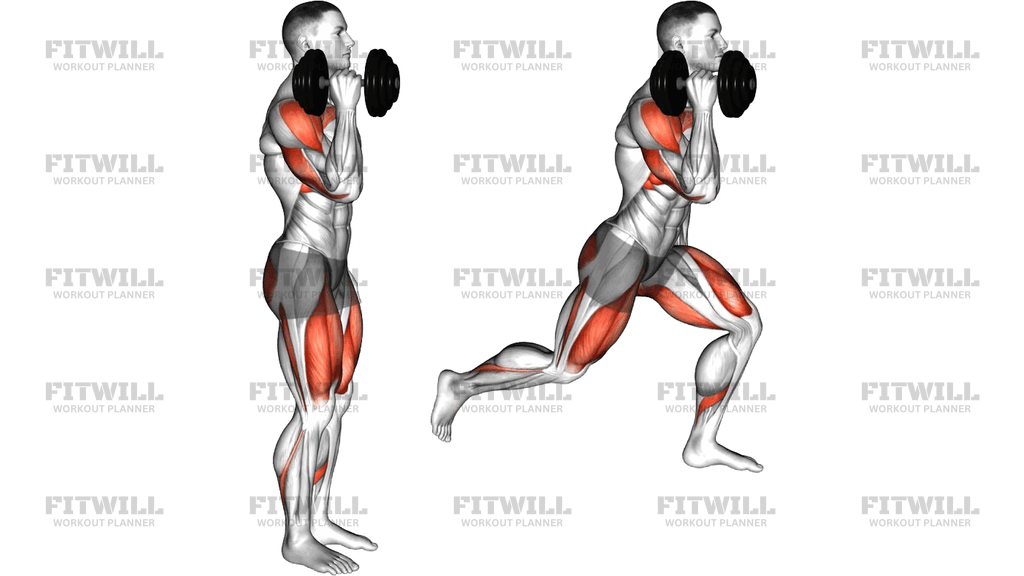
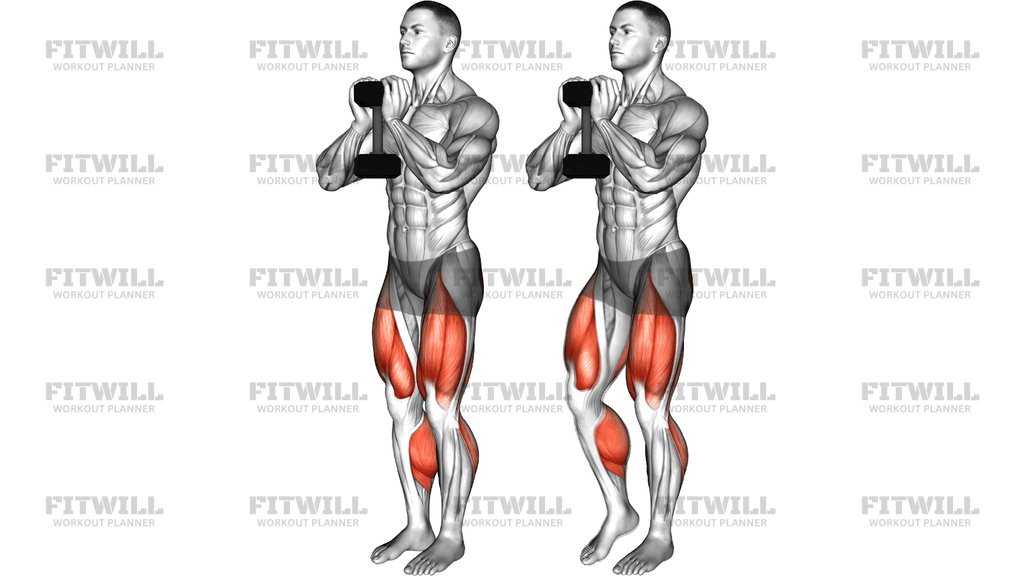
The Dumbbell Goblet Walking Lunge combines two proven movements into one: the goblet hold, where a single dumbbell is gripped vertically at chest height with both hands, and the walking lunge, where you step forward and travel with each repetition. The goblet position places the load right against your sternum, which counterbalances your torso and tends to make the lunge pattern feel more natural than holding weight at your sides. That front-loaded setup is the reason this variation is a favorite for teaching people how to lunge well before moving on to heavier bilateral or unilateral loading.
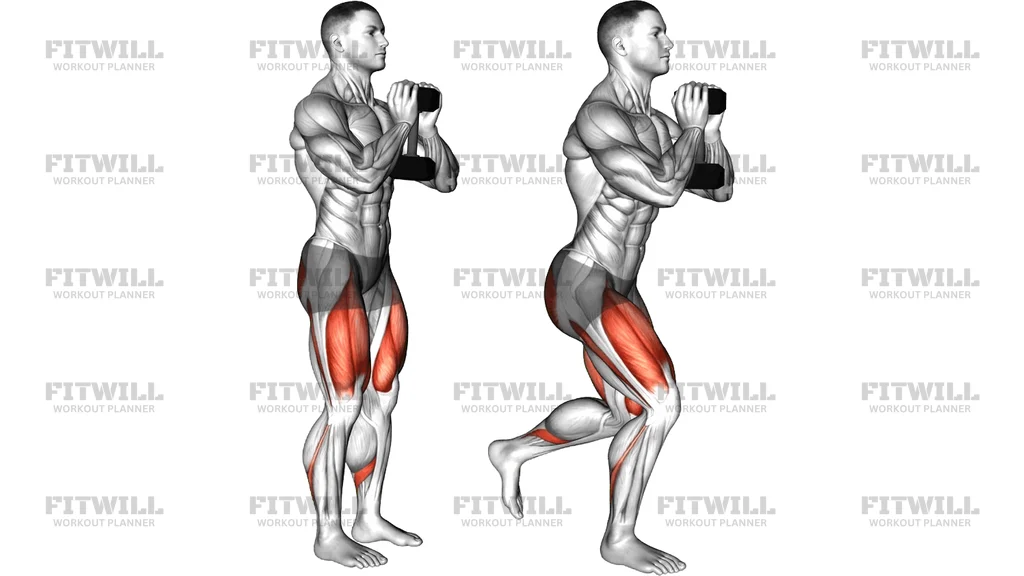
The main work is done by the quadriceps of the lead leg, especially as you lower into the step and press back up out of it. The glutes and hamstrings of the front leg drive you forward into the next stride, while the hip stabilizers on the stance leg keep your pelvis level as you transition from one step to the next. Holding the dumbbell at your chest keeps your trunk musculature engaged the entire time, and your forearms and grip work isometrically to keep the bell tucked in place.
Because the weight sits at your chest rather than hanging from your hands, this version encourages an upright torso and a deep, controlled knee bend. Many lifters find they can sink lower and keep their front heel planted more comfortably than with dumbbells at their sides, which makes it useful for building quad strength through a fuller range of motion.
This exercise suits a wide range of trainees. Beginners use it to learn the lunge pattern with modest weight, since the goblet hold gives immediate feedback when the torso tips forward. Intermediate and advanced lifters use it for higher-rep conditioning work, single-leg strength development, or as a primary lower-body movement when barbell loading is not available. It only requires one dumbbell and a clear walking path of a few meters, which makes it practical in busy gyms or at home.
Execution quality comes down to step length, torso position, and knee tracking. Take a step long enough that your front shin stays close to vertical as you descend, lower until both knees reach roughly 90 degrees, and drive through the front heel to rise into the next stride. Keep the dumbbell pressed gently against your chest with elbows pointing down, and avoid letting your front knee collapse inward as you fatigue.
The most common faults are rushing the steps, taking strides that are too short, and letting the weight drift away from the body as the set gets hard. Slow the tempo, shorten the distance if needed, and treat each step as its own rep. If balance is the limiting factor early on, reduce the load or pause briefly between steps until the pattern feels stable under fatigue.
[ Workout Log & Planner ]
Put your next workout in Fitwill
Keep your plan and training log ready when you are.


Instructions
- Stand tall with your feet hip-width apart and hold one dumbbell vertically by one end with both hands, cupping the top head of the bell so it rests against your upper chest.
- Point your elbows down toward the floor and tuck them close to your ribs so the dumbbell stays anchored at your sternum, then pick a clear walking path of roughly 5 to 10 meters.
- Draw your shoulder blades back slightly, brace your abdominal wall as if bracing for a light push, and set your gaze on a point straight ahead rather than at the floor.
- Step forward with your right foot into a stride long enough that your front shin can stay close to vertical as you descend.
- Lower your body straight down, letting your back knee travel toward the floor, until both knees form roughly 90-degree angles and your back knee hovers just above the ground.
- Check that your front heel stays flat, your front knee tracks in line with your toes, and your torso remains upright with the dumbbell pressed to your chest.
- Drive through the heel and midfoot of your front leg to push yourself up and forward, bringing your back leg through into a standing position.
- Step forward immediately with your left foot into the next lunge and continue alternating legs down the length of your path.
- Exhale as you lower into each lunge and exhale again as you drive up out of it, taking a breath at the top between steps if you need to reset your brace.
- When you finish the set or reach the end of your path, turn carefully, lower the dumbbell to the floor with a flat back, and rest before starting the return trip.
Tips & Tricks
- If your front knee shoots well past your toes, your stride is probably too short; step out farther so the shin stays closer to vertical at the bottom.
- Squeeze the dumbbell gently against your chest with your forearms rather than letting it rest on your hands alone, or it will pull you forward as your grip tires.
- Push up through the whole front foot, with emphasis on the heel, instead of rolling onto your toes, which shifts work away from the quads and strains the knee.
- Keep your hips squared to the direction you are walking; letting the stepping-side hip flare out is a common cause of knee tracking issues.
- Do not rush the transition between steps. Land each stride with a soft knee, control the descent, and only then drive into the next step.
- If your back knee touches down hard, think about lowering with control until it hovers a centimeter off the floor rather than aiming to tap the ground.
- Choose a weight you can hold at your chest for the entire set without your elbows dropping; if the bell drifts away from your torso, the load is too heavy for that distance.
- Turn slowly at the end of a walking path while fatigued, since most stumbles in this exercise happen during the turnaround, not during the lunges.
- If balance is shaky, pause for one full breath at the top of each step with your feet together until your stabilizers adapt to the pattern.
Frequently Asked Questions
Which muscles does the Dumbbell Goblet Walking Lunge work hardest?
The quadriceps of the front leg do most of the work lowering and raising your body, with strong contributions from the glutes and hamstrings as you drive forward. Your core and forearms work isometrically to hold the dumbbell at your chest.
Why hold the dumbbell at my chest instead of at my sides for walking lunges?
The goblet position places the load in front of your sternum, which counterbalances your torso and makes it easier to stay upright and sit down into the front leg. Many lifters also find it more comfortable on the grip and shoulders for longer sets.
Is the Dumbbell Goblet Walking Lunge good for beginners?
Yes, it is one of the best loaded lunge variations to start with, because the front-held weight gives immediate feedback if your torso tips forward. Begin with a light dumbbell, a short walking path, and focus on step length before adding load.
How far should I step forward on each lunge?
Step far enough that your front shin stays close to vertical and both knees can reach about 90 degrees at the bottom. A stride that is too short pushes the knee past the toes and overloads the front of the knee joint.
Should my back knee touch the floor?
It should lower toward the floor under control and hover just above it, but there is no need to slam it down or rest it on the ground. Aim for a soft, controlled descent so the working leg stays loaded throughout the rep.
What should I do if I lose balance between steps?
Pause with both feet together at the top of each rep and take a breath before stepping again, and slightly reduce the weight. Balance in this exercise usually improves quickly as the hip stabilizers adapt to the alternating pattern.
Can I substitute the Dumbbell Goblet Walking Lunge if I only have a kettlebell?
Yes, a kettlebell held by the horns at your chest replicates the same front-loaded goblet position and makes an excellent substitute. Reverse lunges in place with the same hold are another option if you lack space to walk.
How many steps should I do per set?
Count each lunge as one rep and start with 8 to 12 steps per set, alternating legs, then build toward 20 or more for conditioning. Stop the set when your torso starts leaning forward or the dumbbell drifts from your chest.
Is it safe for my knees to do this exercise?
When done with a full foot on the floor, a knee that tracks over the toes rather than caving inward, and a controlled tempo, lunges are a well-tolerated leg exercise for most people. If you have a current knee issue, clear the movement with a qualified professional first and start with shallow depth.