Kneeling Rotation Torso Alternate Row To Thread Th
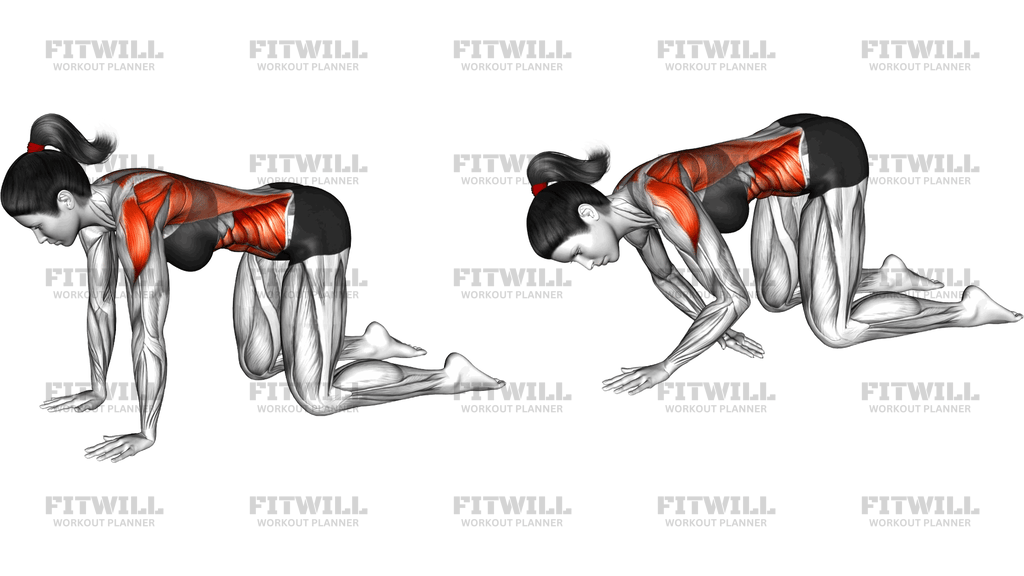
The Kneeling Rotation Torso Alternate Row To Thread The Needle is a quadruped bodyweight drill that combines two complementary arm patterns from the same all-fours position: an alternating pulling or rowing motion with an open torso rotation, followed by a thread-the-needle reach that folds the same arm under and across your body. Because you stay on hands and knees the whole time, your trunk has to control rotation in both directions while your shoulder does the steering.
Think of it as training rotation from both ends. The row-to-rotate portion teaches you to pull the shoulder blade back and turn the chest open, working the mid-back muscles, rear delts, and lats along with the obliques that drive the turn. The thread-the-needle portion reverses that motion, sending the arm under your torso toward the opposite side, which lengthens the same muscles you just contracted and challenges your deep core to resist collapsing. Alternating sides keeps the workload balanced and forces each side of your trunk to organize itself independently.
This movement is useful for a wide range of people. Desk workers who spend hours rounded over a keyboard often lose comfort with rotation, and this drill reintroduces it with almost no load on the spine. Lifters use it as a warm-up before pressing, pulling, or rotational work because it wakes up the shoulder blades and the trunk without fatigue. It also fits well into mobility sessions or as low-impact core work for anyone who finds standing rotational exercises too demanding on the knees or lower back.
Setup matters more than it looks. Your hands sit directly under your shoulders and knees under your hips, with weight spread evenly across a flat palm rather than dumped into the wrist. If your knees or kneecaps are uncomfortable on a hard surface, kneel on a mat or folded towel. Keep the shin of the working side planted so your hips stay squared toward the floor; if your hips swing open, the rotation happens at the pelvis instead of the thoracic spine and you lose most of the benefit.
To execute it well, move with intent rather than speed. On the rowing rotation, think of dragging your elbow back and slightly up as your chest turns toward that side, eyes following your hand. On the thread, slide the same arm palm-down across the floor beneath you, letting the shoulder and side of the torso lower toward the ground as far as feels comfortable, then press back up to the starting position. Exhale as you rotate or thread, inhale as you return, and switch sides only after completing your reps on the first side.
A few practical cautions: keep the movement in a range you can control without your lower back twisting, and stop the thread if you feel pinching in the shoulder rather than a stretch through the torso. The goal is smooth, deliberate rotation on both sides of the pattern, not depth at any cost. Done consistently, this exercise builds rotational control, mid-back strength, and shoulder comfort that carry over into nearly everything else you do.
[ Workout Log & Planner ]
Put your next workout in Fitwill
Keep your plan and training log ready when you are.


Instructions
- Set up on all fours on an exercise mat or the floor: hands directly under your shoulders, knees directly under your hips, spine flat from head to tailbone.
- Spread your fingers and press the floor away slightly so your upper back stays active, and rest the tops or balls of your feet on the floor behind you.
- Brace your core gently as if bracing for a light poke, keeping your hips squared toward the floor so rotation comes from your upper back, not your pelvis.
- Begin the rowing phase: lift one hand, draw the elbow back toward your ribs while rotating your chest and head open toward that side, as if pulling an imaginary handle.
- At the end of the rotation, look up at your raised hand and feel the squeeze across your mid-back on the working side.
- Reverse the motion smoothly and continue the same arm forward, sliding it palm-down under your opposite armpit into the thread-the-needle position.
- Lower the shoulder and side of your torso toward the floor as the arm reaches across, keeping your supporting elbow firm and hips level, then press back up to all fours.
- Complete all reps on one side, breathing out on the rotation and thread and breathing in as you return to the start.
- Switch sides and repeat for the same number of reps, keeping the tempo deliberate and matching both sides.
Tips & Tricks
- The most common fault is letting the hips rotate with the arm during the rowing phase. Park an imaginary cup of water on your lower back; if it would spill, your pelvis is turning instead of your thoracic spine.
- In the thread-the-needle portion, people often just poke the arm through and stay high. Actively lower the working shoulder and the side of your ribs toward the floor to get the real rotational stretch.
- If your wrist aches when you rotate back down, place your palm flat and fingers pointing slightly outward rather than straight ahead, so the fold happens at the shoulder and not the wrist.
- Avoid shrugging the supporting shoulder up toward your ear. Press that hand into the floor to keep space in the neck while the other arm moves.
- Do not rush the transition between the row and the thread; the value of this drill lives in the smooth change of direction, where your obliques control the trunk both ways.
- If your knees are sore on hard floors, kneel on a mat or folded towel and shift your weight slightly back into your hips without rounding your lower back.
- Only turn your head as far as your chest actually rotates. Cranking the neck to look at the ceiling while the torso barely moves is a common compensation.
- Keep the range on each side equal. If one side threads noticeably deeper than the other, spend a few extra reps on the stiffer side rather than chasing depth on the mobile one.
- If your supporting arm fatigues before your trunk does, shorten the pause in the thread position and reset on both knees briefly between sides.
Frequently Asked Questions
What muscles does the Kneeling Rotation Torso Alternate Row To Thread The Needle work?
The primary work comes from the obliques, which rotate the trunk in both directions. The mid-back muscles, rear delts, and lats handle the rowing and threading arm motions, while the deep core stabilizes the pelvis throughout.
Is this exercise suitable for beginners?
Yes, it is very beginner friendly because it is performed on all fours with only bodyweight as resistance. Start with a modest range of motion on both the rotation and the thread, and add depth as control improves.
Why does the exercise combine a rowing rotation with a thread-the-needle reach?
The two phases train the same rotation in opposite directions: the row rotation contracts the trunk and mid-back muscles, while the thread lengthens them under control. Together they cover both strength and mobility through the full rotational arc.
Should my hips stay facing the floor the entire time?
Yes, keeping the hips squared is the key detail that forces rotation to come from the upper back and ribs. If your pelvis swings open, the movement becomes a hip twist and the spinal rotation benefit shrinks considerably.
How many reps should I do per side?
Six to ten controlled reps per side works well, either as a warm-up or as a core finisher. Match both sides exactly, and if one side feels stiffer, give it one or two extra reps.
What should I do if my shoulder pinches during the thread phase?
Reduce how deeply you reach across and keep more of your weight on the supporting arm. If pinching continues even with a shallower range, stop the movement and switch to a standing rotation drill until you can assess the shoulder.
Can I do the Kneeling Rotation Torso Alternate Row To Thread The Needle without a mat?
You can perform it on any firm floor, but kneeling directly on a hard surface bothers many people's knees. A mat or folded towel under the knees solves this without changing the movement.
When is the best time to use this exercise in a workout?
It works well as a warm-up before pressing, pulling, or rotational training because it primes the shoulder blades and trunk without creating fatigue. It also stands on its own as low-impact rotational core work.
How is this different from a regular thread the needle stretch?
The standard thread the needle is a static stretch that only reaches under the body. This version adds an alternating rowing rotation before each thread, so you actively train the pulling muscles and rotational control instead of just passively stretching.