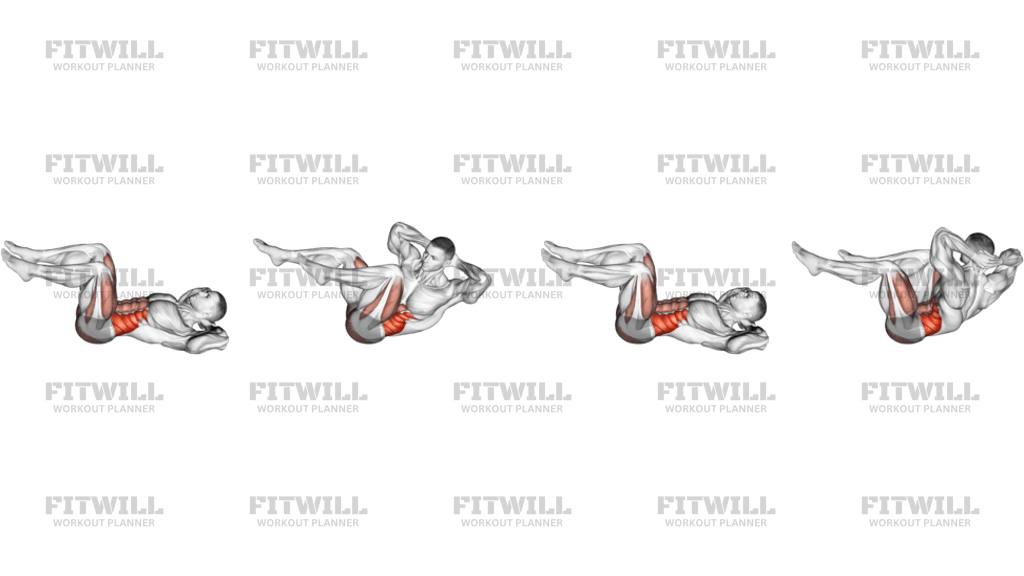
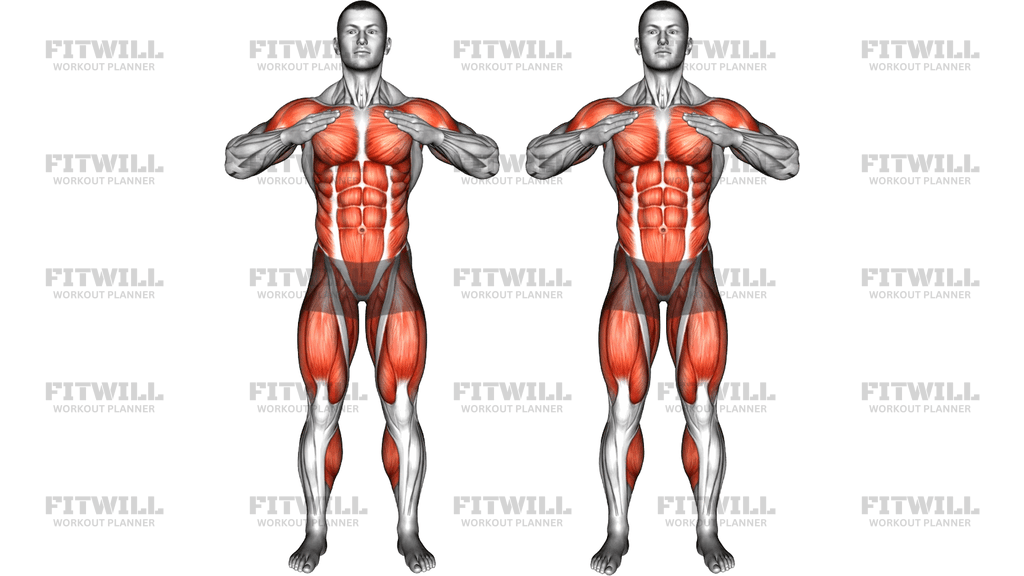
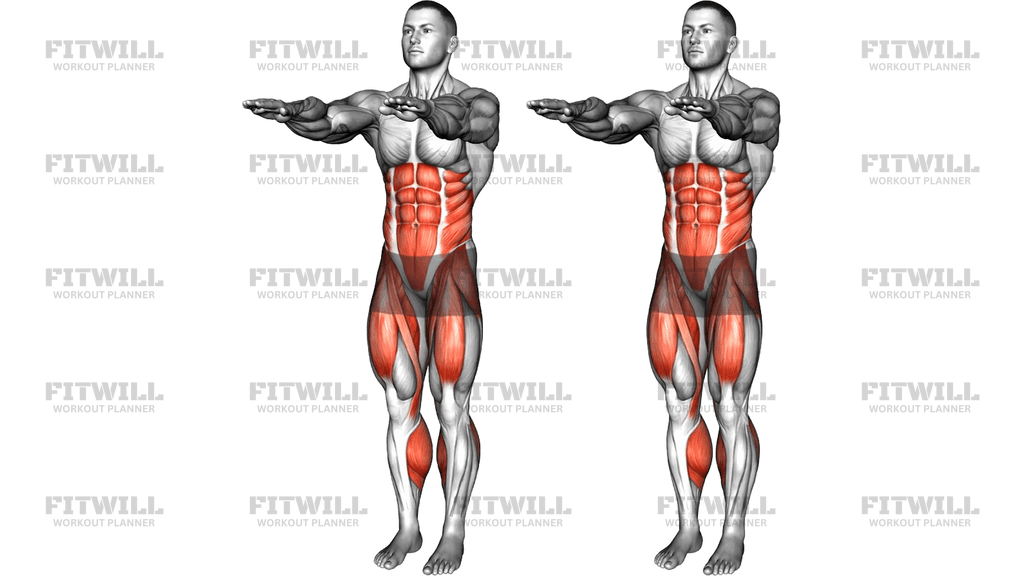
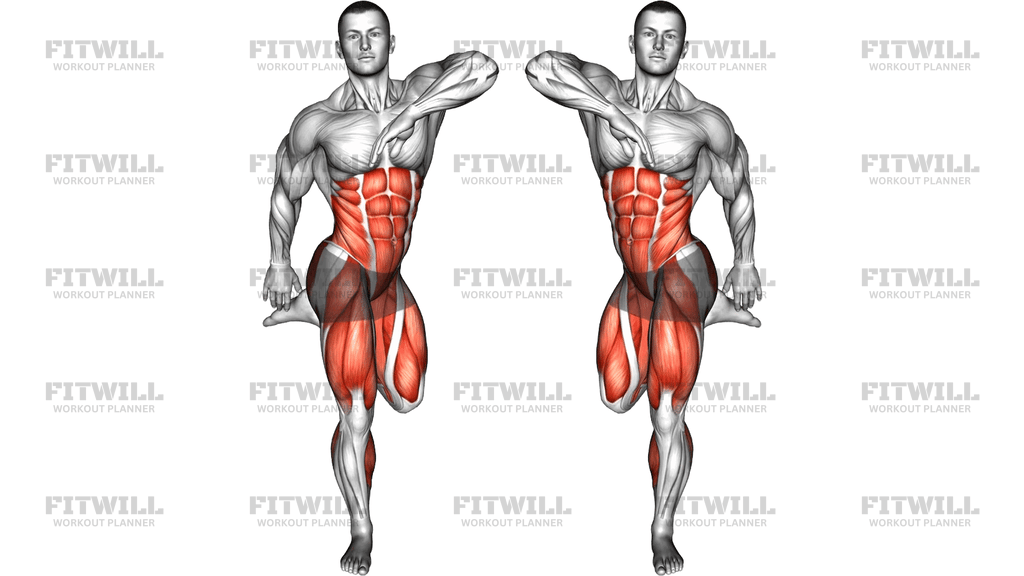
Side Plank Twist Arm Delt Raise
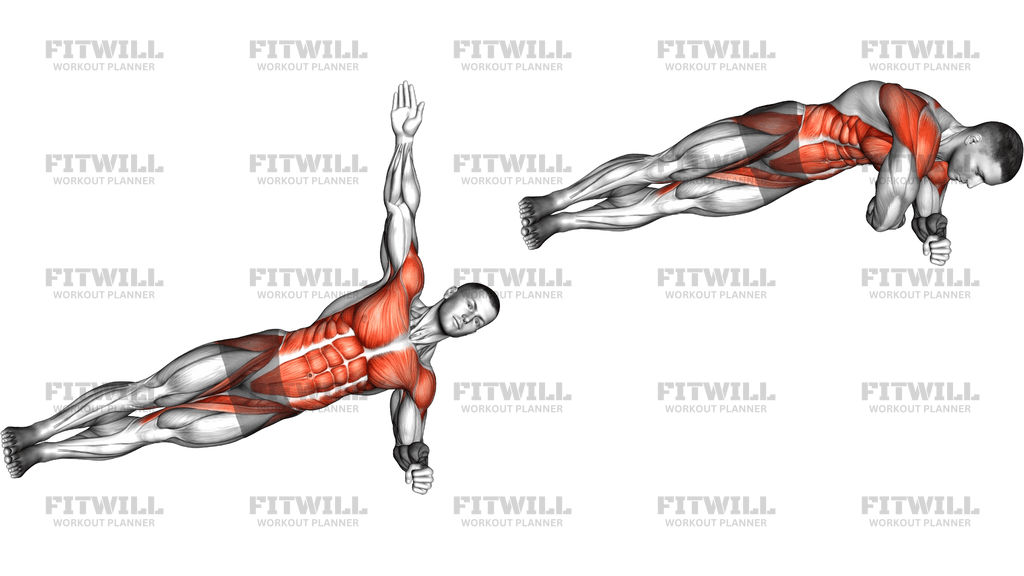
The Side Plank Twist Arm Delt Raise combines two demanding elements into one flowing movement: a stable side plank hold and a rotational reach that finishes with your top arm sweeping up toward the ceiling. You support yourself on one forearm while your body forms a straight line from head to feet, thread your top arm down and under your torso, then rotate your chest open as that arm travels up into a raise. It looks simple from the outside, but the combination of holding a side plank and rotating under load makes it one of the more complete bodyweight movements for the trunk and shoulder working together.
The main work comes from the obliques on the underside of your body, which resist collapse at the waist as you rotate, along with the deep core muscles that keep the spine stacked throughout the twist. The deltoid of your top arm drives the raising portion, and the shoulder stabilizers on your supporting arm work overtime because your torso rotates right over that fixed forearm. Your glutes and outer hip of the bottom leg quietly do a lot here too, holding the pelvis level so the twist comes from your trunk rather than your hips sagging or stacking.
This movement suits intermediate trainees who already own a solid static side plank, typically 30 seconds or more on each side without the hip dropping. It appears frequently in Pilates-informed programming, athletic warm-up circuits, and core finishers, because it trains anti-lateral-flexion and rotation in the same rep. That mix transfers well to throwing, swinging, and changing direction, where the trunk has to transfer force while the shoulder moves freely.
Setup matters more than most people expect. The supporting elbow should sit directly under the shoulder, not drifted forward or out to the side, because every degree of drift multiplies the stress on the joint as your body twists over it. Feet stacked or staggered, hips lifted so the body reads as one straight diagonal, and the head kept neutral all set you up to rotate cleanly. If the elbow or hip position is off before you start, the twist will expose it immediately.
Execution comes down to one controlled path: reach the top arm down and across your body as you rotate the torso toward the floor, then reverse the arc, opening the chest and raising that arm straight up until it points to the ceiling, with the shoulder blade settling onto the back rather than shrugging toward the ear. Breathe steadily, keep the ribs from flaring as the arm lifts, and return through the same arc with the same control you used going up. Move deliberately rather than fast; the twist is where most people lose the plank position.
A note on safety: if you feel pinching in the supporting shoulder or your hip drops toward the floor as you rotate, stop there and regress to a side plank with the top arm resting on the hip. Rotational work under a plank position rewards patience, and building the base first makes the full version far more productive.
[ Workout Log & Planner ]
Put your next workout in Fitwill
Keep your plan and training log ready when you are.


Instructions
- Lie on your right side on an exercise mat with your legs stacked and your right elbow directly beneath your right shoulder, forearm flat on the floor and perpendicular to your body.
- Lift your hips off the floor until you form one straight line from head through heels, bracing your abs and squeezing your glutes to hold the plank position.
- Place your left hand on your left hip or let it rest lightly on your top waist to start, keeping your neck long and your gaze forward.
- Inhale, then reach your left arm down and across the front of your body as you rotate your torso toward the floor, letting your chest turn down toward the mat while your hips stay lifted.
- Exhale and reverse the arc, rotating your chest open toward the ceiling as your left arm sweeps up and out until it points straight up above your shoulder.
- At the top, keep the raised arm long with fingers spread, shoulder blade settled down your back, and avoid letting the shoulder creep toward your ear.
- Pause briefly at the top with the plank position intact, hips still high and ribs stacked over the pelvis.
- Lower the arm back down through the same arc, rotating the torso toward the floor again with control rather than letting gravity pull you down.
- Complete your repetitions on this side, breathing in on the twist down and out on the raise up, then lower your hips to the mat and switch to your left forearm to work the other side.
Tips & Tricks
- If your top arm fails before your core does, drop to one or two reps fewer and prioritize keeping the hips level; the raise is the easy part to strengthen later.
- The most common breakdown is the supporting elbow drifting forward during the twist, which strains the shoulder, so check your elbow position under the shoulder before every rep.
- Keep the feet either stacked or with the top foot just in front of the bottom foot; a wide staggered base makes the movement easier but removes much of the oblique demand.
- Push the floor away with your supporting forearm the entire time, because a collapsed shoulder sits too low and turns the raise into a grind on the joint.
- Reach the arm across your body rather than just dipping the shoulder, since the twist should come from the thoracic spine and ribs, not from tilting the whole torso toward the floor.
- Do not let the pelvis rock forward or backward as the arm travels; a steady pelvis is what separates a Side Plank Twist Arm Delt Raise from an arm swing with a side plank nearby.
- If your hip sags as you rotate, try the version from the forearm with the top hand on the hip first, or shorten the reach until you can hold the line.
- Keep the raised arm in the frontal plane, moving in one vertical arc overhead and down, instead of swinging it forward across your face as you open up.
- Filming from the side for one set is worth it here, because from your own viewpoint a dropping hip feels identical to a correct plank.
Frequently Asked Questions
What muscles does the Side Plank Twist Arm Delt Raise work?
The obliques on your supporting side do most of the trunk work, with the deltoid of the top arm driving the raise and the deep core stabilizing the spine. The glutes and outer hip of the bottom leg also work to keep the pelvis level through the rotation.
Can beginners do the Side Plank Twist Arm Delt Raise?
It is best treated as an intermediate progression. If you cannot yet hold a static side plank for around 30 seconds per side, build that first, then add the twist and arm raise gradually.
How is this different from a regular side plank?
A standard side plank is a static hold against lateral collapse, while this version adds rotation of the torso and a dynamic arm raise. That turns it into a moving exercise that trains the obliques through a range instead of only under an isometric load.
Should my feet be stacked or staggered?
Stacked feet make the movement harder and challenge the obliques and outer hip more, while a slight stagger gives you a wider base and more control. Start slightly staggered if you are new to the twist, and progress toward stacking as the plank holds steady.
Why does my supporting shoulder hurt during the twist?
The supporting elbow has likely drifted forward or the shoulder has collapsed toward the floor, which loads the joint awkwardly as the body rotates over it. Reset with the elbow directly under the shoulder and actively push the floor away; stop if discomfort continues.
Do I need any equipment for the Side Plank Twist Arm Delt Raise?
No, it is a bodyweight movement, and an exercise mat is all you need to cushion the supporting forearm and knees between sets. No dumbbells or cables are required since the deltoid works against the resistance of the arm's own weight and position.
What is the most common mistake in this exercise?
Letting the hips drop or rock as the top arm travels, which shifts the work away from the obliques and onto the lower back and shoulder. Another frequent error is swinging the arm quickly instead of controlling the rotational arc, which turns a core exercise into momentum practice.
What can I substitute if the full version is too hard?
Perform the same movement from a knee-down side plank, or keep the top hand on your hip and simply add the torso rotation without the arm raise. Both options preserve the oblique demand while reducing the shoulder and stabilization load.
How many reps and sets should I do per side?
Start with 5 to 8 controlled reps per side for 2 to 3 sets, resting briefly between sides. Because quality of position matters more than volume here, end the set as soon as your hips sag or the arm path gets sloppy.