Ring Plank
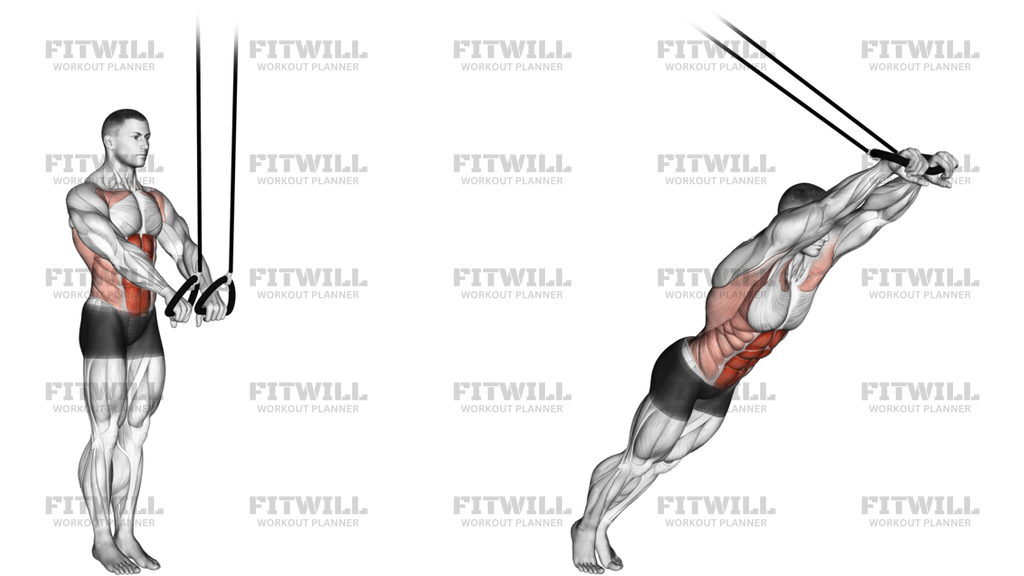
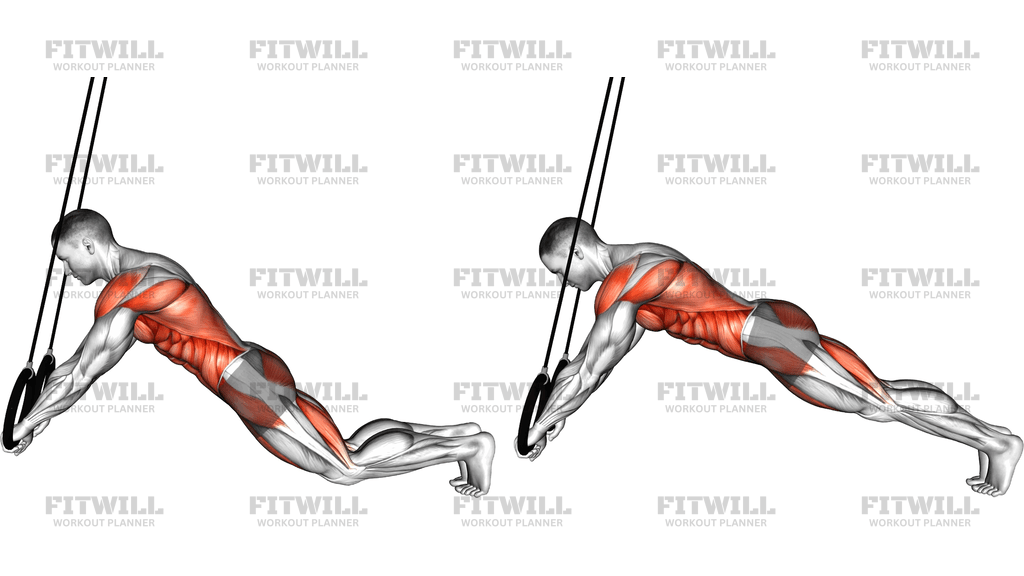
The Ring Plank is an isometric core hold performed with your hands gripping a pair of suspended gymnastic rings or ring-style straps instead of resting on the floor. Because the rings hang freely from an overhead anchor, every point of contact is unstable, and your entire trunk has to work continuously just to keep your spine from bending or twisting. What looks like a simple plank quickly becomes a full-body tension exercise once the ground disappears from under your palms.
This movement suits anyone who has already built a comfortable floor plank and wants a harder challenge without adding external weight. It is a staple in gymnastic strength training and calisthenics, and it carries over well to ring dips, ring push-ups, and other suspended work because it teaches you to stabilize the rings before you try to move on them. It is also a time-efficient option for lifters who want direct anti-extension and anti-rotation work for the trunk at the end of a session.
The primary demand lands on the deep abdominals and rectus abdominis, which fight to keep your ribs down and your hips from sagging. Your obliques and lower back stabilizers work to stop side-to-side sway, while the shoulders, particularly the front delts and the stabilizing muscles around the shoulder blade, hold you tall over the rings. Glutes, quads, and even the forearms and grip contribute, since the rings squeeze inward and your hands must stay closed around them for the duration of the hold.
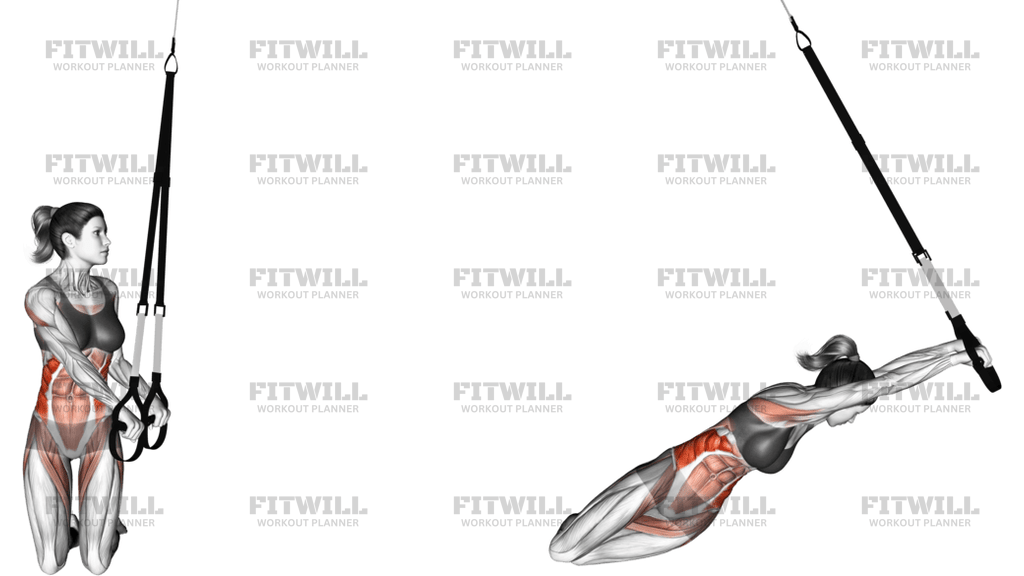
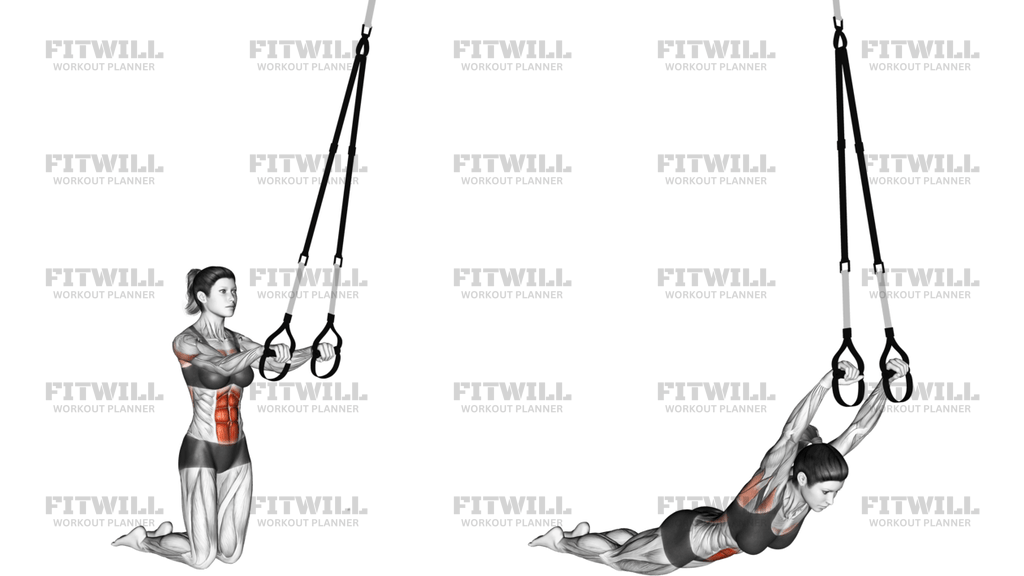
Setup matters more here than in a floor plank. Ring height, body angle, and strap length all change the difficulty, and because the rings can drift apart or shift under you, your hand position needs to be deliberate before you commit your weight. Starting with the rings set at knee height or lower and walking your feet back gradually is the safest way to find a workable angle.
To execute the hold well, grip the rings firmly, straighten your arms without locking them hard, and build a rigid line from head to heels before you lift your knees off the floor. Squeeze the rings toward each other slightly, pull your shoulder blades down away from your ears, and brace your stomach as if bracing for a light punch. Hold for a set number of breaths, keeping your hips level with your shoulders the entire time.
The most common faults are a sagging lower back, flared shoulder blades, and rings that drift wide apart, all of which shift stress away from the core and toward the joints. Progress by extending hold time in small increments, moving your feet further back to lengthen the lever, or elevating your feet once longer holds feel solid. If your hips drop or your shoulders creep up toward your ears, end the set rather than grinding through a compromised position.
[ Workout Log & Planner ]
Put your next workout in Fitwill
Keep your plan and training log ready when you are.


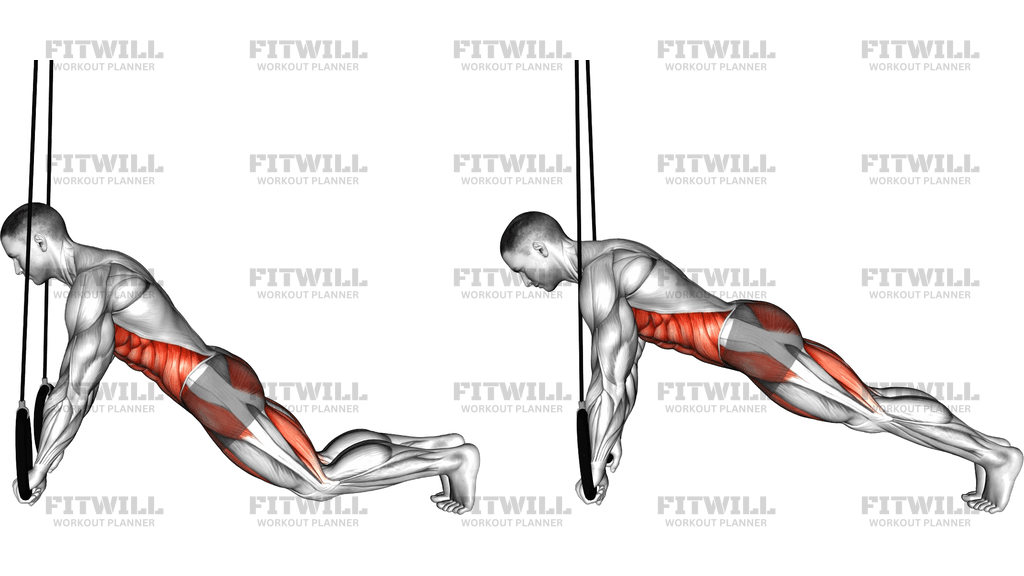
Instructions
- Set a pair of rings so the bottoms hang roughly at knee height, with the straps even in length and the anchor point directly above where your hands will sit.
- Grip the rings on top with a neutral, closed-hand grip, placing them about shoulder-width apart directly under your shoulders.
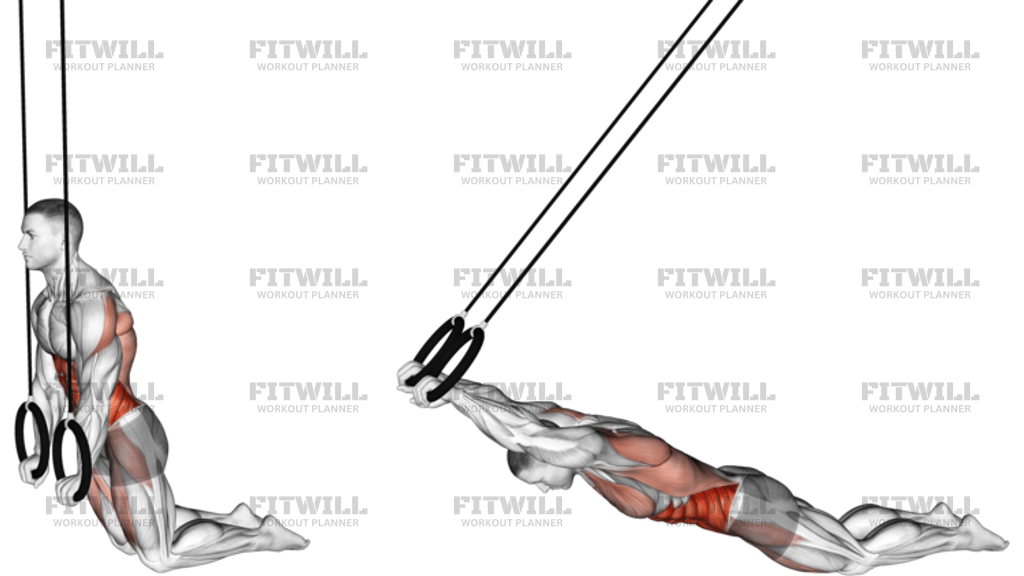
- Kneel behind the rings, place your toes on the floor, and walk your feet back until your body forms a straight line at roughly a push-up angle.
- Before loading the hold, squeeze the rings inward toward each other and pull your shoulder blades down and together so your upper back stays tall.
- Brace your abdominals and squeeze your glutes, then lift your knees off the floor into the full plank position with arms nearly straight but not hard-locked.
- Check your line: ears, shoulders, hips, knees, and ankles should stack in one plane, with the rings staying directly under your shoulders and no wider.
- Hold this position, breathing steadily through your nose and keeping your ribs pulled down toward your hips rather than letting your chest lift.
- If the rings begin to drift apart or your hips sag, lower your knees back to the floor in a controlled manner to end the rep.
- Rest briefly while staying knelt, reset your grip and brace, then step back in for the next hold.
Tips & Tricks
- Squeezing the rings inward toward the midline is not optional decoration; it is what stabilizes the apparatus and keeps the straps from swinging, so apply that tension before your knees leave the floor.
- If your lower back arches and your stomach drops, the fix is usually a harder glute squeeze and a posterior pelvic tilt, not a shorter hold with the same slack posture.
- Keep the rings directly under your shoulders. Letting them drift out to the sides turns the hold into an unstable chest exercise and dumps load onto the shoulder joints.
- Count your holds in slow breaths instead of seconds at first; if your breathing turns choppy or you hold your breath, the brace is too rigid or the angle is too advanced.
- Begin with the rings higher and your body more upright. Lowering the rings and stepping your feet back lengthens the lever far faster than most people expect.
- Avoid fully locking out your elbows. A soft elbow keeps constant tension through the arms and protects the joint while the rings wobble.
- If your grip fails before your core does, the set is over regardless of how your trunk feels, so chalk your hands or shorten the hold rather than risking an open-hand slip.
- Elevate your feet on a low box only after you can hold a strict 45 to 60 seconds at the standard angle without your hips sagging or the rings wandering.
- Film yourself from the side once in a while; from your own viewpoint the plank line often feels straight while the hips are actually sitting a few degrees low.
Frequently Asked Questions
Which muscles does the Ring Plank work the most?
The Ring Plank targets the abdominals, especially the deep core muscles that resist extension, with strong support from the obliques, lower back stabilizers, shoulders, and triceps. Because the rings are unstable, your grip and shoulder stabilizers work harder than they would in a floor plank.
Is the Ring Plank suitable for beginners?
Beginners should first master a solid 45 to 60 second floor plank, then start Ring Planks with the rings set high and the body at a steep, upright angle. Short holds of 10 to 15 seconds with a rigid body line are a better starting point than long, sagging holds.
How high should I set the rings for the Ring Plank?
Set the rings around knee height for a standard plank angle, or higher for an easier incline version. The lower the rings and the further back your feet go, the more load lands on your core and shoulders.
Why do my shoulders shake so much during the Ring Plank?
The rings move independently, so the small stabilizing muscles around your shoulder blades have to work constantly to keep your arms stacked over your hands. This shaking is normal early on and usually settles as you build time under tension.
How long should I hold the Ring Plank?
Aim for sets of 15 to 30 seconds where your body line stays rigid the entire time, resting between holds. Once you can hold 45 to 60 seconds cleanly, progress by lowering the rings or elevating your feet rather than chasing much longer times.
The rings keep drifting apart during my hold. What should I do?
Actively squeeze the rings toward each other throughout the hold and keep your hands stacked directly under your shoulders. If they still wander, your grip or shoulder fatigue is the limiting factor, so shorten the set.
Can I substitute the Ring Plank with a regular floor plank?
A floor plank is a reasonable substitute for general core endurance, but it removes the instability that makes the Ring Plank distinct. If you have rings or a suspension trainer, the Ring Plank is worth keeping because it also prepares you for ring dips and ring push-ups.
Is the Ring Plank safe for my lower back?
It is safe when your hips stay level and your ribs stay down, so your abdominals and glutes share the load. If your lower back arches and sags during the hold, end the set, as that position transfers stress to the lumbar spine instead of the core.
How is the Ring Plank different from a plank on a stability ball or suspension handles?
The Ring Plank keeps your hands fixed in place while the rings themselves shift and swing, demanding continuous tension in every direction. Stability ball and strap planks usually challenge one plane of movement, while rings challenge your control in all of them at once.