Kneeling Rotation Torso Rear Fly To Thread Through
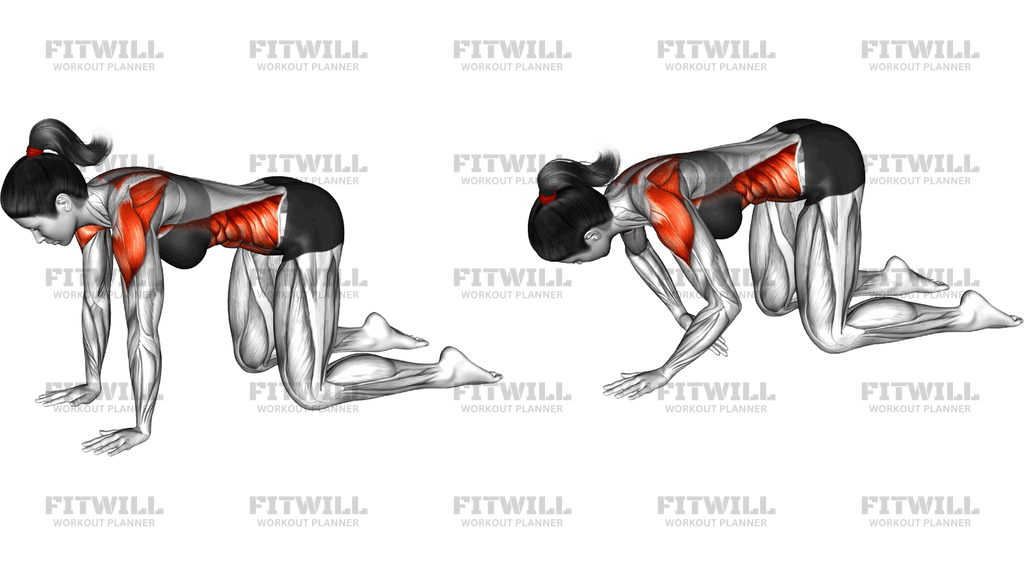
The Kneeling Rotation Torso Rear Fly To Thread Through is a bodyweight movement performed on all fours that combines two complementary arm actions: an open-book style rear fly with one arm, followed by a rotational thread through the gap between your supporting arm and leg. Because one hand stays planted on the floor while the other travels, your trunk has to resist collapse in one direction and then rotate freely in the other, which makes this a two-for-one drill for the rear shoulders and the muscles that control spinal rotation.
The first half of the rep targets the posterior deltoid and upper back as you lift the arm up and out to the side, pulling the shoulder blade back onto the ribcage. The second half targets the obliques and deep spinal rotators as you reach that same arm under your torso, letting the ribcage rotate toward the floor. Few floor-based drills train both of these qualities back to back with no equipment, which is why this pattern shows up in warm-ups, shoulder health routines, and thoracic mobility work.
Setup matters more than it looks. A quadruped position with knees under hips and hands under shoulders gives you a stable base, but only if you keep the supporting elbow soft rather than locked and the spine long rather than sagging. If your hips drift or your lower back takes over the rotation, the shoulder and thoracic work you are chasing gets diluted, so the knee stack and quiet hips are the details to watch.
To execute well, think of the two phases as one smooth arc. Lift the arm out to the side with the palm facing forward and the chest rotating slightly open, then reverse the arc and slide the arm through the space between your supporting arm and thigh, exhaling as the shoulder and ribs lower toward the floor. Move at the speed of control, not momentum, and let your head follow the moving hand so the neck stays part of the rotation instead of cranking against it.
This exercise suits people who sit a lot and need rotational mobility, lifters warming up the rear shoulders before pressing or pulling, and anyone building mid-back strength without equipment. It is gentle on the lower body and can be scaled by adjusting how far the arm reaches in each direction. Stop short of any position that pinches the shoulder or forces the lower back to twist, and keep the range honest rather than chasing a big look.
[ Workout Log & Planner ]
Put your next workout in Fitwill
Keep your plan and training log ready when you are.


Instructions
- Kneel on an exercise mat and set up on all fours with hands directly under shoulders and knees directly under hips, shins resting on the floor behind you.
- Settle into a neutral spine by lengthening the crown of your head forward and your tailbone back, then place your left hand flat on the mat with a soft, unlocked elbow.
- Shift slightly so your weight feels balanced between the supporting hand and both knees, and brace your core lightly as if preparing for a light tap to the stomach.
- Starting with your right hand near your left, lift that arm up and out to the side in a rear fly arc, rotating your chest open toward the ceiling and letting your eyes follow the hand.
- Pause briefly at the top with the arm roughly pointing up and the shoulder blade squeezed toward the spine, keeping the hips level and square to the floor.
- Reverse the same arc and reach the arm down and through the gap between your supporting left arm and left thigh, palm turning up as the shoulder lowers toward the floor.
- Exhale as you thread through, allowing the upper back and ribs to rotate while keeping the hips stacked over the knees rather than swaying sideways.
- Inhale and trace the arm back out along the same path to the open rear fly position, then lower the hand to the starting spot near your supporting hand.
- Complete all reps on one side, then reset your hand position and brace before switching to the other side.
Tips & Tricks
- If your hips rock sideways during the rear fly, widen your knee stance slightly or think about pressing the opposite knee gently into the mat to lock the base.
- A locked supporting elbow is a common fault in this setup; keep a micro-bend in that arm so the shoulder, not the joint, absorbs the load.
- Do not chase floor contact with the shoulder when threading through. The rotation should come from the upper back and ribs, not from dumping weight into the lower back.
- Keep the reaching arm long and active rather than limp, especially through the thread, so the rotator cuff and scapular muscles stay engaged through the full arc.
- Let the head travel with the moving hand. Holding the gaze straight down while the torso rotates is the usual cause of neck strain in this drill.
- If the top of the rear fly feels pinchy at the front of the shoulder, lower the arm stop point to about chest height instead of straight up.
- Move slower on the way out of the thread than on the way in. Most people rush the return and lose the rear fly contraction entirely.
- Place a folded towel under the knees if the mat is thin; discomfort there will quietly pull your attention and form away from the torso rotation.
- Breathe in a steady cycle tied to the movement: inhale on the opening fly, exhale on the thread. Holding your breath is a sign the range has gone too far.
Frequently Asked Questions
What muscles does the Kneeling Rotation Torso Rear Fly To Thread Through work?
The rear shoulders and upper back drive the fly portion, while the obliques and deep spinal rotators control the thread-through rotation. The supporting arm and trunk also work isometrically to hold the quadruped base steady.
Is the Kneeling Rotation Torso Rear Fly To Thread Through suitable for beginners?
Yes, it is a low-load bodyweight drill that suits beginners well. Start with a smaller arc in both directions and build range only as the hips stay quiet and the movement feels smooth.
Why do my hips move when I lift my arm in the rear fly phase?
That usually means the base is too narrow or the core is not braced, so the torso tips to compensate for the weight shift. Widen the knees slightly, press the opposite knee into the mat, and reduce the lift height until the hips stay square.
How deep should I reach during the thread-through portion?
Reach only until you feel a comfortable rotation through the upper back with the shoulder lowering toward the floor. Forcing the shoulder flat against the ground often comes from the lower back twisting instead of the thoracic spine rotating.
Can I do the Kneeling Rotation Torso Rear Fly To Thread Through as a warm-up?
It works well as a warm-up before pressing, pulling, or throwing because it wakes up the rear shoulders and rotational control without heavy load. Two or three slow controlled reps per side is usually enough.
What can I substitute if kneeling is uncomfortable?
You can perform the same fly-and-thread pattern standing bent over at the hips, or lying on your side as an open-book rotation. Both keep the same shoulder and torso actions with less pressure on the knees.
Should my supporting arm be straight or bent?
Keep a soft bend in the supporting elbow rather than locking it out. A locked elbow pushes the shoulder joint into end-range compression while the other arm travels, which is an unnecessary strain.
How many reps and sets of this exercise should I do?
Five to eight slow, controlled reps per side for two to three rounds covers most warm-up and mobility needs. If you are using it for strength-endurance in the upper back, stay at the higher end and keep the tempo deliberate.
Is it safe for my shoulders and lower back?
For most people yes, because the load is bodyweight and the range is self-selected. Avoid any point that causes pinching at the front of the shoulder, and keep the rotation in the upper back rather than forcing the lower spine to twist.