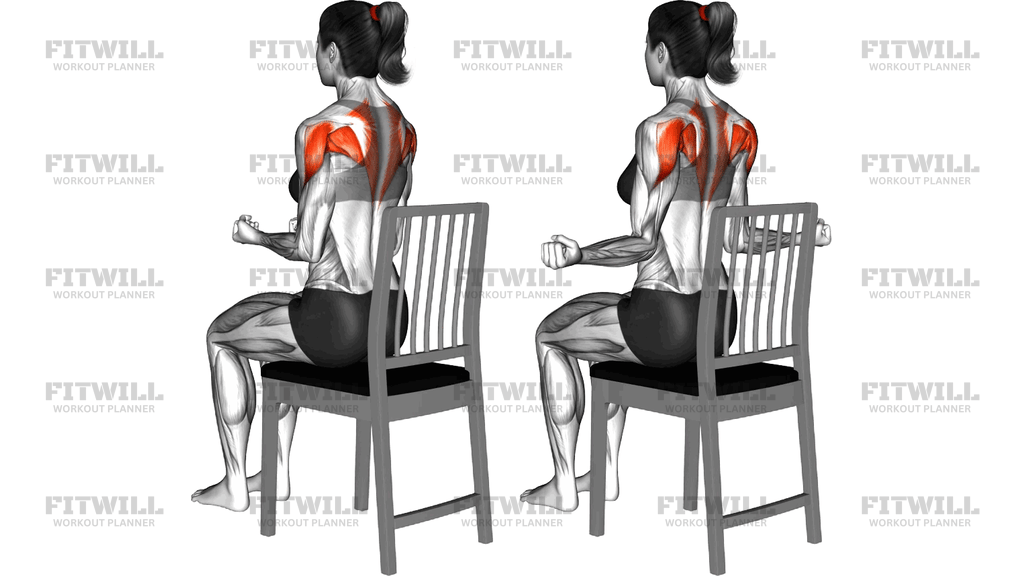
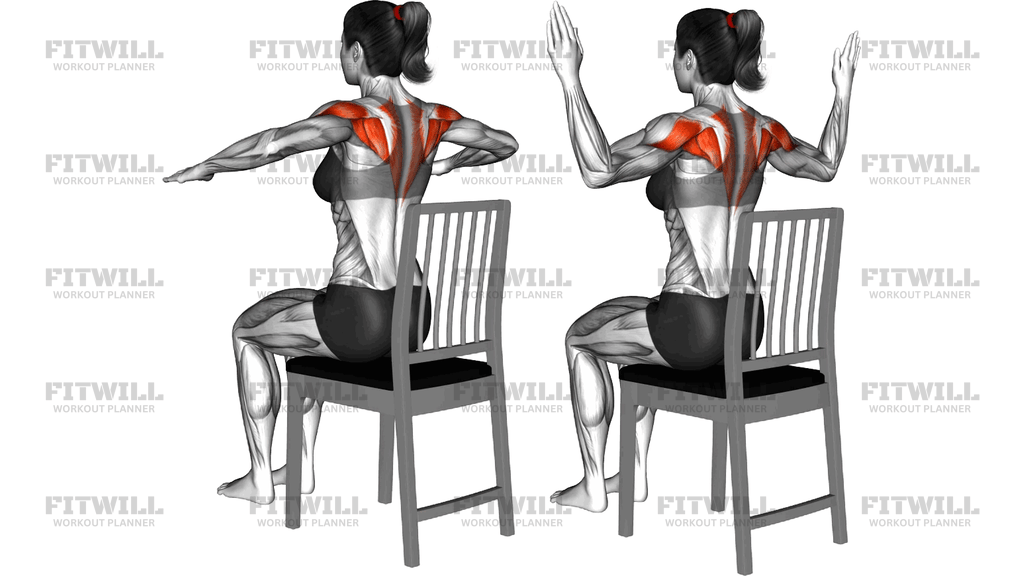
Seated Thumbs Up Pulse
The Seated Thumbs Up Pulse is a body-weight isolation movement for the rear shoulders and upper back. You sit on the floor, extend both arms straight out to your sides at shoulder height, rotate your thumbs toward the ceiling, and pulse the arms up and down through a short range. Because the thumbs-up position places the shoulder in external rotation, the back of the shoulder and the muscles between the shoulder blades do most of the work, which the highlighted areas in the exercise artwork reflect clearly.
This is a small, honest movement with no equipment and no momentum to hide behind. It suits people who spend long hours at a desk and feel rounded forward through the chest, lifters who want extra work for the often-neglected rear deltoids, and anyone building shoulder health with light, controlled volume. Because the pulse keeps constant tension on a short range, it also works well as a finisher after rows or presses when the upper back is already warmed up.
The seated position matters more than it looks. Sitting cross-legged with a tall spine removes the option of leaning back or using leg drive, so the arms and upper back have to do the work on their own. If you let the torso rock or the shoulders creep up toward the ears, the traps take over and the rear shoulders stop getting the attention you sat down to give them.
To perform it well, lift the arms to shoulder height and keep them there for the entire set. Each pulse is a small, deliberate lift of an inch or two, followed by a controlled lowering back to shoulder height. The arms stay straight, the elbows stay soft, and the shoulder blades stay pulled gently down your back rather than shrugged up. Breathing stays steady and rhythmic, one breath per pulse or one breath every two pulses.
Sets are usually longer here than on heavy lifts, since the resistance is your own arm weight. Twenty to forty pulses per set is a common working range. Stop the set when your form changes, not when the burning starts. If your shoulders shrug, your lower back arches, or your arms drift forward of shoulder height, that is the point to rest.
There are no hard safety concerns with this movement, but repeated sloppy reps can irritate the neck and traps. Keep the neck long and relaxed, the jaw loose, and the chest open. If shoulder-height arms cause discomfort, slightly lower the arm angle and rebuild from there.
[ Workout Log & Planner ]
Put your next workout in Fitwill
Keep your plan and training log ready when you are.


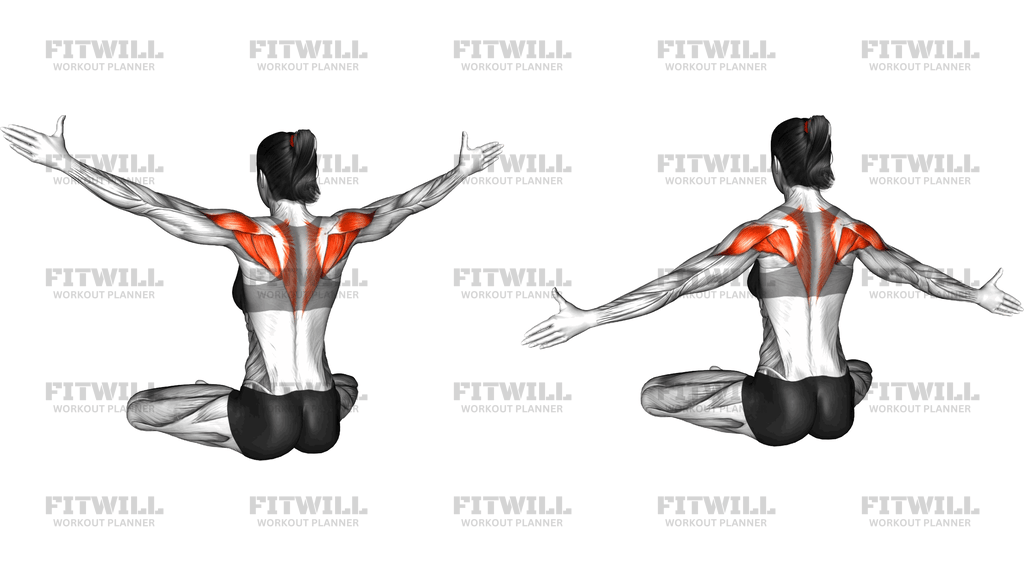
Instructions
- Sit on the floor with your legs crossed or folded comfortably beneath you, and place your hands lightly on your thighs to settle your posture.
- Sit up tall through the spine, lift the crown of your head, and let your shoulder blades settle down and slightly together.
- Extend both arms straight out to your sides at shoulder height, forming a long T-shape with your torso, and rotate your thumbs so they point up toward the ceiling.
- Soften the elbows just enough that the arms are straight but not locked, and relax your neck away from your ears.
- Brace your core lightly and keep your ribcage stacked over your pelvis so the torso stays still.
- Pulse both arms upward by an inch or two, leading with the backs of the hands and feeling the effort across the backs of your shoulders.
- Lower the arms back to shoulder height under control so there is tension even at the bottom of each pulse.
- Continue pulsing at a steady, moderate tempo, exhaling on the lift up and inhaling on the way down.
- When the set ends, lower your arms slowly to your sides, shake out the shoulders, and reset your seated posture before the next set.
Tips & Tricks
- If your traps burn instead of the backs of your shoulders, your arms have drifted above shoulder height or your shoulders have shrugged; drop the arms slightly and press the shoulder blades down.
- Check that your thumbs stay pointed at the ceiling for the whole set. When the thumbs roll forward, the external rotation that targets the rear shoulders disappears.
- Keep the pulse range genuinely small. Big swings up and down turn this into a momentum exercise and take tension off the rear deltoids.
- If your torso starts rocking with each pulse, imagine your pelvis is glued to the floor; the only moving parts should be the arms at the shoulders.
- If sitting cross-legged bothers your hips or knees, sit on a folded mat or firm cushion to raise the hips, or sit on the edge of a low bench instead.
- Stop the set when your arms sink below shoulder height between pulses. Holding the height is the actual work; once it goes, the set is over.
- Keep the elbows very slightly bent. Fully locked elbows with the arms held out for a long set can strain the inner elbow.
- Use this as a finisher after rows or rear delt work, when the muscles are warm, rather than as your first heavy upper-back exercise.
- If one arm fatigues before the other, finish with a short set of single-arm pulses on the weaker side to balance things out.
Frequently Asked Questions
Which muscles does the Seated Thumbs Up Pulse work?
The rear shoulders do the main work of lifting the arms, with the middle traps and rhomboids between the shoulder blades supporting and holding the position. The thumbs-up rotation also brings the rotator cuff's external rotators into play.
Why do the thumbs need to point up during this exercise?
Rotating the thumbs toward the ceiling externally rotates the shoulders, which shifts the emphasis toward the rear deltoids and rotator cuff and away from the front of the shoulder. If the thumbs face forward or down, the movement becomes a plain lateral hold.
Is the Seated Thumbs Up Pulse suitable for beginners?
Yes. It uses only your arm weight and a small range, so most people can learn it in one session. Beginners should start with shorter sets of around 15-20 pulses and focus on holding the arms at shoulder height without shrugging.
How high should my arms be during the pulses?
Your arms should stay level with your shoulders, forming a T with your torso, and each pulse lifts them only slightly above that line. If you cannot tell whether you are at shoulder height, check in a mirror once and then keep that height by feel.
My upper traps feel this more than my rear shoulders. What am I doing wrong?
Shrugging is the usual culprit. Lower the arms slightly, pull the shoulder blades gently down your back, and soften your neck. If the trap burn persists, reduce the number of pulses per set and build up slowly.
How many pulses should I do per set?
Most people work well in the 20-40 pulse range per set, taken to the point where holding shoulder height becomes difficult. Two to three sets is enough, especially at the end of an upper-body session.
Can I do the Seated Thumbs Up Pulse standing instead of sitting?
You can, but sitting makes it harder to cheat. Standing gives you room to lean back and swing the arms, while the seated position pins your torso and forces the shoulders and upper back to do the work.
What can I use if sitting on the floor is uncomfortable?
Sit on a folded exercise mat, a firm cushion, or the edge of a low bench. The exercise only requires a stable, upright seated position with your hips level or slightly above your knees.
Is it safe to do this exercise every day?
Because the load is light and the range is small, it is generally fine to perform often, but treat any pinching or sharp discomfort in the shoulder as a signal to stop and reduce the range or frequency.
Where does the Seated Thumbs Up Pulse fit in a workout?
It works best as a finisher after rows, face pulls, or presses, when the upper back is already warm, or as a stand-alone posture-focused set on recovery days. As the first exercise of a session, it is usually too light to drive meaningful progress.