Band Incline Row
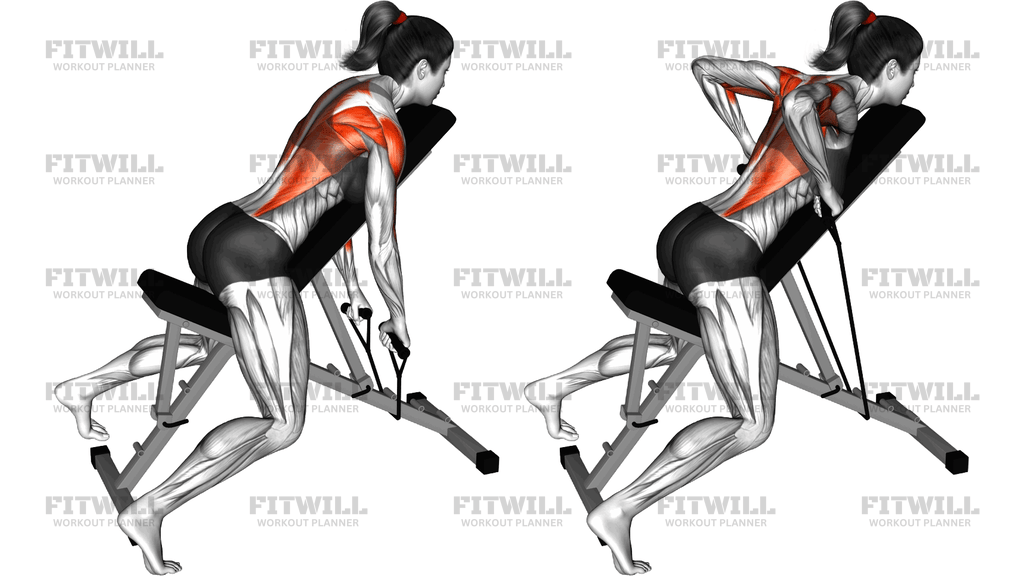
Band Incline Row is a chest-supported rowing exercise performed lying face down on an incline bench while pulling the handles of a resistance band toward your torso. Because the bench supports your chest, your lower back never has to hold you up against gravity, which lets you concentrate fully on squeezing the shoulder blades together at the top of each rep. The band provides resistance that peaks as your elbows travel behind your body, exactly where the rear shoulders and upper back do their best work.
This movement is a great fit for anyone who struggles to feel back exercises in the right place, or whose lower back fatigues before their upper back does during bent-over rows. Lifters rebuilding after a layoff, home trainees with limited equipment, and people who want extra rear-shoulder and upper-back volume without loading the spine all benefit from it. It also works well as a finishing movement after heavier free-weight rows.
The primary work comes from the rhomboids and mid-traps pulling the shoulder blades back and down, with strong assistance from the rear shoulders as the elbows drive up and past the torso. The lats contribute as the elbows come down toward your sides, and the biceps bend the elbows throughout. Because the band anchors low near the base of the bench, the pull angle naturally targets the upper back rather than pure lat strength.
Setup matters more here than in most band exercises. Your chest must stay glued to the incline pad, and the band needs even tension on both sides before the first rep starts. If the band is anchored too high or too far forward, the resistance pulls you forward off the bench; if it is slack at the bottom, you get a jerky start instead of smooth tension. Position the bench at roughly 30 to 45 degrees so your arms hang straight down toward the floor with the band already slightly stretched.
To execute well, pull your elbows up and back toward the ceiling, keeping them at about 45 degrees from your torso rather than flared straight out. Lead with the shoulder blades, pause briefly when the handles reach your lower ribs, and lower with control so the band never snaps you back down. Breathing is simple: exhale as you pull, inhale as you return.
The most common errors are shrugging the handles up with the upper traps, yanking the band with momentum from the hips, and letting the chest lift off the pad to steal range of motion. Keep the movement honest — if you have to rock or lift your chest to finish the rep, the band is too strong. Step down in band tension or choke up on the handles to reduce resistance before your form pays the price.
[ Workout Log & Planner ]
Put your next workout in Fitwill
Keep your plan and training log ready when you are.


Instructions
- Anchor a resistance band securely at the low base of an incline bench, then set the bench to roughly a 30-45 degree angle.
- Lie chest-down on the bench with your chest and stomach in contact with the pad; place one knee on the seat and the opposite foot on the floor behind you for stability.
- Grip one band handle in each hand with a neutral grip, palms facing each other, and slide forward or back until the band has light tension with your arms hanging straight down.
- Brace your core lightly, keep the back of your neck long, and let your shoulders relax down away from your ears before starting.
- Pull the handles up and back by driving your elbows toward the ceiling, keeping them around 45 degrees from your torso.
- Squeeze your shoulder blades together at the top so the handles finish near your lower ribs, and hold that squeeze for a beat.
- Lower the handles slowly and under control until your arms are nearly straight, resisting the band's pull on the way down.
- Exhale as you pull up, inhale as you lower the handles back down.
- Keep your chest in contact with the pad for every rep — if it lifts, reset your position or reduce band tension.
- Complete your reps, then release one handle at a time and stand up carefully to avoid the band snapping back.
Tips & Tricks
- If the band pulls you forward at the bottom of each rep, your anchoring point is too far away or the band is too long — shorten it or re-anchor it so tension starts immediately but gently.
- Shrugging at the top is the most common fault on this setup; fix it by thinking 'elbows to the ceiling, blades to the back pockets' instead of pulling with your hands.
- Because the bench blocks your chest from rising, any torso rocking is obvious — if you feel your hips driving the pull, drop to a lighter band.
- Keep your wrists neutral and in line with your forearms; bending the wrists back to 'finish' the handle higher steals work from the upper back.
- Pause for a full second at the top of each rep — the chest-supported position makes this safe and dramatically improves the mind-muscle connection in the rhomboids.
- Avoid letting your arms hang perfectly slack at the bottom; keeping slight tension prevents a dead stop that encourages jerky rep starts.
- If one knee on the seat feels unstable, widen your base by placing that foot flat on the floor with the knee braced against the bench side.
- Shorter bands or holding the band closer to the anchors both reduce resistance without needing a different band.
- Match the incline angle to your goal: a steeper bench shifts more emphasis toward the rear shoulders, while a flatter angle favors the lats and mid-back.
Frequently Asked Questions
Which muscles does the Band Incline Row work?
The rhomboids and mid-traps of the upper back do the main work, with strong support from the rear shoulders and lats. The biceps assist by bending the elbows on every pull.
Why lie chest-down on an incline bench instead of doing a regular bent-over band row?
The pad supports your torso, so your lower back and legs don't have to hold you in a hinged position. That removes the usual lower-back limit and lets you focus entirely on pulling with the upper back.
Is the Band Incline Row suitable for beginners?
Yes — the chest support and smooth band resistance make it one of the more forgiving rowing variations. Start with a light band and focus on squeezing the shoulder blades before adding tension.
Where should the band be anchored for the Band Incline Row?
Anchor it low, at or near the base of the bench, so your arms hang straight down with light tension at the start. If the anchor is too high or far forward, the band drags you off the pad instead of resisting your pull.
How far should my elbows flare during the Band Incline Row?
Keep them around 45 degrees from your torso rather than fully out to the sides. This angle hits the upper back and rear shoulders together without stressing the shoulder joints.
What should I do if my shoulders shrug up toward my ears during the pull?
Lighten the band and consciously pull your shoulder blades down and back before each rep. Shrugging means the upper traps are taking over work the upper back should be handling.
Can I substitute the Band Incline Row with another exercise?
A dumbbell chest-supported incline row is the closest swap, followed by a seal row or a machine chest-supported row. All keep the torso supported while training the same pulling pattern.
How many reps and sets should I do?
Two to four sets of 10-15 reps works well, since band resistance climbs quickly at the top. Keep the last few reps challenging but doable without your chest lifting off the pad.
Is it safe if the band slips off the anchor mid-set?
Check that the band is fully secured around a stable part of the bench frame before every set. Release one handle at a time when finished, and never anchor a band to something that can tip or slide.