Assisted Hyperextension
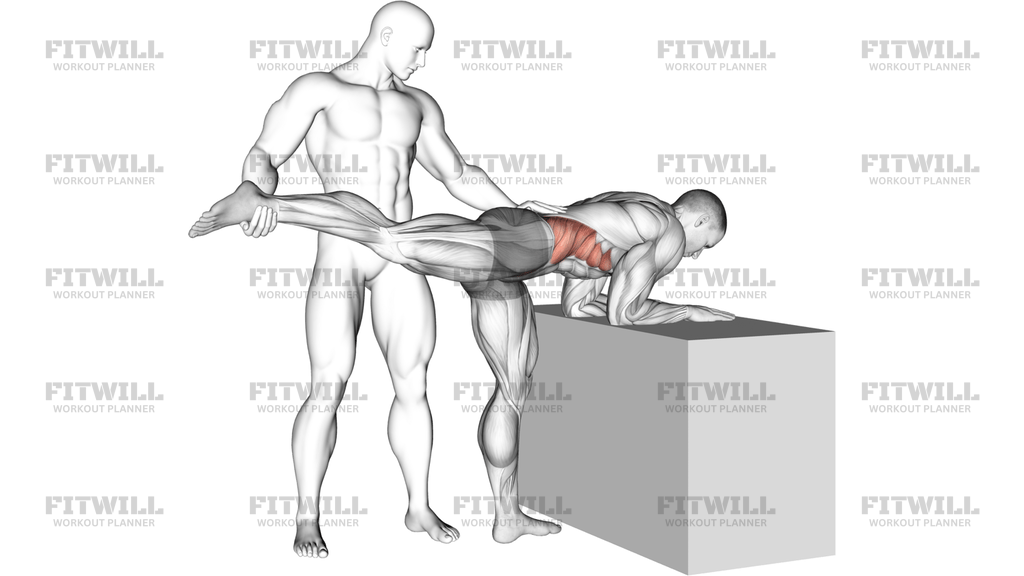
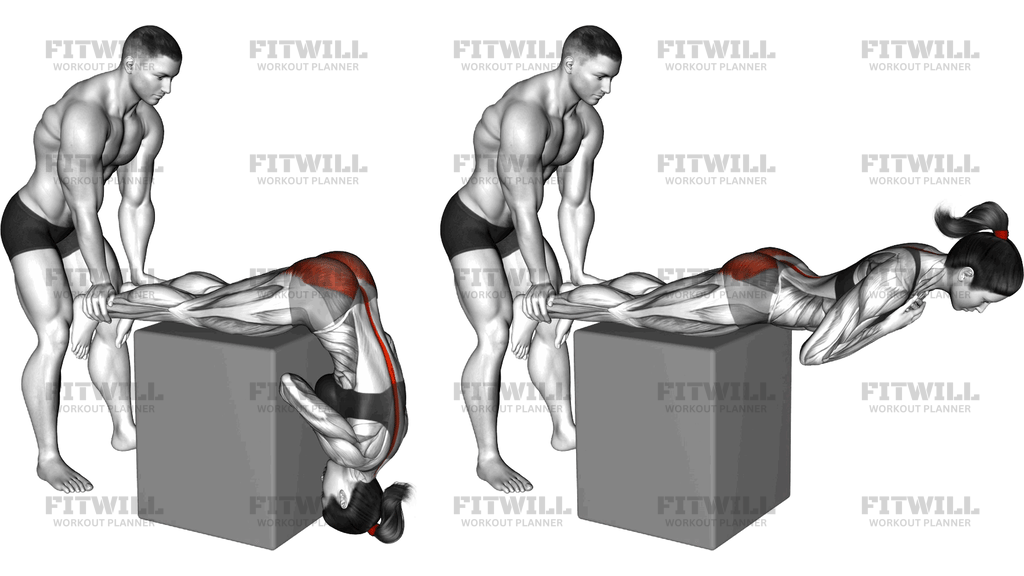
The Assisted Hyperextension is a partner-assisted back extension performed over a stable box or bench. Instead of using a dedicated hyperextension bench with foot pads, a partner anchors your ankles or lower legs while your hips rest on top of the box and your torso hangs down toward the floor. From there, you extend back up until your body forms a straight line, lifting with your lower back and hips rather than pulling with your arms or jerking your head up.
This setup is useful when you don't have access to a Roman chair or 45-degree back extension bench, which makes it a common choice in home training, group settings, and warm-ups before heavier hip-hinge work. Because the box is usually taller and more horizontal than a dedicated bench, the range of motion is generous, so control matters more than height. The partner's role is simply to hold you steady, not to pull you up.
The main muscles worked are the erector spinae along the lower back, with strong support from the glutes and hamstrings as they extend the hips toward the top position. Your core works isometrically the whole time to keep the ribcage and pelvis aligned, and the upper back helps control where your head and shoulders travel. When done slowly, this becomes as much a lesson in spinal control as it is a strength exercise.
Setup is where most people go wrong. Your hip crease should sit right at the edge of the box so the pelvis can tilt freely, and the partner should grip just above the ankles or at the calves with a firm, stable hold. If your hips are too far back on the box, you lose range; if they drift past the edge, the lower back takes the movement at a mechanically tougher angle.
Execute the rep by folding down under control, inhaling at the bottom, then exhaling as you raise your chest back up to hip height. Stop when your shoulders, hips, and knees form one straight line. Rising well above that line with an arched back shifts stress onto the spinal joints and takes work away from the glutes, so treat a flat finish as the goal. Use this exercise in sets of 8-15 controlled reps, either as preparation before deadlifts and good mornings or as direct lower back and glute work in its own right.
[ Workout Log & Planner ]
Put your next workout in Fitwill
Keep your plan and training log ready when you are.


Instructions
- Lie face down across a stable box or bench with the front of your hip crease resting right at the edge and your legs extending off the far side.
- Have your partner stand beside or behind you and grip firmly just above your ankles or at your calves, pinning your legs down against the top surface.
- Walk your hips forward or back slightly until only your pelvis is supported and your torso can fold down freely over the edge.
- Cross your arms over your chest or place your fingertips lightly at your temples, and brace your abdominal wall as if preparing for a light exhale.
- Inhale, then slowly lower your torso toward the floor, letting your spine round gradually until you feel a mild stretch through the lower back.
- Exhale and raise your chest by pushing your hips down into the box and squeezing the glutes, stacking one vertebra at a time until your head, shoulders, hips, and knees form a straight line.
- Pause for one second at the top without arching past flat or throwing your head backward.
- Lower your torso back down under control over 2-3 seconds to start the next rep.
- Keep breathing steadily throughout the set, and signal your partner before stopping so they release your legs only when you are fully settled on the box.
Tips & Tricks
- Check your hip position before the first rep: if your torso won't fold down far, your hips are too far back on the box; if you feel pressure in the lower back at the start, slide back toward the center.
- Aim for a flat finish at the top. Overextending past a straight line with the chest high and head back is the most common fault on this movement and shifts load from the glutes to the lumbar spine.
- If your hamstrings cramp at the top, reduce the hold time and think about driving the hips down into the box rather than pulling the heels toward the ceiling.
- Keep the partner's grip just above the knees or at the calves, not on the ankles alone if the box edge is hard; a grip behind the knee line changes the leverage and can strain the joint.
- Tuck the chin slightly and keep the neck neutral as you fold down, letting the head travel with the spine instead of leading the lift.
- Slow the lowering phase down first. If you can't descend in three quiet seconds, the eccentric control, not the lift, is the weak point.
- Start with bodyweight-only reps even if you normally add load on a hyperextension bench; the taller box gives a longer lever arm and a bigger stretch than most machines.
- Avoid bouncing out of the bottom position. The stretched start is where momentum takes over and form slips most easily in this setup.
- Place a mat or towel under the hips if the box edge is sharp, and check that the box cannot slide before your partner commits their weight to holding your legs.
Frequently Asked Questions
Which muscles does the Assisted Hyperextension target?
It primarily works the erector spinae of the lower back, with the glutes and hamstrings extending the hips as you rise to the top. The core and upper back stabilize throughout.
Why does the Assisted Hyperextension need a partner?
Your legs hang off the box with nothing to anchor them, so the partner pins your calves or ankles in place. Their role is stabilization only; they should not lift or pull your torso up.
Is the Assisted Hyperextension safe for beginners?
Yes, if the range is kept modest and the tempo is slow. Beginners should stop at a straight-line finish and limit the depth of the fold until they can control the descent smoothly.
Where exactly should my hips sit on the box?
Your hip crease should rest right at the edge so the pelvis can tilt freely as you fold. Hips too far back shorten the range; hips past the edge overload the lower back at the start of the lift.
How high should I raise my torso at the top of the Assisted Hyperextension?
Until your head, shoulders, hips, and knees form one straight line. Lifting much beyond flat relies on lumbar arching rather than hip extension and adds stress to the spine.
What is the most common mistake in this exercise?
Jerking the chest up quickly and overextending at the top, often with the head thrown back. Fix it by slowing the descent, driving the hips into the box, and finishing flat.
Can I do the Assisted Hyperextension without a partner?
You need something to anchor your legs, so options include wedging your ankles under a heavy barbell, using a door anchor, or switching to a regular hyperextension bench or floor back extension instead.
How does the Assisted Hyperextension differ from a machine back extension?
A box is usually higher and more horizontal than a 45-degree bench, so you get a longer range and a deeper stretch. There are also no hip pads, so your own positioning determines the pivot point.
How many reps and sets should I use?
For general strength and endurance, 2-3 sets of 8-15 controlled reps works well. If you are using it as a warm-up before deadlifts, keep it to 1-2 easy sets of 8-10.
Should I feel the Assisted Hyperextension in my hamstrings?
Some hamstring involvement is normal because they help extend the hips, but the effort should center on the lower back and glutes. If hamstrings dominate or cramp, focus on pressing the hips down and reduce the top-end squeeze.