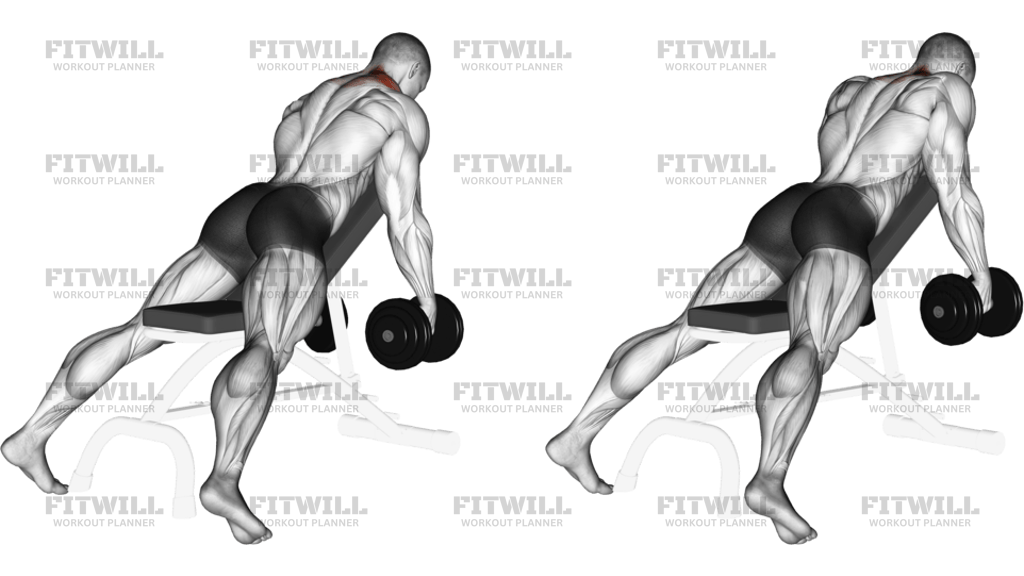
Dumbbell Bent Over Y Raise
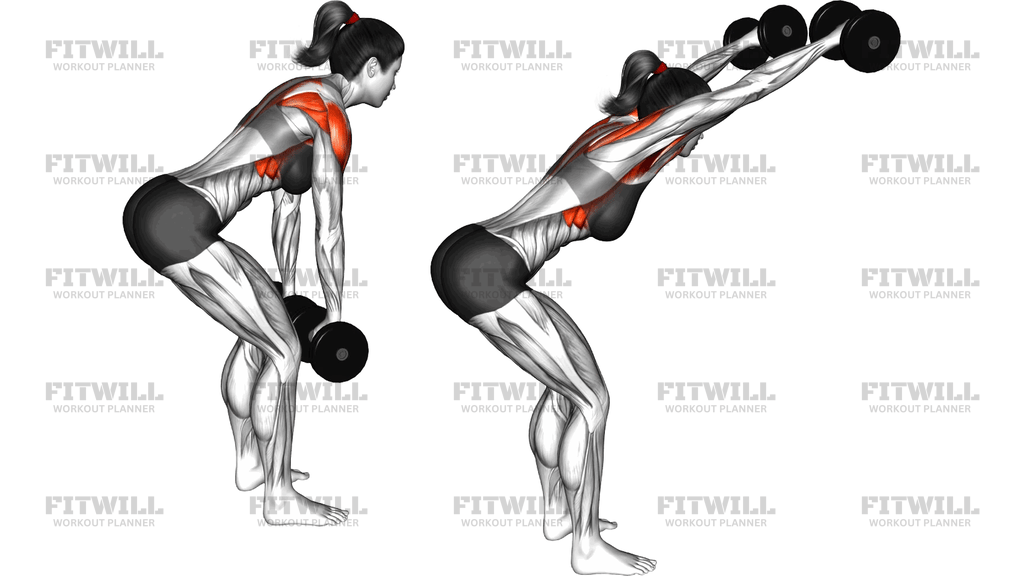
The Dumbbell Bent Over Y Raise is a hinge-position raise that takes your arms from hanging straight down to an overhead Y shape, with your torso folded forward throughout. Unlike a bent-over lateral raise, where the arms travel out to the sides, this version drives the dumbbells up and forward along a diagonal path so your arms finish wide of your ears. That angle is what makes it such a direct builder of the lower trapezius, a section of the upper back that most pulling exercises only touch indirectly.
This movement is especially useful for people whose training is heavy on pressing and vertical pulling but light on scapular upward rotation. Desk workers with rounded shoulders, lifters whose overhead press stalls because their shoulder blades don't move well, and anyone chasing better posture all benefit from it. It also trains the rear shoulders and rhomboids, but the emphasis sits higher on the back than in rows, which is exactly the point.
Setup matters here because the hinge position does double duty. Bending forward at the hips not only lets the dumbbells hang below your chest for a full range of motion, it also forces your spinal erectors, glutes, and hamstrings to work isometrically to hold your torso steady. If your hinge is too shallow, the weights drift toward a front raise; if it's too low or your back rounds, your lower back takes abuse instead of your upper back taking load.
To perform it well, keep a light bend in the elbows and lead with the thumbs, letting the arms rotate slightly outward as they rise. The weights should travel in a wide arc, not a narrow one, and the top position looks like a capital Y viewed from behind. Lift only as high as you can without your chest lifting or your hips shifting backward, then lower under control. Because the leverage is poor at the top, this exercise works best with lighter dumbbells than you'd use for lateral raises.
You'll see the Dumbbell Bent Over Y Raise programmed as an accessory on shoulder or back days, as a warm-up activation before pressing or overhead work, and in higher-rep finisher sets. Start with two to three sets of ten to fifteen reps, rest briefly between sets, and treat any urge to swing the weights as a signal to drop the load rather than push through it.
[ Workout Log & Planner ]
Put your next workout in Fitwill
Keep your plan and training log ready when you are.


Instructions
- Hold a dumbbell in each hand with a neutral grip, palms facing your body, and stand with your feet about hip-width apart.
- Hinge forward at the hips until your torso is roughly 45 degrees or slightly above parallel to the floor, knees softly bent, and let the dumbbells hang straight down beneath your shoulders.
- Draw your shoulders back and down, brace your core, and set your gaze on the floor a short distance ahead of your feet so your neck stays in line with your spine.
- Exhale and raise both dumbbells up and forward in a wide arc at the same time, keeping a slight, fixed bend in the elbows.
- Lead with your thumbs and let the arms rotate outward slightly so that at the top your body and arms form a Y shape, with the weights above shoulder height and wide of your head.
- Pause briefly at the top without shrugging the dumbbells toward your neck or lifting your chest.
- Inhale and lower the dumbbells slowly along the same arc back to the hanging position, resisting the pull of gravity rather than dropping them.
- Keep your hips and torso completely still from rep to rep; the only joints moving should be the shoulders.
- Finish the set, stand up slowly by driving your hips forward, and set the dumbbells down on the floor rather than dropping them from the bent-over position.
Tips & Tricks
- Choose noticeably lighter dumbbells than you'd use for bent-over lateral raises; the long lever arm overhead makes the top half of the Y raise far harder than it looks.
- If your chest rises toward the ceiling as the weights go up, you're extending your spine to cheat the range. Slow the tempo and reduce the height until your torso angle stays locked in.
- Think about pulling your shoulder blades down and together at the top rather than just lifting your hands. Reaching with the hands alone shifts work to the deltoids and away from the lower traps.
- Watch where your hips drift. Shifting them backward as you raise turns the set into a partial good morning and steals tension from the shoulders.
- Keep the elbow bend constant. Straightening the arms at the top to squeeze out extra height strains the elbow and shoulder without adding useful muscle work.
- Your neck should follow your spine. Craning up to watch yourself in a mirror is a common cause of neck discomfort in this position; look at the floor instead.
- If your lower back fatigues before your shoulders, try supporting your free hand... or in this two-dumbbell version, simply shorten the set or place your forehead against an incline bench set low to take load off the spine.
- Squeeze the dumbbells firmly. A loose grip lets the wrists bend back at the top, which usually triggers shoulder impingement-style pinching.
- Add a one-second pause at the top of each rep instead of adding weight; the pause builds the mind-muscle connection to the upper back better than extra load does.
Frequently Asked Questions
What muscles does the Dumbbell Bent Over Y Raise work?
The primary target is the lower trapezius, with strong support from the rear deltoids and rhomboids. Your spinal erectors, glutes, and hamstrings also work isometrically to hold the bent-over position.
How is the Dumbbell Bent Over Y Raise different from a bent-over lateral raise?
A lateral raise sends the dumbbells straight out to the sides until they're level with your shoulders, while the Y raise continues the arc up and forward so the arms finish overhead in a wide Y. This shifts the emphasis up the back toward the lower traps and requires lighter weight.
Is the Dumbbell Bent Over Y Raise suitable for beginners?
Yes, as long as you can hold a hip hinge comfortably and start with very light dumbbells, often 2 to 5 kg per hand. Beginners frequently overshoot the height of the lift, so focus on feeling the upper back work rather than getting the weights overhead.
Why do my lower back and hamstrings burn during this exercise?
The bent-over position loads the posterior chain isometrically, so some fatigue there is normal and even useful. If it becomes the limiting factor before your shoulders feel anything, shorten your sets, lighten the load, or brace harder by squeezing your glutes.
Should my elbows stay bent or straight during the Dumbbell Bent Over Y Raise?
Keep a small, fixed bend of roughly 10 to 20 degrees throughout the rep. Fully locked elbows strain the joint at the top, and bending them further turns the movement into a row.
What's the most common mistake with this movement?
Using too much weight and turning the lift into a combination of torso extension and a shrug. If your chest lifts, your hips shoot back, or the dumbbells end up close to your head instead of wide of it, the load is too heavy.
Can I do the Y raise lying face down on a bench instead?
Yes, an incline or flat bench Y raise is a good substitution that removes the lower back demands entirely. The standing bent-over version adds the hinge-strength benefit, so use the bench version mainly when fatigue or back discomfort is an issue.
How high should I raise the dumbbells at the top of the movement?
Aim for a position where your arms are in line with your torso and wide of your ears, forming a Y. Stop just short of the point where your chest starts to lift or your shoulders shrug up toward your ears.
How many sets and reps should I do?
Two to four sets of 10 to 15 controlled reps works well, either as an activation drill before pressing or as an accessory at the end of a shoulder or back session. Because the leverage is poor, progress by refining technique and adding reps before adding weight.
Is it safe for my shoulders if I feel a pinch at the top?
A pinching sensation usually means the weights are traveling too close to your body or your thumbs are pointing down. Rotate your palms so the thumbs lead, widen the arc, and reduce the height slightly. If the pinch persists, stop and consult a qualified professional before continuing.