Front To Under Knee Clap
The Front To Under Knee Clap is a rhythmic, body-weight coordination drill that combines a front hand clap with a second clap beneath your bent knees. You start standing tall with arms swinging from out at your sides, clap your hands together in front of your chest or waist, then quickly swing both straight arms down and back as your knees bend and your torso tips slightly forward, bringing your palms together underneath your legs. From there the arms swing back up and wide to restart the cycle. Because the whole pattern runs on timing rather than load, it works best as a flowing, continuous movement rather than a series of separate attempts.
This drill earns its place in warm-ups, cardio circuits, and general conditioning work. It is especially useful for anyone who wants to raise the heart rate quickly without equipment, and for athletes who need better hand speed, reaction timing, and lower-body rhythm. Because the under-knee clap demands a coordinated bend at the hips and knees while the arms are moving fast, it also doubles as a useful gross-motor coordination challenge for kids, beginners, and older trainees who want to keep reactive movement patterns sharp.
In terms of muscles, the shoulders and chest drive the arm swings, with the front delts doing most of the lifting on each clap. The abs brace to control the quick forward tip of the torso, and the quads and hips power the repeated shallow bend under the arms. None of this is heavy strength work, but the repeated cyclical effort adds up: performed continuously, the Front To Under Knee Clap delivers a genuine aerobic and shoulder-endurance stimulus along with dynamic hip and hamstring mobility.
Setup matters more than people expect for a drill with no equipment. Your feet should be about hip-width to shoulder-width apart with weight spread across the whole foot, knees soft rather than locked. If your stance is too narrow, the under-knee clap turns into a balance struggle; too wide, and the knee bend becomes a deep squat that wastes energy. Keep your spine long and hinge slightly from the hips rather than rounding your back to reach the clap.
To execute it well, think of the arms as pendulums that stay nearly straight the entire time. Swing them out wide and together for the front clap, then let their momentum carry them down and back as you bend your knees and hinge forward a few degrees. The under-knee clap happens at the lowest point of the bend, right behind or beside your shins, and then the same momentum swings the arms forward again to reset. When the timing is right the movement feels bouncy and self-sustaining; when it is off, you will find yourself stopping to reposition your hands.
Use the Front To Under Knee Clap in warm-up blocks for 20 to 40 seconds, or as a conditioning station in circuits for longer intervals. Move at a pace you can maintain with clean claps, and stop the set as soon as your timing breaks down, since sloppy reps teach sloppy patterns. If bending under the knees bothers your knees or lower back, reduce the depth of the bend and let the hands meet just beside your knees instead of fully beneath them.
[ Workout Log & Planner ]
Put your next workout in Fitwill
Keep your plan and training log ready when you are.


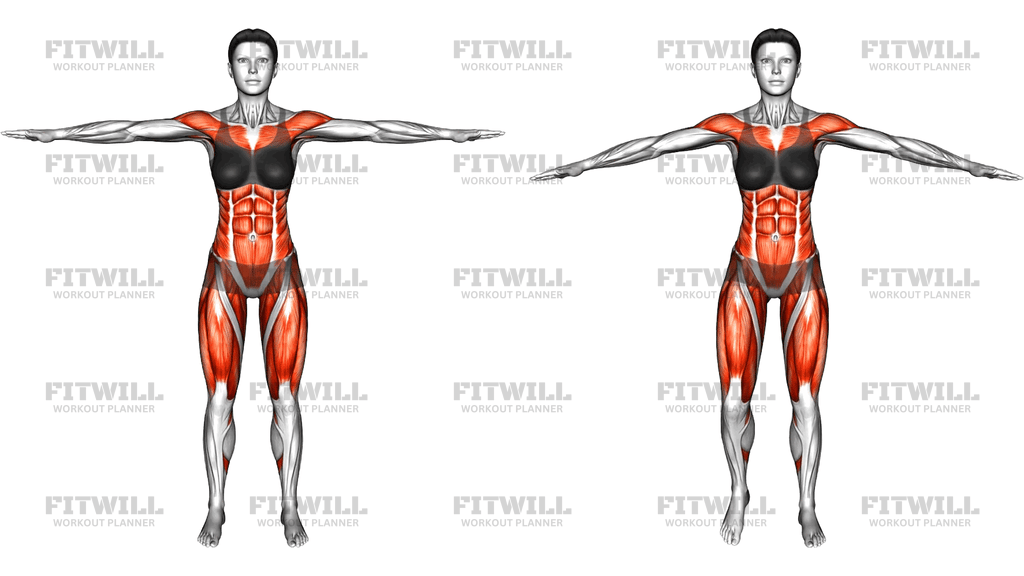
Instructions
- Stand with your feet hip-width to shoulder-width apart, weight spread evenly across both feet, and let your arms hang relaxed at your sides.
- Soften your knees slightly and brace your abdominal muscles so your torso stays supported before the arms start moving.
- Swing both straight arms out to the sides and up, then bring your palms together for a crisp clap in front of your body at chest or waist height.
- Immediately let the arms swing back down along the same wide path as you bend your knees and hinge forward a few degrees from the hips.
- At the bottom of the bend, bring your straight arms together underneath your knees for the second clap, keeping your back long rather than rounded.
- Use the momentum from the under-knee clap to swing the arms back out wide and up while you straighten back to standing.
- Exhale sharply on each clap, especially the under-knee clap, and inhale naturally as the arms return to the wide position.
- Continue the front-clap, under-knee-clap cycle in a steady rhythm, keeping the arms nearly straight throughout.
- To finish, complete an under-knee clap, return to standing, and let the arms swing gently at your sides for a few seconds before stopping completely.
Tips & Tricks
- If you keep missing the under-knee clap, slow the tempo down first. Most timing errors come from swinging the arms faster than your hips and knees can bend.
- Bend from the hips and knees together instead of rounding your back to chase your hands. A rounded spine under the clap is the most common form breakdown in this drill.
- Keep the knees behind or in line with your toes during the bend. Pushing the knees forward too far shifts the load awkwardly and makes the under-knee space smaller.
- Aim the second clap just beside or behind your shins rather than forcing it deep under the legs. The clap position should match your natural bend depth, not the other way around.
- Keep the arms almost fully straight on both claps. Bent elbows shorten the swing, kill the pendulum momentum, and make the front clap land low and mushy.
- Land each rep softly on flat feet. Popping onto your toes during the bend usually means your stance is too narrow or your timing is rushed.
- Start with a shallow, comfortable bend and only add depth once the clap timing feels automatic. Depth without rhythm just fatigues the quads early.
- If your shoulders tire before your breathing does, reduce the swing height on the front clap. Bringing the arms to waist height still trains the pattern with less deltoid demand.
- Use a smooth, continuous pace instead of stopping between claps. Momentum from one clap feeds the next, so pauses cost more energy than the reps themselves.
Frequently Asked Questions
What muscles does the Front To Under Knee Clap work?
The front shoulders and chest power the arm swings and claps, while the abs stabilize your torso as it tips forward. The quads and hips handle the repeated shallow bend under the arms.
Is the Front To Under Knee Clap good for beginners?
Yes, because it uses no equipment and the difficulty is mostly timing. Beginners can slow the tempo down and clap just beside the knees instead of fully underneath them until the rhythm clicks.
How deep should I bend for the under-knee clap?
Bend only as deep as you need for your palms to meet, typically a shallow knee bend with a slight forward lean from the hips. Forcing a deeper bend than your timing allows just breaks the rhythm and rounds your back.
Why do I keep hitting my legs instead of clapping under my knees?
Your arms are probably swinging straight down instead of slightly back. Let the hands travel down and behind the knees as your hips shift back, and widen your stance slightly if your shins are in the way.
Should my arms stay straight during the Front To Under Knee Clap?
Yes, keeping the arms nearly straight creates the pendulum swing that makes the drill efficient and rhythmic. Bent elbows shorten the arc and force the shoulders to work much harder for each clap.
Can I use the Front To Under Knee Clap in a warm-up?
It works very well as a warm-up drill because it raises the heart rate while mobilizing the shoulders, hips, and knees together. Twenty to forty seconds of continuous reps is usually enough before moving on.
What can I substitute if bending under my knees is uncomfortable?
Try a front clap to behind-the-back clap while standing taller, or a front clap combined with a high-knee lift and a clap under that single raised knee. Both keep the timing challenge without the deep two-leg bend.
How many reps or how long should I perform this drill?
For warm-ups, work in 20 to 40 second bouts; in circuits, 30 to 60 seconds fits well. End the set when your claps stop landing cleanly, because timed, accurate reps matter more than total volume.
Is it safe for my knees and lower back?
For healthy joints, the shallow bend and forward lean are well within normal movement, and keeping your spine long protects your back. If you have knee or back issues, keep the bend shallow, clap beside the knees instead of under them, and stop if either area complains.