Resistance Band Push Up
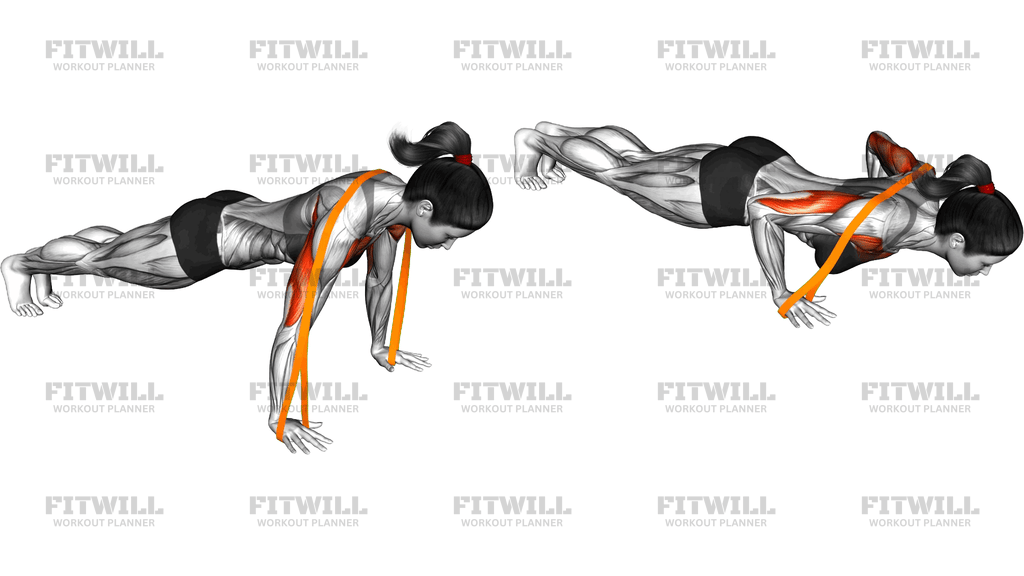
The Resistance Band Push Up is a standard push-up with a flat resistance band looped around your upper back and anchored under both palms. As you press up, the band stretches across your shoulder blades and adds extra load at the top of the movement, which is exactly where a regular push-up feels easiest. The result is a push-up that stays challenging through the entire range of motion instead of only at the bottom.
This exercise works well for anyone who has outgrown bodyweight push-ups but does not have access to a weighted vest or plates. The band creates accommodating resistance: it is nearly slack at the bottom, so the hardest portion of the lowering phase remains manageable, then ramps up as you extend your arms. That makes it a smart progression tool for intermediate lifters and a way for stronger trainees to squeeze more out of a high-rep set without adding external weight.
Muscularly, the movement targets the chest as the prime mover, with strong contributions from the triceps and front delts as they extend the elbows and assist the press. Because the band pulls your shoulders forward slightly, your core works harder than in a plain push-up to keep your ribs down and hips from sagging. The shoulder blades also get useful work stabilizing against the band's pull.
Setup matters more here than in a regular push-up. The band must sit squarely across your upper back near the armpits and stay secure under both hands, or it can slide toward your neck or slip out mid-rep. Hand position should be slightly wider than shoulder width, directly under the shoulders at the bottom, with fingers spread to trap the band in place.
To perform it well, think about pushing the floor away rather than just lifting your body. Keep your elbows at roughly 45 degrees to your torso rather than flaring them wide, and finish each rep with straight arms while actively pressing through the floor. Lower under control until your chest is close to the ground, then drive back up against the increasing band tension.
Common use cases include home workouts with minimal equipment, finishing sets after bench pressing, and building push-up volume with progressive overload. If the band feels unstable at first, use a lighter band or position it slightly lower on your back until you are comfortable with the added pressure across the shoulders.
[ Workout Log & Planner ]
Put your next workout in Fitwill
Keep your plan and training log ready when you are.


Instructions
- Choose a flat resistance band and drape it across your upper back so it sits just under your armpits, with an equal length of band hanging on each side.
- Place your hands on the floor slightly wider than shoulder width and trap the ends of the band under your palms, spreading your fingers so the band cannot slip forward.
- Walk your feet back until your body forms one straight line from head to heels, resting on your toes with your legs together or hip-width apart.
- Squeeze your glutes and brace your abs so your lower back stays flat and your ribs stay pulled down before the first rep.
- Bend your elbows at about a 45-degree angle to your torso and lower your chest toward the floor, keeping the band seated on your upper back.
- Stop when your chest is a few inches from the floor or your upper arms are roughly parallel to the ground.
- Press the floor away and straighten your elbows, pushing hard at the top where the band tension is greatest.
- Exhale as you press up and inhale as you lower into the next rep.
- Complete your set, then stand up and remove the band by lifting one hand at a time, never letting it snap off your shoulders.
- Reset your plank position between reps if your hips drop or your hands shift.
Tips & Tricks
- If the band drifts toward your neck during the set, move it lower onto your back and widen your hand placement so more of the band is pinned under your palms.
- A band that is too heavy will buckle your midsection at the top; if your hips sag as you press out, drop to a lighter band rather than shortening the range.
- Keep your head in line with your spine by looking at a spot on the floor about a foot ahead of your hands, not straight down.
- Elbows flaring out to 90 degrees is the most common fault in this setup and puts the shoulders in a rough spot under band pressure; cue them slightly tucked.
- Press all the way to locked elbows on every rep, because cutting reps short robs you of the top half where the band does its work.
- Loop a longer band around both hands and your back in a figure-eight style if a single loop keeps sliding off your shoulders.
- Warm up your wrists with a few plain push-ups or wrist circles first, since the band presses your palms into the floor more firmly than bodyweight alone.
- On a slippery floor, place the band under your palms with your hands flat rather than on your knuckles, or use a mat to keep the band anchored.
Frequently Asked Questions
What muscles does the Resistance Band Push Up work?
The chest is the primary muscle, with the triceps and front delts assisting the press. Your abs and shoulder stabilizers also work harder than in a plain push-up because the band pulls your upper body forward.
How is the Resistance Band Push Up different from a regular push-up?
The band adds tension that increases as you press toward the top, making the lockout much harder than a normal push-up. At the bottom the band is slack, so the hardest point of the rep shifts to the end of the press.
Where exactly should the band sit on my back?
It should rest across your upper back just below your armpits, roughly where a barbell would sit in a back squat. If it rides up near your neck, it can create uncomfortable pressure and reduce control.
Is the Resistance Band Push Up good for beginners?
It can be, but most beginners benefit from mastering regular push-ups first. If you want to use a band as a beginner, choose a very light one, or use a band for assistance from a rack instead of added resistance.
What strength band resistance should I use?
Start with a light to medium band that adds a noticeable but manageable load at lockout. If your form breaks down in the last third of the press or your hips sag, the band is too strong.
Why does the band keep slipping off my shoulders?
Usually the band is sitting too high or your hands are not trapping it firmly enough. Pull it lower onto your back, spread your fingers, and press your palms fully into the floor so the band ends stay pinned.
Can I do the Resistance Band Push Up on my knees?
Yes, kneeling keeps the same band setup and works well if full push-ups are too difficult. Keep a straight line from head to knees and avoid letting the band slide up your back as you press.
What can I use instead of a Resistance Band Push Up if I have no band?
Regular push-ups with your feet elevated, deficit push-ups with hands on blocks for a deeper stretch, or tempo push-ups with a slow three-second lowering phase all add difficulty without equipment.
Is it safe for my shoulders and wrists?
For most people with healthy shoulders and wrists, yes, as long as the band stays on your upper back and your elbows stay near 45 degrees. If you feel pinching at the top, use a lighter band and stop short of fully locked arms.