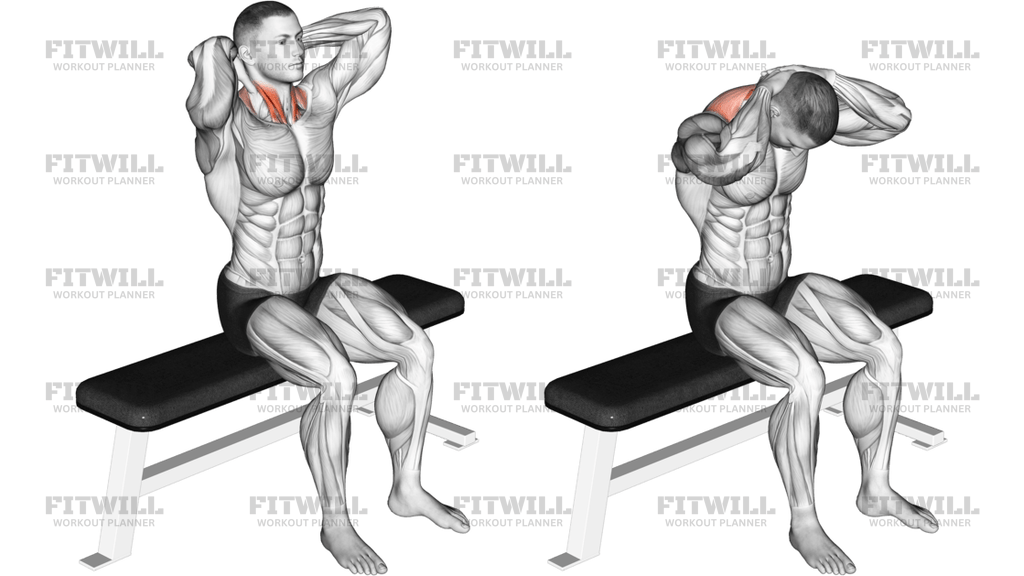
Sitting Swimmer On A Chair
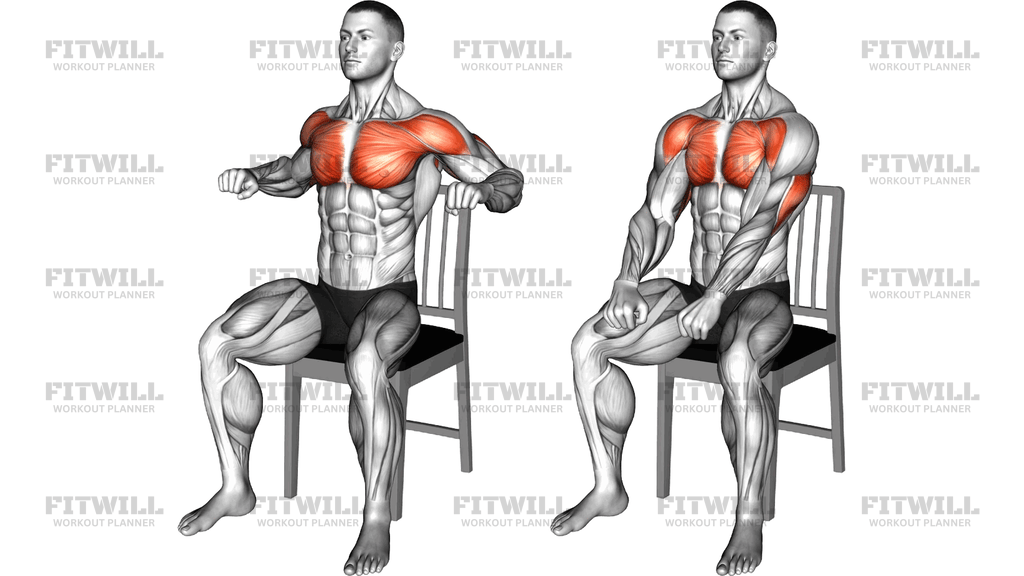
Sitting Swimmer On A Chair is a seated body weight drill in which you sit upright on a sturdy chair and sweep your arms in an alternating swimming pattern: one arm reaches up and forward toward the ceiling while the other swings down and back behind your hip, then the two switch roles in a smooth, continuous rhythm. It mimics the arm path of a freestyle stroke without water, without weights, and without needing floor space, which makes it a practical choice for anyone who trains at a desk, in a small apartment, or as part of a warm-up before upper body work.
The main work is done by the front and side shoulders as each arm travels through its long arc, with the chest assisting as the arm drives down and across. Because your arms move in opposition, your torso naturally wants to rotate, so the obliques and deep abdominal muscles stay engaged to keep your ribcage stacked over your hips. Holding a tall seated posture also quietly challenges the muscles along your spine, which is why this drill feels surprisingly demanding after thirty to forty seconds even though no load is involved.
The chair setup matters more than it might seem. A stable, armless chair with a firm seat lets you sit at the front edge with your feet flat and your knees bent around ninety degrees, which gives your hips a solid base and frees your arms to move through a full range. Sit too far back and you slouch; use a chair with wheels or a soft cushion and the base itself becomes the weak link. Feet planted about hip-width apart keep the movement in your shoulders and trunk instead of leaking into your lower back.
Execution is all about rhythm and reach quality rather than speed. Drive one hand up and slightly forward as if entering water above your head, let the other hand brush back past your hip, then trade positions continuously while your torso stays tall and mostly square to the front. Small, controlled rotations are natural and welcome; exaggerated twisting or leaning is not. Breathe steadily throughout, matching your breath to the arm cycles rather than holding it.
This movement fits well as a shoulder and trunk warm-up before pressing or pulling sessions, as a low-impact strength and mobility drill for older adults or people returning from a sedentary stretch, and as a desk-break exercise that gets blood moving without a change of clothes. If a full overhead reach is uncomfortable on your shoulders, shorten the arc and bring your hands closer to shoulder height, then gradually extend the range as your mobility allows. Stop and reassess if you feel pinching at the top of the movement rather than muscular effort.
[ Workout Log & Planner ]
Put your next workout in Fitwill
Keep your plan and training log ready when you are.


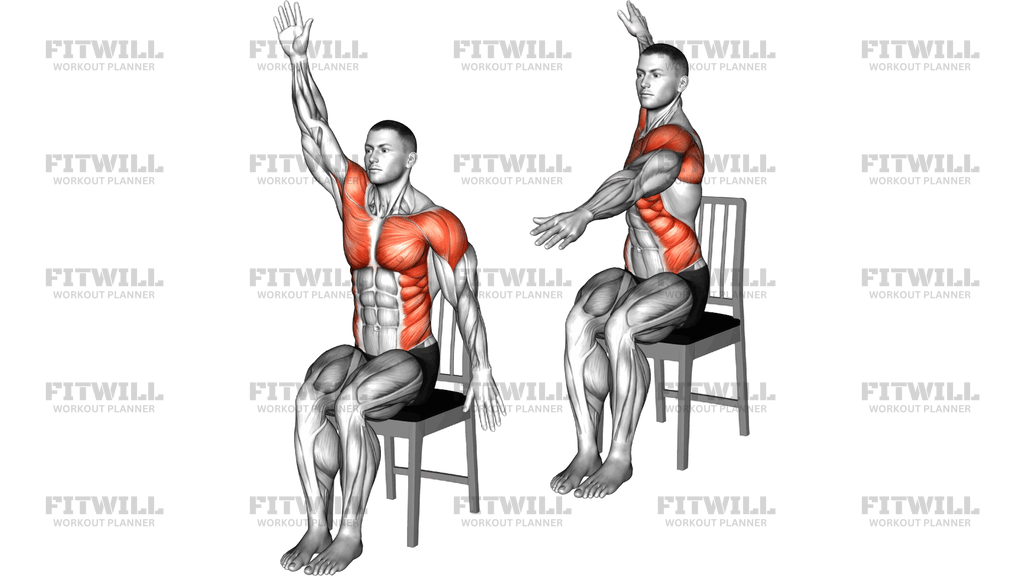
Instructions
- Sit on the front half of a sturdy armless chair with your feet flat on the floor about hip-width apart and your knees bent roughly ninety degrees.
- Sit up tall, imagining your sternum lifted, and let your shoulders relax down away from your ears before you start moving.
- Begin with one arm extended up and slightly forward toward the ceiling, palm facing forward, and the other arm down at your side or slightly behind your hip.
- Brace your abdominal muscles lightly to keep your ribcage stacked over your pelvis throughout the set.
- Sweep the raised arm down and back past your hip while the opposite arm simultaneously swings up and forward toward the ceiling, like alternating freestyle strokes.
- Keep the arcs smooth and equal on both sides, allowing only a small, natural rotation of your torso with each switch.
- Continue the alternating cycle at a steady, controlled pace for your target time or rep count, keeping your eyes forward and your head level.
- Exhale on the upward sweep of each arm and inhale as it travels back down, avoiding any breath-holding.
- Finish with both arms lowered to your sides, reset your posture, and shake out your shoulders before the next set.
Tips & Tricks
- The most common mistake is slouching back into the chair as the arms tire; check that your lower back keeps its natural curve and your shoulders stay over your hips.
- Avoid craning your neck to watch the raised hand. Keep your gaze forward so the top of your spine stays long.
- If your overhead reach feels pinched, let the top hand stop at about ear height instead of forcing full extension, and expand the range over several sessions.
- Keep your feet planted and still. If your legs start rocking or your heels lift, slow the arm tempo down rather than moving faster with less control.
- Match the amplitude of both arms. Many people unconsciously make the down-swinging arm travel further than the rising one, which skews the rhythm.
- Think of reaching the top hand toward the ceiling rather than just lifting it sideways. This keeps the shoulder working through its front range, which is the point of the drill.
- Do not let your torso twist into a large rotation. A slight counter-rotation is fine, but if your chest turns noticeably toward each side, tighten your abs and square back up.
- Sit far enough forward that your thighs are unsupported near the knees; this makes it harder to lean back and easier to feel your trunk doing the stabilizing work.
- Start with twenty to thirty second bouts to learn the rhythm before extending duration, since the pattern degrades quickly once you rush.
Frequently Asked Questions
What muscles does Sitting Swimmer On A Chair work?
The front and side shoulders do most of the arm-driving work, with the chest assisting on each downward sweep. Your obliques and abdominal muscles stabilize the torso against the alternating arm motion.
Is this exercise suitable for complete beginners?
Yes. The load is only your own arms, so the main demands are coordination and posture rather than strength. Beginners can shorten the arm arc and start with twenty-second bouts before building up.
Why is Sitting Swimmer On A Chair done on a chair instead of standing?
Sitting removes the legs from the equation, which isolates the shoulders and forces the trunk muscles to control rotation without help from the hips. It also makes the drill usable at a desk or for anyone who has trouble standing for long periods.
What kind of chair should I use?
A stable, armless chair with a firm seat and no wheels. Armrests block the arm path, and a rolling or soft chair makes the base unstable, which changes the exercise into something else entirely.
Should my torso rotate while my arms switch positions?
A small, natural counter-rotation is expected, but large twisting means your core has stopped controlling the movement. Keep your chest mostly facing forward and tighten your abs if the rotation grows.
How many reps or how long should I perform it?
Count arm cycles or use time. Thirty to forty seconds of smooth, continuous alternating strokes per set is a solid target, and two to three sets work well as a warm-up or as a standalone trunk and shoulder drill.
My shoulder pinches when my arm goes overhead. What should I do?
Stop the arc at about ear height instead of full extension and see whether the pinch disappears. Reach slightly more forward than straight up, and build the range gradually. Persistent discomfort warrants skipping the top portion of the movement.
Can I use Sitting Swimmer On A Chair as a warm-up?
It works well before overhead pressing, pull-ups, or swimming sessions because it raises the shoulders' temperature and rehearses an alternating overhead pattern. Keep the tempo relaxed and treat it as preparation, not a fatiguing set.
Is there a faster, more aerobic way to do it?
Yes. Once your rhythm and posture are consistent, increasing the tempo turns it into a light conditioning drill, since the large arm arcs elevate your breathing. Only speed up once you can keep the trunk steady at a slow pace.