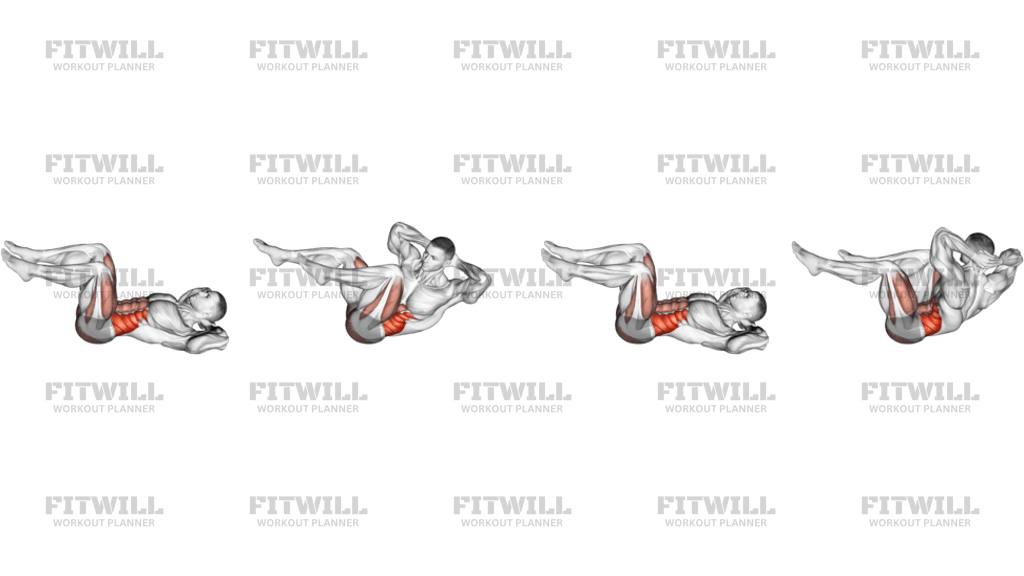
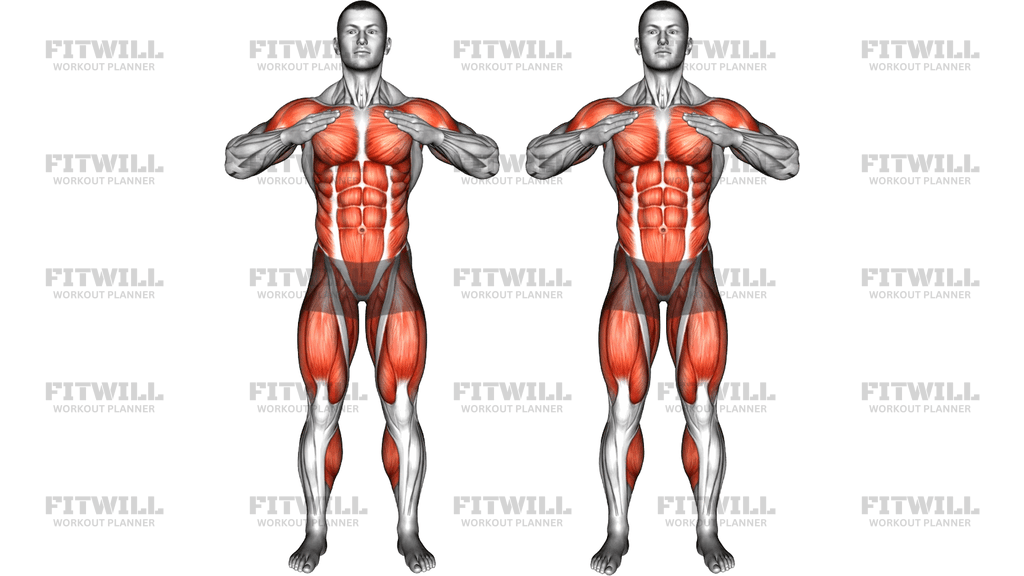
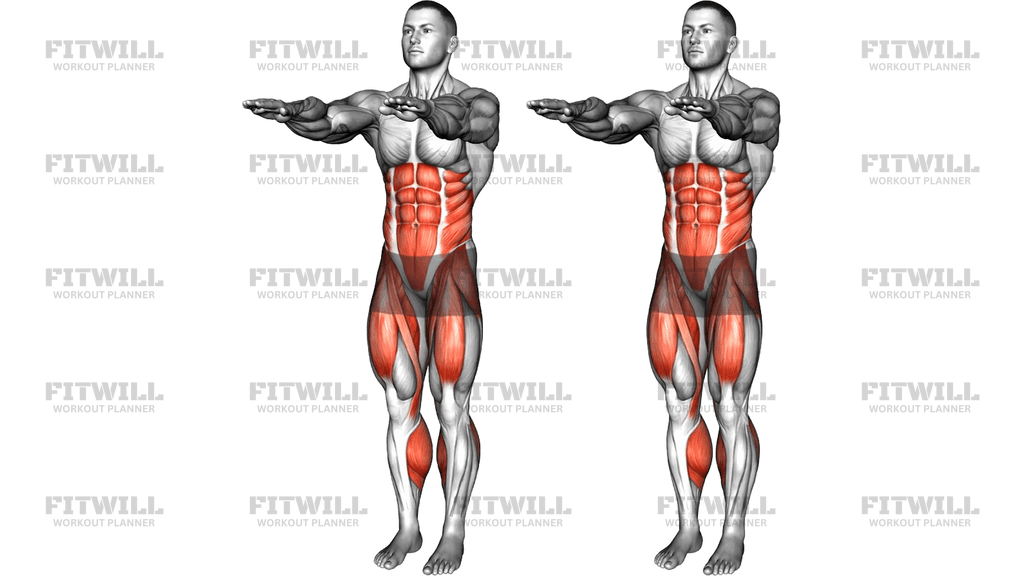
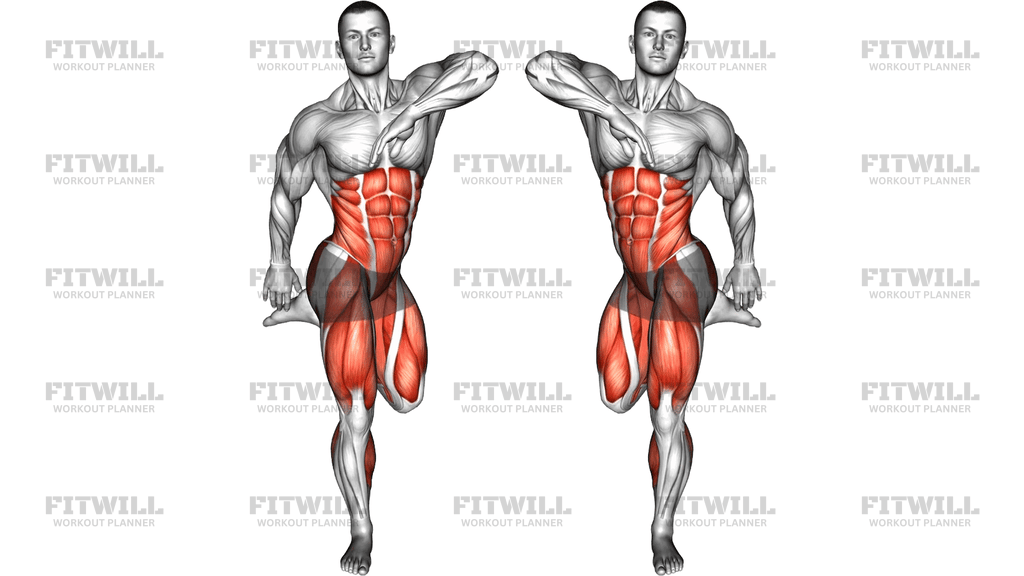
Sitting Woodchopper On A Chair
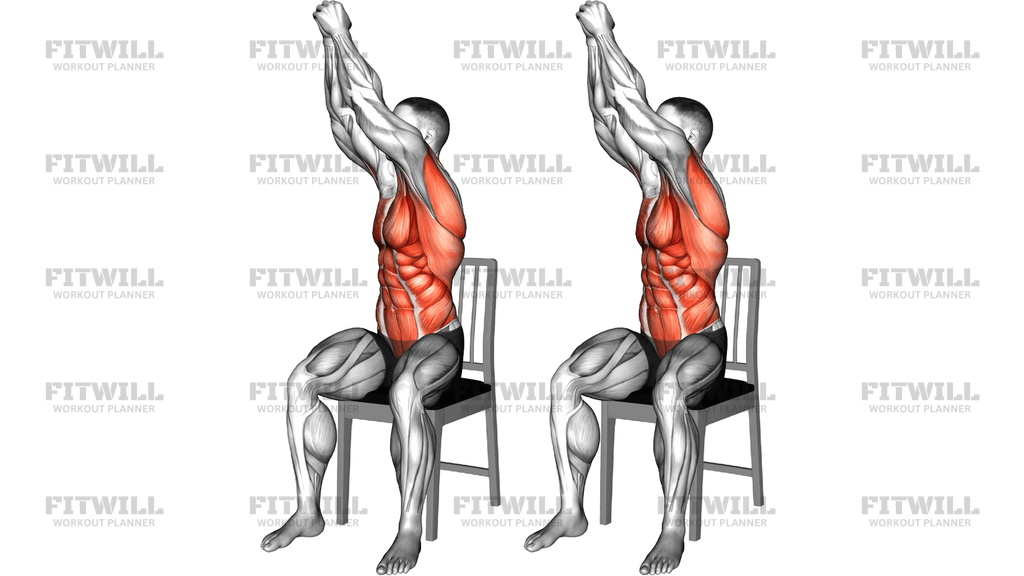
Sitting Woodchopper On A Chair is a seated, bodyweight rotation exercise that mimics the diagonal path of chopping wood, but with your hips and legs fixed on a chair. You sit upright with feet planted, clasp your hands together, and sweep your straightened arms from high on one side of your body down and across toward the opposite hip, then reverse the path back up. Because the chair removes your legs from the equation, your trunk has to do all of the rotating work.
The main workers are the obliques on the side of your trunk that drives the chop, supported by the rectus abdominis, the deep core muscles that brace your spine, and the chest and front of the shoulders, which hold the arms extended along the diagonal line. Your lower back and upper back also contribute as you wind up and return, and the seated position quietly trains your ability to rotate without letting your hips twist or your torso collapse.
This version is a great fit for anyone who wants rotational core work without standing balance demands: beginners learning what a proper trunk rotation feels like, older adults, office workers who train at their desk, or lifters recovering from lower-body fatigue who still want to hit their core. It is also a useful teaching tool before progressing to loaded woodchopper variations with cables, bands, or a medicine ball, because the seated setup makes it easy to feel whether the ribs and pelvis are staying connected.
The setup matters more than it looks. Sit tall on a stable chair with your feet flat and roughly hip-width apart, and commit to keeping your hips square to the front for the whole set. If your pelvis swivels with each rep, your obliques stop doing the work and your lower back takes the stress. The wider and more deliberate your arm path, the more range your trunk rotation gets, so reach fully overhead at the start and follow through toward the opposite hip at the bottom.
Execute the chop with intent rather than speed. Clasp your hands, extend your arms, rotate your trunk to bring both hands high over one shoulder, then pull them down and across your body as if swinging an axe, exhaling as you pass the midpoint. Pause briefly at the bottom, feel the obliques shorten, then control the arms back up the same diagonal. Complete all reps on one side before switching so you can compare how each side feels and moves.
Keep the effort moderate and the movement smooth. This is not a race, and jerking the arms down does not make the core work harder — it just recruits momentum and rounds your spine. If you feel pinching in your lower back or neck, reduce the range slightly and focus on rotating from the ribs. Two to three sets of eight to twelve chops per side is a practical starting dose, either as a core finisher or as part of a broader trunk routine.
[ Workout Log & Planner ]
Put your next workout in Fitwill
Keep your plan and training log ready when you are.


Instructions
- Sit on a stable chair with your back tall, feet flat on the floor about hip-width apart, and both sit bones weighted evenly on the seat.
- Clasp your hands together with fingers interlaced and extend your arms straight in front of your chest so your shoulders are relaxed and down.
- Rotate your trunk to one side and lift your clasped hands up and over that shoulder until your arms are fully extended overhead, keeping your hips and knees pointing forward.
- Brace your abdominal wall lightly as if bracing for a light push, and take a breath in at the top of the movement.
- Exhale and sweep your straight arms down and across your body on a diagonal, rotating from the ribs until your hands pass the opposite hip and your arms finish low.
- Pause for a beat at the bottom and squeeze the obliques on the side you just chopped toward.
- Inhale and reverse the exact diagonal path, controlling the arms back up until they are extended over the starting shoulder.
- Keep your hips square to the front and your sit bones planted throughout; if they shift, the rotation is coming from the wrong place.
- Complete all repetitions on one side, then reset your posture and switch to the opposite shoulder for the same number of reps.
Tips & Tricks
- Think of your torso as a rotating column and your arms as an axe handle — the power comes from the trunk turning, not from pulling with the shoulders.
- A very common mistake is dropping the arms straight down instead of on a diagonal; fix it by picking a spot on the floor outside your opposite knee and chopping toward it.
- If your lower back starts arching or rounding at the bottom of the chop, shorten the range slightly and finish the rotation with the ribs instead of the spine bending.
- Watch for the hips sneaking into the movement — if one buttock lifts off the chair as you rotate, plant your feet harder and reduce the range until the pelvis stays still.
- Keep the elbows nearly locked but not hyperextended; soft arms let the chop drift, while completely rigid arms can strain the elbow joints over time.
- Avoid craning your neck to follow your hands; let your head turn naturally with the trunk while your eyes track your hands loosely.
- Move slower on the return than on the way down — the upward diagonal is where many people lose tension and just flop the arms back into place.
- If one side feels noticeably stiffer or weaker, start your sets with that side and match the reps to what the weaker side can do with good form.
- Use a chair without wheels or armrests so the seat stays stable and your arms can travel freely across your body.
Frequently Asked Questions
What muscles does the Sitting Woodchopper On A Chair work?
The obliques are the primary movers, with the rectus abdominis and deep core stabilizing the trunk through the rotation. The chest and front shoulders hold the arms extended along the diagonal, and the lower back assists on the return.
Is this seated version good for beginners?
Yes, and it is actually one of the best ways to learn rotational core control. The chair stabilizes your hips and legs, so you can focus entirely on turning from the trunk without worrying about balance or stance.
Why do my hips keep twisting during the chop?
Your hips rotate when the trunk is not producing the movement, usually because the range is too large or the pace is too quick. Plant your feet firmly, brace lightly, and chop a bit less far until the pelvis stays square to the front.
How is the Sitting Woodchopper On A Chair different from a standing woodchopper?
The seated version removes hip drive and balance from the movement, isolating the trunk rotation, while the standing version lets you load heavier and involves the legs and glutes. Use the seated version to groove the pattern or to train when standing work is not an option.
Can I add resistance to this exercise?
Yes, holding a light medicine ball, dumbbell, or weight plate between your clasped hands works well once the bodyweight version feels easy. Add load only when you can keep your hips still and your spine neutral through the full diagonal.
How many reps and sets should I do?
Start with two to three sets of eight to twelve controlled chops per side. If your obliques feel worked the next day but your lower back does not, the dose is about right.
Should my arms stay straight the whole time?
Keep them extended with a soft, almost-straight elbow so the arms act as one long lever along the diagonal. Bending the elbows turns the movement into an arm exercise and shortens the rotation your trunk gets.
Is it safe if I have lower back sensitivity?
The seated, supported position is generally easier on the back than standing rotations, but reduce the range and slow the tempo if any position provokes discomfort. Stop and consult a professional if you feel sharp or radiating pain rather than muscle effort.
What kind of chair should I use?
Any sturdy, armless chair without wheels works, as long as it will not tip when you rotate. Sit toward the front edge with both sit bones on the seat so your posture stays tall and your arms can sweep freely across your body.
Why do I only feel it on one side?
Most people have a rotation imbalance, so one side coordinates better and feels more active. Always start with the stiffer side, match reps on the weaker side, and spend an extra moment squeezing at the bottom of the chop on the side that lags.